2026 Contest · International Affairs Essay
Write on the questions shaping our world.
The Harvard International Review (HIR) Academic Writing Contest invites students in grades 7–12 to make an argument about the world—and defend it. This is an independent guide to help you choose a prompt, meet the standards, and submit with confidence.
What the contest is
An essay contest run by the Harvard International Review
The Harvard International Review is a quarterly journal of international affairs founded in 1979 and produced by students at Harvard University. Its Academic Writing Contest asks pre-college students to do what the journal itself does: take a serious question about the world and argue a clear, evidence-based position on it.
You write a single analytical essay of 800 to 1,200 words on a set theme. Essays are read and scored by HIR’s editors against a published rubric. The strongest writers in each cycle are invited to a Defense Day, where they present their argument and answer questions from the judges in a 15-minute oral defense.
It is an academic exercise, not an op-ed. As the contest puts it: an essay should have an argument, but it should not have an agenda. The goal is disciplined reasoning—a claim a thoughtful reader could disagree with, supported by evidence and analysis.
At a glance
- Two divisions: Junior (grades 7–8) and Senior (grades 9–12)
- One analytical essay, 800–1,200 words, written in English
- AP Style formatting; original work only
- No AI-generated text—strictly prohibited and checked
- Recognition by medal tier, plus a certificate for every entrant
This year’s prompts
Choose one question and build a real argument around it
Junior writers respond to a single accessible prompt; Senior writers pick one of three themes in contemporary international affairs.
Inventions That Changed How We Live
Examine an invention—past or present—and argue how it reshaped the way people live, work, or relate to one another. A focused claim beats a broad survey.
Global Culture in the Digital Era
How is the digital era reshaping shared culture across borders—what is gained, what is lost, and who gets to shape it?
Security in a Multipolar World
As power spreads across many centers, what does real security look like—and who keeps the peace when no single state leads?
Technology, Innovation & Power
From AI to biotech, how is technology redrawing the map of global power—and who should write the rules?
Themes shown are for the 2026 cycles. Confirm the current prompt for your cycle before you begin—see the contest guide.
How it works
Four steps from prompt to podium
How you’re judged
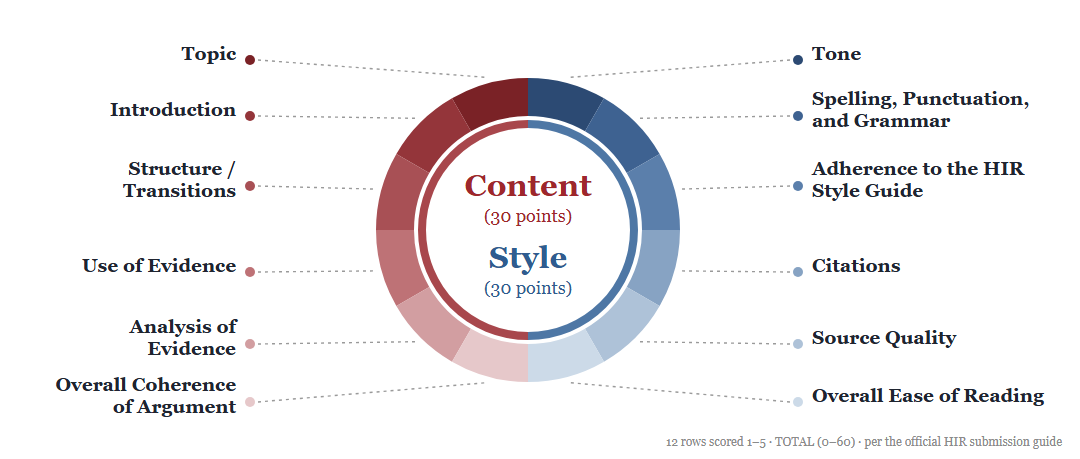
A published rubric, worth 60 points
Editors score every essay on two axes. Content (30 points) rewards a sharp topic, a clear introduction, logical structure and transitions, strong use and analysis of evidence, and overall coherence of argument. Style (30 points) covers tone; spelling, punctuation and grammar; adherence to the HIR Style Guide; citations; source quality; and overall ease of reading.
In practice, the essays that advance share one trait: the writer picked a question they could argue, not just summarize—and then defended it cleanly. Knowing the rubric before you write is the simplest edge you can give yourself.
See the submission checklist →Recognition
Medals, commendations, and a certificate for everyone
Recognition is awarded by global percentile, so you are measured against every entrant worldwide.
Additional honors include High Commendation and Outstanding Writing. Every student who submits a complete essay receives a Certificate of Completion, and finalists earn recognition through Defense Day.
2026 calendar
Three cycles, three chances to enter
| Cycle | Registration closes | Submission due | Defense Day |
|---|---|---|---|
| Spring | April 25, 2026 | May 31, 2026 | June 29, 2026 |
| Summer | June 25, 2026 | August 31, 2026 | October 5, 2026 |
| Fall–Winter | Rolling | January 2, 2027 | February 5, 2027 |
Dates reflect the 2026 cycles as published by the operator and should be confirmed against the official contest page before you register. We keep this guide updated each season.
Who should enter
Grades 7–8
Middle-school writers ready to move beyond the five-paragraph essay. The Junior prompt is accessible, but the bar for argument and evidence is real—excellent preparation for high-school competition.
Grades 9–12
High-school students interested in international relations, economics, history, or policy—and anyone building a writing portfolio for selective university applications.
How to enter
Not sure how to actually enter?
Registration windows and the official entry route can change from cycle to cycle. Add our teacher on WeChat for the fastest help—we’ll guide you through the current way to enter and build a coaching plan around your division, prompt, and deadline.

Frequently asked questions