The Contest
One essay, one argument, judged on a published rubric.
Everything you need to understand the HIR Academic Writing Contest: format, divisions, this year’s prompts, how essays are scored, and the Defense Day round that sets it apart.
Format & rules
What you submit
You write one analytical essay on a set theme in international affairs. The essay runs between 800 and 1,200 words—not counting charts, data tables, or the authorship declaration—and is written in English in AP Style.
The essay must make an argument. The contest is explicit that an essay “should have an argument, but it should not have an agenda”: the aim is disciplined analysis of a question, not advocacy. The strongest entries stake out a claim a reasonable reader could dispute, then defend it with evidence.
All work must be original. Plagiarism and AI-generated text are prohibited and screened for; either results in disqualification.
The rules, in brief
- 800–1,200 words, in English, AP Style
- One analytical essay on a set theme
- Individual work—no co-authors
- Original writing only; no AI-generated text
- Authorship declaration required
- Submit before your cycle’s deadline
Divisions & this year’s prompts
Two divisions by grade—pick the prompt that lets you argue
Junior writers in grades 7–8 respond to one accessible prompt; Senior writers in grades 9–12 choose one of three themes in contemporary international affairs.
Inventions That Changed How We Live
Choose an invention—historical or contemporary—and argue how it reshaped the way people live, work, or relate to one another. A focused, well-supported claim outperforms a broad survey.
Global Culture in the Digital Era
As the internet and streaming spread culture across borders, what is gained and what is lost—and who should shape a shared digital culture? Make a case, not a survey.
Security in a Multipolar World
As power disperses across many centers, what does genuine security require—and who maintains order when no single state leads? Make a case, not a survey.
Technology, Innovation & Power
From artificial intelligence to biotechnology, how is technology redistributing global power—and who should set the rules that govern it?
Prompts shown are for the 2026 cycles. Always confirm the current theme for your cycle before you begin.
How essays are scored
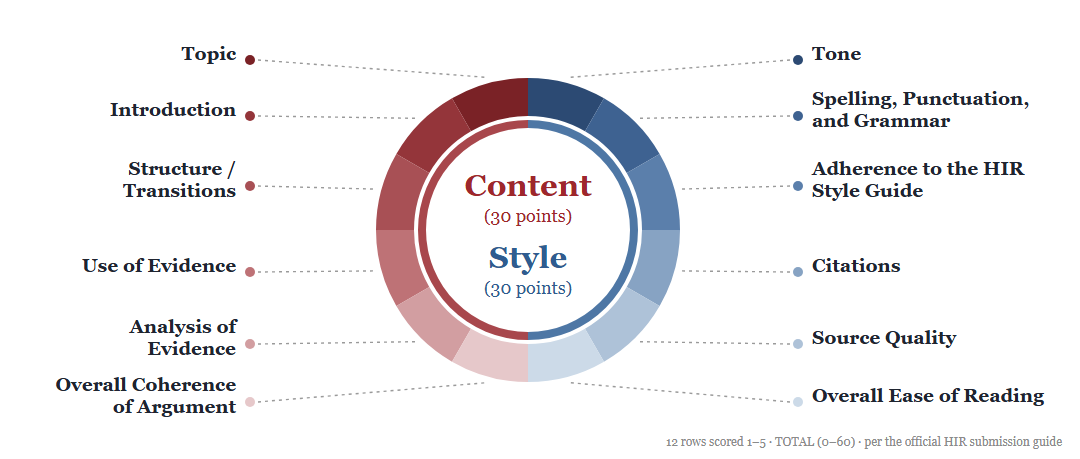
The 60-point rubric
Content—30 points. Six dimensions, five points each: topic, introduction, structure and transitions, use of evidence, analysis of evidence, and overall coherence of argument.
Style—30 points. Five dimensions, five points each: tone; spelling, punctuation and grammar; adherence to the HIR Style Guide; citations; and overall ease of reading.
Reading the rubric before you draft is the single simplest edge you can give yourself—each line is a checklist for revision.
The signature round
Defense Day
Top-scoring writers in each cycle are invited to Defense Day. You give a 15-minute presentation of your argument and then answer questions from Harvard International Review judges—an oral defense of the essay you wrote.
It is not enough to have written a strong essay; on Defense Day you have to think on your feet and defend it.
Defense Day rewards writers who truly understand their own argument: its assumptions, its evidence, and its limits. Preparing for it—by anticipating counter-questions—tends to make the underlying essay sharper, too.
2026 cycles
Three cycles a year
| Cycle | Registration closes | Submission due | Defense Day |
|---|---|---|---|
| Spring | April 25, 2026 | May 31, 2026 | June 29, 2026 |
| Summer | June 25, 2026 | August 31, 2026 | October 5, 2026 |
| Fall–Winter | Rolling | January 2, 2027 | February 5, 2027 |
Dates reflect the 2026 cycles and should be confirmed against the official contest page before you register.
Contest FAQ
Common questions
Can I enter more than one cycle?
Do I pick one Senior theme or write on all three?
What is AP Style, and is it required?
Is the essay opinion writing?
How will I know if I reached Defense Day?
How to enter
Not sure how to actually enter?
Registration windows and the official entry route can change from cycle to cycle. Add our teacher on WeChat for the fastest help—we’ll guide you through the current way to enter and build a coaching plan around your division, prompt, and deadline.