Defense Day is what sets the HIR Academic Writing Contest apart from almost every other essay competition. The strongest writers in each cycle are invited to present and defend their argument in a roughly 15-minute oral defense before the judges. The students who do well treat it as exactly that — a defense of a position, not a recital of an essay. This guide gives you the mindset, four concrete preparation moves, and a checklist to walk in confident.
What Defense Day actually is
After the written round, the contest invites its strongest writers to a live oral defense: you briefly present the argument from your essay, then answer questions from the judges about it. It is short — on the order of 15 minutes — which means there is no room to hide behind a memorised script. The judges are not re-grading your prose; they are testing whether the thinking behind it is really yours: do you understand your own evidence, can you handle a challenge, and do you know where your argument is weakest? That is good news for honest preparation and bad news for anyone who leaned on someone else’s words.
The mindset shift: defend a position, don’t recite an essay
The most common mistake is preparing as if Defense Day were a memory test. It is not. If you try to recite paragraphs, the first unexpected question will derail you. Instead, internalise the structure of your argument — your claim, the two or three pieces of evidence that carry it, and why each one matters — so you can talk about it from any angle. A student who truly owns their argument can answer a question they never rehearsed; a student who memorised cannot. Aim to be the first kind.
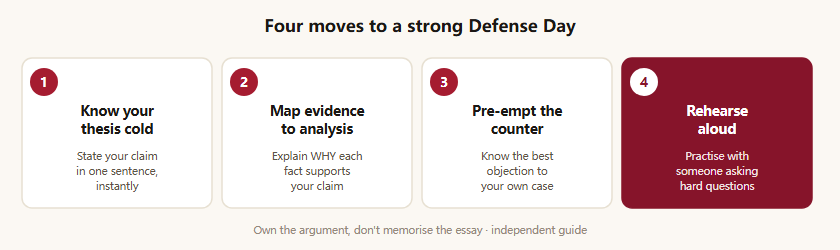
Move 1 · Know your thesis cold
You should be able to state your central claim in one clear sentence without looking at your essay. This is the spine everything else hangs on. If a judge asks “so what are you actually arguing?”, a crisp one-sentence answer signals control; a rambling one signals that you are not sure yourself. Write your thesis on a card, say it aloud until it is automatic, and make sure it takes a real position — something a reasonable person could disagree with.
Move 2 · Map evidence to analysis
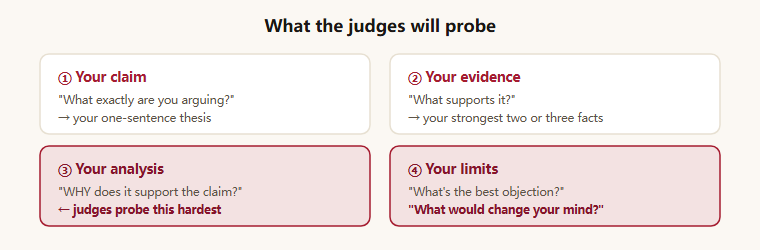
The HIR rubric scores use of evidence and analysis of evidence as separate lines, and Defense Day probes the second one hardest. For each major piece of evidence in your essay, be ready to answer: why does this support my claim? Judges rarely doubt that your facts exist; they test whether you understand what those facts mean. Build a simple two-column map — evidence on the left, the analytical link on the right — and rehearse the link, not just the fact. (Our guide to the 60-point rubric goes deeper on this distinction.)
Move 3 · Pre-empt the strongest counter-argument
The fastest way to look mature under questioning is to have already found the best objection to your own argument. Before Defense Day, deliberately attack your own thesis: what would a smart skeptic say? Then decide how you respond — sometimes you rebut it, sometimes you concede a limit gracefully and explain why your claim still holds. Either is strong; being blindsided is not. Judges respect a writer who can say “the strongest case against me is X, and here is why I still think Y.”
Move 4 · Rehearse aloud, under questioning
Reading your essay silently is not preparation. Find a teacher, parent, or friend, give them your thesis, and ask them to interrupt you with hard questions. Practising out loud does three things: it surfaces the parts of your argument you cannot actually explain, it trains you to think on your feet, and it makes the real thing feel familiar. Do at least two or three mock rounds. If your questioner can rattle you, better they do it now than the judges on the day.
Common Defense Day mistakes
- Reciting, not defending. Memorised paragraphs collapse on the first unscripted question. Own the argument instead.
- Getting defensive. A challenge is not an attack. Treat each question as a chance to show you have thought it through.
- Dodging. If you do not know, say so and reason aloud — judges value honest thinking over bluffing.
- Over-claiming. Defending a slightly narrower, well-supported claim beats defending a grand one you cannot back up.
Your pre-Defense checklist
| Before the day | You can… |
|---|---|
| Thesis | State your claim in one sentence, from memory |
| Evidence → analysis | Explain why each major fact supports your claim |
| Counter-argument | Name the strongest objection and your response to it |
| Limits | Say honestly where your argument is weakest and what would change your mind |
| Out loud | Survive 2–3 mock Q&A rounds with a tough questioner |
New to the contest? Start with our complete HIR Academic Writing Contest guide, and make sure the essay you are defending is built on a clear 800–1,200 word structure.
Frequently asked questions
What is HIR Defense Day?
It is the contest’s oral round: the strongest writers in each cycle present their argument and answer questions from the judges in a roughly 15-minute oral defense. It tests whether you understand and can defend your own argument.
Should I memorise my essay for Defense Day?
No. Memorising backfires on the first unexpected question. Internalise your argument’s structure — claim, evidence, why it matters, and the strongest objection — so you can discuss it from any angle.
What do judges ask on Defense Day?
Typically about your claim, your evidence, and — most deeply — your analysis (why the evidence supports the claim) and your limits (the best objection, and what would change your mind).
How do I practise for Defense Day?
Rehearse aloud with someone who interrupts you with hard questions. Do two or three mock rounds so the real defense feels familiar and you have already met your argument’s weak points.
Ready to enter? →
Turn this into an actual entry — the next steps:
- How to enter the HIR contest — deadlines, word limits and the step-by-step submission
- The contest at a glance — divisions, format and the 60-point rubric in one place
- Read past winning entries — see what a scoring paper actually looks like
Filed underDefense Day · Hir Academic Writing Contest · International Students
This is an independent guide to the HIR Academic Writing Contest, operated by Hanlin Education for China-based international-school students. We are not affiliated with, endorsed by, or sponsored by the Harvard International Review or Harvard University. Contest formats and the Defense Day round can change each year — always confirm the current details on the official Harvard International Review contest page. Confirmed errors are corrected within 7 working days.