The HIR Academic Writing Contest is a high-school international-affairs essay competition run by the Harvard International Review (HIR), a quarterly journal of global affairs founded in 1979 and edited by students at Harvard University. It is open to students in grades 7–12 worldwide: you write an 800–1,200 word analytical essay on a set theme, in English and AP Style, and the strongest writers are invited to defend their argument aloud at Defense Day. This independent guide explains how it works — and how international students take part.
Quick facts (2025–2026)
| What it is | A high-school international-affairs essay contest — one analytical essay on a set theme |
| Who runs it | The Harvard International Review (HIR) — a quarterly journal edited by Harvard students, not Harvard University officially (we are an independent guide — not affiliated) |
| Who can enter | Students worldwide in two divisions: Junior (grades 7–8) and Senior (grades 9–12) |
| What you write | An 800–1,200 word analytical essay, in English, AP Style; an argument, not an op-ed |
| How it is scored | A published 60-point rubric: 30 for Content, 30 for Style |
| What sets it apart | Defense Day — the strongest writers present and defend their argument in a 15-minute oral defense |
| When (2026) | Three cycles — Spring (May 31), Summer (Aug 31), Fall–Winter (Jan 2, 2027); confirm dates officially |
| Official source | hir.harvard.edu (Harvard International Review) |
Who actually runs it (read this first)
The single most common misunderstanding is the word “Harvard.” The contest is organised by the Harvard International Review — a quarterly magazine of international affairs founded in 1979 and produced by students at Harvard University. It is a student-edited publication, not an official program of Harvard University, and entering the contest is not an application to Harvard. That does not make it unserious: the journal is read by students, academics, and practitioners worldwide, and its Academic Writing Contest extends that mission to pre-college writers. But it does mean you should treat it as a respected, student-run academic contest, judge it on its own merits, and ignore anyone who implies it is “Harvard admissions.”
What you actually write
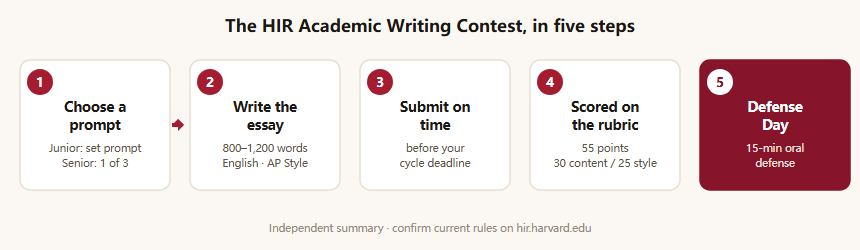
You write one analytical essay on a set theme in international affairs — global politics, economics, security, or policy. The essay runs 800 to 1,200 words (not counting charts, data tables, or the authorship declaration), in English and AP Style. Crucially, it must make an argument. The contest is explicit that an essay “should have an argument, but it should not have an agenda”: the goal is disciplined analysis of a question, not advocacy. The strongest entries stake out a claim a reasonable reader could dispute, then defend it with evidence and analysis. All work must be original and individual — no co-authors — and AI-generated text is prohibited and screened for, as is plagiarism; either means disqualification. An authorship declaration confirming your own work is required.
Two divisions: Junior and Senior
You enter the division that matches your current grade. Junior Division is for grades 7–8 (middle-school students worldwide), who write on the set Junior prompt. Senior Division is for grades 9–12 (high-school students worldwide), who choose one of three Senior themes. The contest is open to students globally; capacity is limited and admission to each cycle is rolling, so registering early is wise.
How it is judged: the 60-point rubric
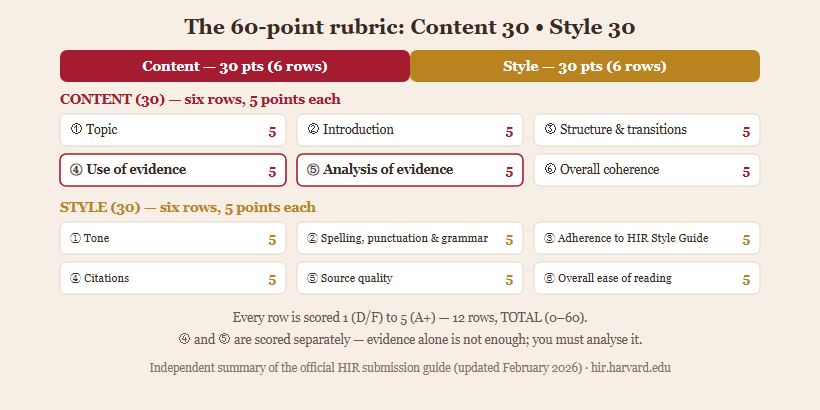
Every essay is scored on a published 60-point rubric: 30 points for Content and 30 points for Style. Content is split into six dimensions worth five points each — topic, introduction, structure and transitions, use of evidence, analysis of evidence, and overall coherence. Notice that four of the six are about argument, not information: the judges are not testing how much you know, but whether you can build a case. The rubric even scores “use of evidence” and “analysis of evidence” as separate lines — a strong hint that stacking facts is not enough; you must interpret them. Treating each rubric line as a revision checklist is the simplest edge you can give yourself.
What sets it apart: Defense Day
Most essay contests end when you submit. The HIR contest does not. The strongest writers in each cycle are invited to Defense Day, where they present their argument and answer questions from the judges in a 15-minute oral defense. This is the contest’s signature round, and it changes how you should write: you are not just producing a polished document, you are building a position you can stand behind and defend live. If you cannot explain why your evidence supports your claim — or what the strongest objection to it is — Defense Day will expose it. The best preparation is to write an essay whose argument you genuinely understand and could argue aloud.
Eligibility, cost, and how international students take part
The contest is open to any student in grades 7–12, anywhere in the world, which makes it genuinely accessible to international and China-based students — there is no national round to clear; you register for a cycle and submit directly. Two practical points: admission to each cycle is rolling with limited capacity, so register early rather than waiting for the deadline; and because the essay is judged partly on AP Style, non-native English writers should budget time to learn that house style, where avoidable points are often lost. Work backwards from your cycle’s deadline — give yourself weeks to choose a theme, research, draft, and cut to 1,200 words. Always confirm fees, formats, and dates on the official contest page before you register.
The three cycles, and which one to enter
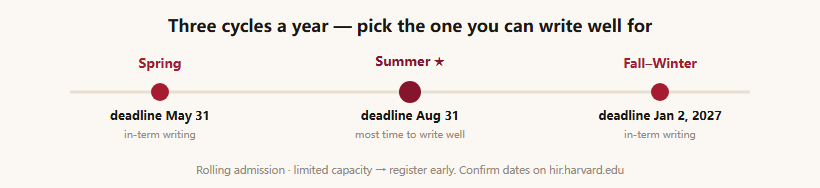
A distinctive feature of the HIR contest is that it runs three times a year, so you can pick the cycle that fits your schedule rather than racing a single deadline. The 2026 cycles close on Spring — May 31, Summer — August 31, and Fall–Winter — January 2, 2027 (always confirm on the official page). Which to choose? The Summer cycle is the natural fit for most students, because the long break gives you the weeks a good analytical essay actually needs — to research, draft over length, and edit down. The Spring and Fall–Winter cycles work if you can protect writing time during term. The one rule: do not enter a cycle you cannot give a real draft to. Because admission is rolling and capacity is limited, registering early in your chosen cycle is wiser than rushing a weak essay into an earlier one.
How the HIR contest compares to other writing competitions
The HIR contest sits among several writing competitions, and its angle is specific: analytical writing on international affairs. Compared with the New York Times Learning Network contests — which span editorial, narrative, review, and STEM writing for a general audience — the HIR contest is narrower and more academic: a single disciplined argument about a global question, judged on a formal rubric and defended aloud. Compared with broad essay prizes like the John Locke Institute‘s, HIR is shorter (800–1,200 words) and squarely focused on international relations and policy rather than philosophy or history. The takeaway: if your interests point toward international relations, political science, or global policy, the HIR contest is one of the most on-target credentials you can pursue — and the Defense Day round gives you something few other contests do: a chance to show you can defend your thinking in person.
Is the HIR Academic Writing Contest worth it?
For students aiming at international relations, political science, economics, or PPE, a strong HIR result is a credible signal — evidence that you can build a rigorous, evidence-based argument about a real-world question and defend it under questioning. It does not guarantee admission anywhere, and a single entry is not a “hook”; it is one component of a coherent application. The deeper value is the work itself: researching a serious global question, arguing it in 1,200 words, and then defending it aloud genuinely strengthens you as a thinker and writer, whether or not you place. Treat it as one well-chosen, well-executed credential — not a lottery ticket.
Ready to go deeper? See our companion guides on preparing for Defense Day, the 60-point rubric, decoded, and choosing a prompt you can actually defend.
Frequently asked questions
Is the HIR Academic Writing Contest run by Harvard University?
No. It is run by the Harvard International Review (HIR), a quarterly journal edited by students at Harvard University. It is a student-run publication, not an official Harvard University program, and entering is not a Harvard application.
How long is the essay, and what style?
An analytical essay of 800–1,200 words (excluding charts, data tables, and the authorship declaration), written in English in AP Style. It must make an argument, not push an agenda.
What is Defense Day?
Defense Day is the contest’s distinctive oral round: the strongest writers in each cycle are invited to present and defend their argument in a 15-minute oral defense before the judges.
Who can enter, and when are the 2026 deadlines?
Students in grades 7–12 worldwide, in a Junior (7–8) or Senior (9–12) division. The 2026 cycles close around Spring May 31, Summer Aug 31, and Fall–Winter Jan 2, 2027 — always confirm the exact dates on the official page, as they can change.
How is the HIR contest different from the NYT writing contests?
The HIR contest is a single analytical essay on international affairs, judged on a 60-point rubric, with a Defense Day oral round. The New York Times Learning Network runs several contests — editorial, narrative, review, STEM — for a general audience. HIR is narrower, more academic, and focused on international relations.
What does “argument, not agenda” mean in practice?
It means analysing a question and defending a claim a reasonable reader could dispute, with evidence — not campaigning for a cause. Take a position, engage the strongest objection, and let the evidence lead. An op-ed that asserts a stance without weighing it is what the rule warns against.
Ready to enter? →
Turn this into an actual entry — the next steps:
- How to enter the HIR contest — deadlines, word limits and the step-by-step submission
- The contest at a glance — divisions, format and the 60-point rubric in one place
- Read past winning entries — see what a scoring paper actually looks like
Filed underHir Academic Writing Contest · International Students · What Is Hawc
This is an independent guide to the HIR Academic Writing Contest, operated by Hanlin Education for China-based international-school students. We are not affiliated with, endorsed by, or sponsored by the Harvard International Review or Harvard University. Prompts, divisions, formats, fees and dates change each year — always confirm the current details on the official Harvard International Review contest page. Confirmed errors are corrected within 7 working days.