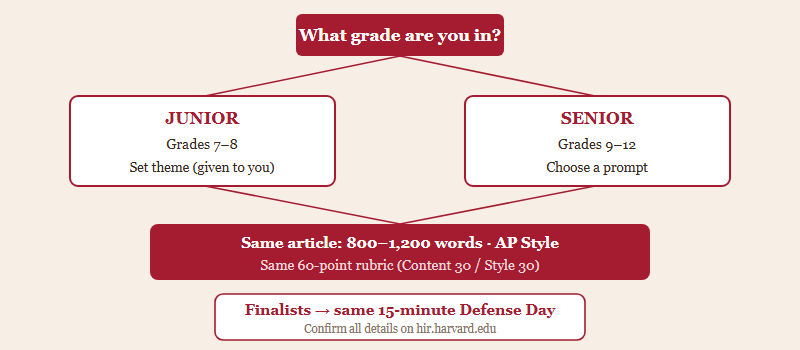
In the 2026 HIR Academic Writing Contest, your division is fixed by your current grade: Junior is for grades 7–8 and Senior is for grades 9–12. The big practical difference is the prompt — Junior writers respond to one set theme (“Inventions that Changed How We Live”), while Senior writers choose from several international-affairs prompts. Both submit an 800–1,200-word article in AP Style, both are scored on the same 60-point rubric, and finalists in both face the same 15-minute Defense Day. You do not pick a division — your grade does — so the real question is how to compete well in the one you are placed in. Always confirm current rules on hir.harvard.edu.
The one-line rule: grade decides, not preference
This is the single most common point of confusion we see among China-based international-school families, so let us be blunt about it. The HIR Academic Writing Contest does not let you “choose” Junior or Senior the way you might choose an essay topic. The division is determined by the grade you are currently enrolled in at the time of submission. A grade-8 student enters Junior; a grade-9 student enters Senior. There is no “compete up” or “compete down” option advertised on the official contest page, and you should not assume one exists.
For most students this removes a decision entirely — which is good news. But it raises a sharper, more useful question: given the division I am in, what does winning actually require? That is what the rest of this guide answers. (If you are still working out what the contest even is, start with our overview of what the HIR Academic Writing Contest is.)
Two edge cases do matter, and both should be resolved with the organiser rather than guessed:
- Grade vs age mismatch. International-school students who skipped or repeated a year sometimes sit a grade that does not match their age. Eligibility follows your enrolled grade, not your birth year — but if your transcript is ambiguous, email contest@hir.harvard.edu before paying.
- Hemisphere / academic-calendar timing. If your school year rolls over between contest cycles, the grade you are “in” can change. Decide which cycle you are entering first, then confirm which grade that cycle records for you.
Side-by-side: how the two divisions actually differ
Most of the machinery is shared. The differences are concentrated in one place — the prompt — and that single difference quietly changes how you should plan your weeks of work. Here is the full comparison, anchored to the official contest page.
| Dimension | Junior division | Senior division |
|---|---|---|
| Eligible grades | Grades 7–8 | Grades 9–12 |
| Prompt model | Set theme — “Inventions that Changed How We Live” | Choose one of several international-affairs prompts |
| Word count | 800–1,200 words | 800–1,200 words |
| Style guide | AP Style (newest edition) | AP Style (newest edition) |
| Scoring | 60-point rubric (Content 30 / Style 30) | 60-point rubric (Content 30 / Style 30) |
| Finalist round | 15-minute Defense Day (presentation + oral defense) | 15-minute Defense Day (presentation + oral defense) |
| AI tools | Strictly prohibited — screened by multiple checkers | Strictly prohibited — screened by multiple checkers |
| Registration | Register & pay before you may submit (confirm fee on official site) | Register & pay before you may submit (confirm fee on official site) |
Read that table once more and notice what it does not say: there is no separate Junior word count, no easier Junior rubric, and no shorter Junior Defense Day on the official page. A grade-7 writer is held to the same 800-word floor and the same 60-point standard as a grade-12 writer. The contest scales difficulty through the topic and the field, not through softened requirements.
Why “set theme” vs “choose a prompt” changes your week-one plan
This is the part most prep guides skip, and it is the most useful thing to understand. The prompt model is not a cosmetic difference — it shifts where the hard work happens and where students typically lose points on the rubric.
Junior writers (set theme) face a “differentiation” problem. Because every Junior entrant writes to the same theme — “Inventions that Changed How We Live” — hundreds of essays will reach for the obvious: the printing press, the internet, the smartphone, electricity. The rubric’s Content section rewards a sharp, specific topic and original analysis, so the Junior writer’s first job is not “what should I write about” but “how do I find an angle on a given theme that 200 other 13-year-olds won’t.” Week one for a Junior is brainstorming a narrow, defensible slice of a shared theme — e.g., one invention’s unintended global consequence — not topic-hunting.
Senior writers (choose a prompt) face a “scoping” problem. Senior prompts sit squarely in international affairs and are deliberately broad. The freedom to choose is also the trap: an over-ambitious Senior tries to “solve” multipolar security or digital culture in 1,200 words and produces something thin and editorial. The rubric penalises exactly this — it rewards coherence, structure, and analysis of evidence, and it explicitly favours the contest’s guiding principle of making “an argument, not an agenda.” Week one for a Senior is choosing the prompt where you already have genuine knowledge, then ruthlessly narrowing it to a claim you can actually defend with evidence.
| If you are in… | Your week-one task | Most common rubric trap |
|---|---|---|
| Junior (7–8) | Find a non-obvious angle on the given theme | Generic topic everyone picks → loses Content points for lack of originality |
| Senior (9–12) | Pick the prompt you know, then narrow to one claim | Scope too wide → loses points for weak structure & shallow evidence |
In both cases the deliverable is identical and the rubric is identical — which is why our walkthrough of the 60-point rubric, decoded applies equally to both divisions. The rubric does not know or care which division you are in; it rewards the same things.
What is the same for everyone (and why it matters for China-based students)
Four things are shared across both divisions, and for students writing from a Chinese international school they deserve special attention because they are where the avoidable losses happen.
- AP Style, newest edition. This is a specific American newsroom style — not the academic MLA/APA most international-school students are trained in. Numbers, dates, titles, and abbreviations all follow AP conventions. The rubric’s Style section (30 points) explicitly checks adherence to the HIR Style Guide, so this is a place where a strong thinker can quietly bleed points. Build an AP-Style checklist before you submit.
- 800–1,200 words, hard limits. Under 800 or over 1,200 puts you outside spec. For non-native writers this discipline is friendly — it forces one clear argument rather than a sprawling one.
- AI is strictly prohibited. HIR runs submissions through multiple AI checkers and disqualifies entries with high AI-generation scores. For students who draft in a second language, the lesson is the opposite of “use AI to fix my English”: write in your own voice and revise by hand. Heavy AI-smoothing can read as machine-generated and get you flagged. The honest path is also the safe one.
- The same 15-minute Defense Day for finalists. If you reach finalist status in either division, you present and defend your argument live to HIR judges for 15 minutes. A grade-7 finalist defends on the same clock as a grade-12 finalist. Our guide on how to prepare for Defense Day covers both.
A note on registration: the official page states that contestants must register and pay before they become eligible to submit. The exact fee is not published on the public contest page at the time of writing, so do not quote a figure you saw on a third-party blog — confirm the current amount, the registration link, and the payment method directly on hir.harvard.edu before you commit.
Timing your entry: which cycle, in which division
There are three submission cycles per year, and they matter for division planning: if your enrolled grade is about to change, the cycle you choose can decide whether you compete as a Junior or a Senior. Plan the cycle and the division together, not separately.
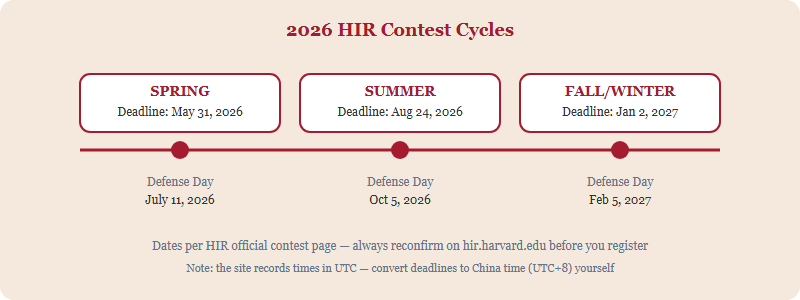
One operational warning for China-based students: the contest platform records times in UTC, not Beijing time. A “January 2” deadline in UTC is not the same instant as midnight on January 2 in China (UTC+8). Do the conversion yourself and submit with a day of buffer — do not hand a strong essay to a timezone rounding error. And because these dates can shift between editions, treat every date above as “verify on the official site,” not gospel.
A quick decision aid (for the cases where you do have a choice)
For nearly everyone, grade decides and there is nothing to choose. But two real decisions remain, and here is how to make them:
- “My grade qualifies — should I enter at all this cycle, or wait?” Enter when you have time to write, revise by hand, and build an AP-Style pass — not when the deadline is three days away. A rushed entry scores poorly on Style and Content alike. If this cycle is cramped, target the next one.
- “I’m a Senior — which prompt?” Choose the prompt where you already read widely and can cite real evidence, then narrow to a single arguable claim. Do not pick the “important-sounding” prompt; pick the one you can defend for 15 minutes on Defense Day. Remember the principle: an argument, not an agenda.
Whichever division your grade places you in, the winning behaviour is the same: a narrow, evidence-backed argument, written in your own voice, formatted in AP Style, inside 1,200 words — and a finalist who can stand behind it live. Start from what the contest is, then work the rubric backwards from the score you want.
Frequently asked questions
Can I choose to enter Junior or Senior?
No. Your division is set by your currently enrolled grade — grades 7–8 enter Junior, grades 9–12 enter Senior. There is no advertised “compete up/down” option; confirm edge cases with HIR.
Do Junior and Senior have different word counts or rubrics?
No. Both divisions submit an 800–1,200-word article in AP Style and are scored on the same 60-point rubric (Content 30 / Style 30). The main difference is the prompt model.
What is the difference between the Junior and Senior prompts?
Junior writers respond to one set theme (“Inventions that Changed How We Live”); Senior writers choose from several international-affairs prompts. Verify current prompts on hir.harvard.edu.
Is there a registration fee, and is registration required?
Registration and payment are required before you can submit. The fee amount is not published on the public contest page — confirm the current fee directly on hir.harvard.edu.
Ready to enter? →
Turn this into an actual entry — the next steps:
- How to enter the HIR contest — deadlines, word limits and the step-by-step submission
- The contest at a glance — divisions, format and the 60-point rubric in one place
- Read past winning entries — see what a scoring paper actually looks like
This is an independent guide operated by Hanlin Education for China-based international-school students. It is not affiliated with, endorsed by, or sponsored by the Harvard International Review or Harvard University. The Harvard International Review is a student-run publication. Contest rules, divisions, prompts, deadlines, fees, and formats can change between editions — always confirm current details on the official site, hir.harvard.edu. Spotted an error? We correct confirmed mistakes within 7 working days.