The HIR Academic Writing Contest rewards an argument, not an agenda: a defensible thesis a thoughtful reader could disagree with, built from evidence and analysis — not persuasion, advocacy, or a fact dump. The Harvard International Review states articles “are expected to have a thesis but should not have an agenda,” and it explicitly does not accept op-eds, editorials, or opinion pieces. Writing analytically (not as a columnist) is the single habit that separates essays that advance from those that stall.
What “argument, not an agenda” actually means
It is easy to nod at this phrase and still write the wrong essay. So let us define both halves precisely, because the distinction is the whole game.
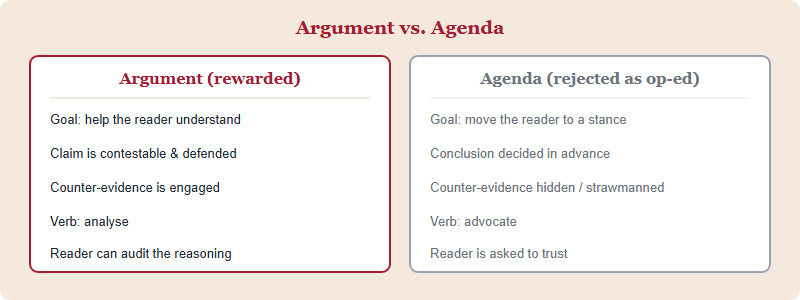
An argument is a contestable claim — one a reasonable, informed reader could push back on — that you then defend with evidence and reasoning. The reader should be able to imagine the opposite position and see why you rejected it. An agenda, by contrast, is a conclusion you have already decided to sell. With an agenda, evidence is recruited to win; counter-evidence is hidden or strawmanned; and the verb shifts from “analyse” to “advocate.”
The HIR draws this line institutionally. Its guidance asks for a thesis but warns against an agenda, and it states plainly that it “does not accept op-eds, otherwise known as editorials or opinion pieces.” That is not a stylistic preference — it is a category. An op-ed exists to move the reader to a stance; an HIR article exists to help the reader understand a question more rigorously than they did before. If you have ever written for a school newspaper’s opinion column, the muscle you trained there is the one to switch off here. For the full structural picture, see our companion guide on what the HIR Academic Writing Contest is.
One more nuance students miss: “no agenda” does not mean “no position.” A neutral summary that refuses to commit is just as wrong as a polemic. The HIR also notes a submission should not be “merely a collection of facts.” You must land a claim — you simply must arrive at it by reasoning the reader can audit, not by assertion they are asked to trust.
Why this is the principle that drives your score
The “argument, not an agenda” rule is not a soft theme — it is wired into how the essay is graded. The contest uses a 60-point rubric split into Content (30) and Style (30). The Content half explicitly rewards “a sharp topic, a clear introduction, logical structure and transitions, strong use and analysis of evidence, and overall coherence of argument.” Notice the phrasing: use and analysis of evidence, and coherence of argument. An agenda-driven essay reliably bleeds points in exactly those boxes, because advocacy substitutes intensity for analysis.
| Rubric area (of 60) | What it rewards | How an agenda loses points here |
|---|---|---|
| Content — sharp topic | A focused, contestable question | Topic is a cause to champion, not a question to examine |
| Content — use & analysis of evidence | Evidence interpreted, not just cited | Evidence cherry-picked to confirm; no analysis of why it supports the claim |
| Content — coherence of argument | Each step follows from the last | Leaps from emotion to conclusion; counter-cases ignored |
| Style — tone | Measured, analytical register | Slogans, exclamation, “we must” calls to action |
| Style — citations | Claims backed by reliable sources via hyperlinks | Assertions presented as self-evident truths |
There is a second, structural reason the principle matters: Defense Day. Top scorers are invited to an optional virtual round with a roughly 15-minute presentation and live questions from judges. An agenda cannot survive cross-examination — the moment a judge asks “what would change your mind?” or “what is the strongest objection?”, an advocate has nothing, while an analyst has a prepared answer. Writing the analytical version is therefore also how you pre-load your defense. We break down that round in how to prepare for Defense Day, and the scoring boxes in the 60-point rubric, decoded.
From op-ed to analysis: a line-level conversion
The fastest way to internalise this is to watch the same idea rewritten. These are illustrative sentences (not from any official prompt) to show the move — the contest’s actual themes change each cycle, so confirm the current prompt on the official site.
| Op-ed / agenda version | Analytical / argument version | What changed |
|---|---|---|
| “Governments must ban facial recognition before it destroys our freedom.” | “Facial-recognition bans reduce one privacy harm while shifting surveillance toward less-visible data brokers — trading a measurable risk for a harder-to-audit one.” | Replaces a call to action with a contestable trade-off claim |
| “Everyone knows social media is ruining a generation.” | “The evidence on adolescent harm is correlational and uneven across studies, which weakens the case for blanket restriction relative to targeted design rules.” | Names the quality of the evidence instead of asserting consensus |
| “We cannot let powerful nations dominate emerging technology.” | “Concentrated control of a general-purpose technology produces standard-setting power that outlasts any single product cycle — the durable advantage, not the gadget, is what reshapes the order.” | Trades a rallying cry for an analysis of mechanism |
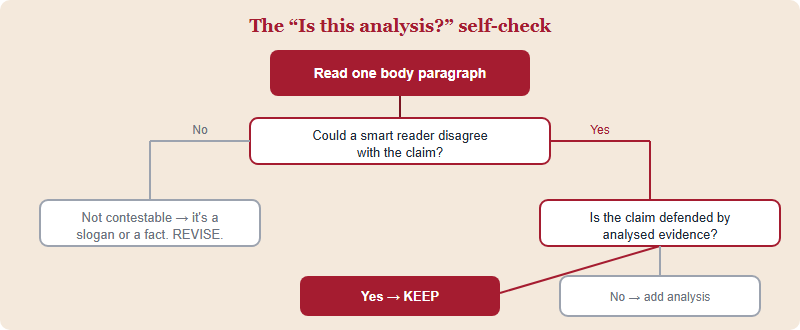
Three patterns recur in every conversion. First, the modal verbs change: must / should / cannot become tends to / produces / trades off. Second, the unit of the sentence becomes a mechanism or trade-off, not a demand. Third, the claim becomes falsifiable — you could, in principle, show data that weakens it. If a sentence cannot be wrong, it is not an argument; it is a banner.
Six habits that keep you analytical
When you sit down to draft your 800–1,200-word article in AP Style, these six habits operationalise the principle so it survives all the way to Defense Day.
- Pick a question, not a cause. Phrase your topic as something with a real answer on both sides (“Does X actually cause Y, or does it shift the cost elsewhere?”) rather than a position to defend.
- Write the strongest objection yourself. Devote a real paragraph to the best counter-argument and answer it on the merits. This is the rubric’s “coherence of argument” in action — and it is your Defense Day insurance.
- Analyse every piece of evidence. After each fact or citation, add the sentence that says why it supports your claim. A statistic with no interpretation is decoration.
- Audit your verbs. Search your draft for must, should, need to, cannot. Each one is a flag that you may have slipped into advocacy; rewrite it as a claim about cause, effect, or trade-off.
- Take a global, not US-centric, lens. The HIR asks writers to examine themes from a global perspective rather than focusing on the United States — a discipline that also pushes you past familiar op-ed talking points.
- Cite, never assert. Every factual claim needs a reliable source, attached via hyperlink per HIR guidance. Unsourced certainty reads as agenda; sourced reasoning reads as analysis. And note: AI-generated text is strictly prohibited and AI-checked, so the analytical thinking must genuinely be yours.
Where the principle fits in the 2026 contest mechanics
A quick, verified frame so you know when and how this work is judged. The HIR runs the contest in three rolling cycles across the year, with capacity limited, and entrants must register and pay before they are eligible to submit. Top-scoring articles are invited to an optional virtual Defense Day several weeks after each deadline.
| 2026 cycle | Submission deadline* | Defense Day (approx.)* |
|---|---|---|
| Spring | May 31, 2026 | July 11, 2026 |
| Summer | late August 2026 | early October 2026 |
| Fall / Winter | January 2, 2027 | February 5, 2027 |
*Dates and the exact Summer deadline vary — admission is rolling and capacity is limited, so always confirm the current cycle dates, registration steps, and fee on hir.harvard.edu before you plan. The principle, though, does not change cycle to cycle: the HIR rewards a defended argument and rejects op-eds. Get that right and the rest of your preparation — structure, sourcing, AP Style, Defense Day rehearsal — has something worth defending.
Frequently asked questions
Does “no agenda” mean my essay shouldn’t take a side?
No. You must land a clear, contestable thesis. “No agenda” means you reach it through analysed evidence a reader can audit — not advocacy or a fact dump.
How is this different from an op-ed?
An op-ed persuades the reader to a stance; an HIR article helps the reader understand a question. The HIR states it does not accept op-eds, editorials, or opinion pieces.
How does the rubric reward an argument over an agenda?
The 60-point rubric (Content 30 / Style 30) rewards use and analysis of evidence and coherence of argument — the exact boxes advocacy tends to lose.
Where can I confirm the current themes and deadlines?
On the official site, hir.harvard.edu. Prompts change each cycle, admission is rolling, and you must register and pay before submitting — verify details there.
Ready to enter? →
Turn this into an actual entry — the next steps:
- How to enter the HIR contest — deadlines, word limits and the step-by-step submission
- The contest at a glance — divisions, format and the 60-point rubric in one place
- Read past winning entries — see what a scoring paper actually looks like
This is an independent guide operated by Hanlin Education for China-based international-school students. It is not affiliated with, endorsed by, or sponsored by the Harvard International Review or Harvard University. Contest rules, themes, deadlines, registration, fees, and rubric details change — always confirm current details on the official site, hir.harvard.edu, before acting. Spotted an error? We correct confirmed mistakes within 7 working days.