Yes — international and China-based students can enter the HIR Academic Writing Contest. Students in grades 7–12 anywhere in the world are eligible, with a Junior division (grades 7–8) and a Senior division (grades 9–12). There are three submission cycles in 2026 (article deadlines 31 May, 24 Aug, and 2 Jan 2027), each followed by a virtual Defense Day. Per the official site, contestants register and pay before they can submit; articles are 800–1,200 words in English using AP Style. Always confirm the current rules at hir.harvard.edu.
Who is eligible — and what “international” actually means here
The HIR Academic Writing Contest is run by the Harvard International Review (HIR) — a student-edited journal of international affairs founded in 1979. It is open to students in grades 7 through 12 worldwide, which is unusually broad: most Harvard-adjacent writing competitions start at grade 9, but HIR explicitly includes 7th and 8th graders through its Junior division. For a student at a Chinese international school, that means a Year 7 or Year 8 student on a British curriculum, or a US-system middle schooler, can enter the same contest as a Senior-division Year 12 applicant.
The official eligibility language separates two groups. US eligibility covers students in the 50 states, D.C., US territories, and — importantly for some China families — US citizens or lawful permanent residents attending high school overseas. International eligibility then welcomes students outside the United States, with the requirement that submissions be written in English using standard American spelling. So a student holding a US passport but studying in Shanghai is typically counted under the US route, while a Chinese-passport student at the same school enters as an international entrant — the entry process is the same; only the category label differs. If your citizenship-vs-location situation is ambiguous, do not guess: confirm your category on the official contest page before you pay.
One practical implication for China-based applicants: because the contest is conducted entirely in English and judged against an English-language style guide, your real “eligibility” hurdle is not paperwork — it is whether you can produce a disciplined 800–1,200-word analytical essay in English under AP Style. We break that craft down in What Is the HIR Academic Writing Contest and in the 60-point rubric decoded.
| Your situation (China-based) | Typical entry category | What to confirm on hir.harvard.edu |
|---|---|---|
| Chinese passport, studying in China | International entrant | Division by grade; English/AP Style requirement |
| US citizen / green-card holder, studying overseas | US eligibility (overseas) | Whether overseas US students file under US route |
| Year 7–8 (any curriculum) | Junior division | Current Junior prompt for the cycle |
| Year 9–12 / Grade 9–12 | Senior division | Current Senior prompt options for the cycle |
The three 2026 cycles and their deadlines
The single most useful thing for a China-based applicant to understand is that HIR runs on a three-cycle calendar, not one annual deadline. Each cycle has an article deadline and, weeks later, a Defense Day for finalists. The cycles spread across the academic year, which is a gift for students balancing IB internal assessments, A-Level mocks, or AP exams — you can pick the window that fits your schedule rather than forcing a January-only submission.
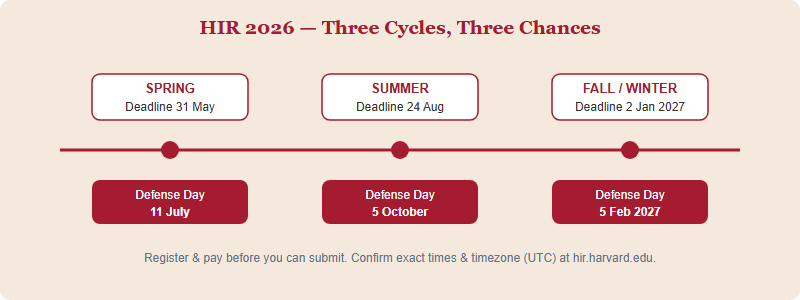
Here are the dates as published on the official contest page for the current rounds:
| Cycle | Article deadline | Defense Day (finalists) | Best for students who… |
|---|---|---|---|
| Spring 2026 | 31 May 2026 | 11 July 2026 | Want to finish before the summer; avoid Jan exam clash |
| Summer 2026 | 24 August 2026 | 5 October 2026 | Have free summer weeks to research and draft |
| Fall / Winter 2026 | 2 January 2027 | 5 February 2027 | Want the latest prompts; can write over winter break |
Two cautions matter specifically for China-based students. First, the contest site operates on a UTC clock, and deadline times are not the same as Beijing time. A “31 May” cutoff can fall on the morning of 1 June in China depending on the exact hour HIR sets — so treat the published date as a hard wall and aim to submit a full day early. Confirm the exact deadline time and timezone on the official site rather than assuming midnight Beijing time. Second, the official page states admissions run on a rolling basis with limited capacity, so registering early in a cycle is safer than waiting until the deadline week.
How entry actually works: register, pay, then submit
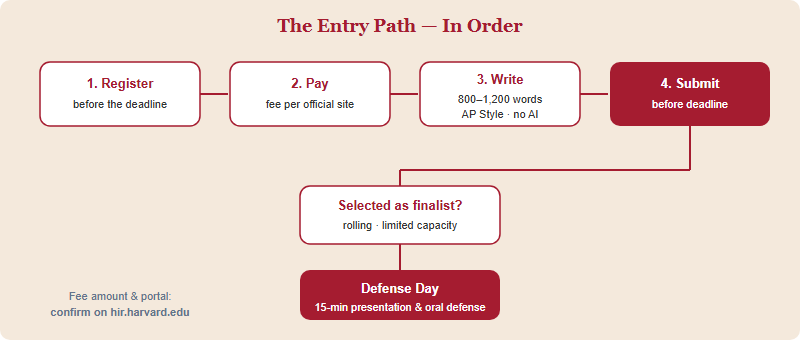
This is where China-based students most often make assumptions — and where the fabrication risk is highest, so we stick strictly to what HIR states. The official page is explicit: “contestants are requested to register and pay before becoming eligible to submit their articles prior to the submission deadline.” In plain terms, the order is register → pay → then submit your article, and all of that must happen before the cycle deadline. Do not back-load registration to the final day; if capacity is limited and rolling, late registration is a real risk.
A few things we deliberately will not invent, because the official page does not state a specific value: the exact registration fee amount, the precise submission portal mechanics, and whether you are issued a candidate ID number. The page confirms a fee exists (“register and pay”), but the figure is not published in the contest overview we reviewed. Confirm the current fee, the submission method, and any file-format rules directly on hir.harvard.edu before you pay — treat any third-party blog quoting a dollar figure with caution, because fees change year to year.
What we can confirm about the article itself: it must be at least 800 and no more than 1,200 words (diagrams, tables, and authorship declarations are excluded from the count), written in English, and formatted in the newest edition of AP Style. AI-generated text is strictly prohibited and submissions are screened for plagiarism and AI use — so for China-based students who draft bilingually, the safe practice is to think and write in English yourself, never to translate or generate with a model and “clean it up.”
A backwards timeline for a China-based applicant
Because international students often juggle a non-English home language, term-time exams, and time-zone math, the safest way to plan is to work backwards from the article deadline — not forwards from “I’ll start soon.” HIR judges an analytical essay against a published rubric weighted toward Content (out of 30) and Style (out of 30) — a 60-point structure decoded in the 60-point rubric decoded — and the strongest pieces follow the contest’s “argument, not an agenda” principle: disciplined analysis, not opinion. That depth takes weeks, not a weekend.
Use this as a roughly six-week runway before any cycle deadline. Adjust the calendar to whichever cycle you choose from the table above.
| When | Action | Why it matters for China-based students |
|---|---|---|
| Deadline − 6 weeks | Register & pay; read the current prompt for your division | Locks your slot early (rolling, limited capacity); confirms fee/portal |
| Deadline − 5 weeks | Choose your angle; gather and log credible sources | Sourcing in English takes longer; build a citation list now |
| Deadline − 4 weeks | Outline within the 800–1,200-word budget | Forces a tight argument before you over-write |
| Deadline − 3 weeks | Draft; keep “argument not agenda” in view | Avoids the op-ed trap that loses Content points |
| Deadline − 2 weeks | Revise to AP Style; check spelling/grammar/citations | AP Style + American spelling is a graded Style criterion |
| Deadline − 1 week | Final proof; run your own integrity check; submit early | Buffer for UTC vs Beijing time; AI/plagiarism screening is strict |
| After shortlisting | If a finalist, prep Defense Day (15-min talk + oral defense) | Practice presenting in English; see our prep guide |
If you reach the shortlist, Defense Day is a virtual 15-minute presentation and oral defense in front of HIR judges. For a China-based student, the two real obstacles are presenting analysis in spoken English and managing the call across time zones — both fixable with rehearsal. We walk through exactly what judges probe in how to prepare for Defense Day.
Common China-pathway mistakes to avoid
- Assuming one annual deadline. There are three cycles — if you miss Spring, Summer and Fall/Winter are still open. Don’t wait a full year.
- Treating the deadline as Beijing midnight. The site runs on UTC; build in a one-day buffer and confirm the exact cutoff time officially.
- Registering on the last day. Admission is rolling with limited capacity — register and pay early in the cycle.
- Using AI to draft or “polish” English. AI text is strictly prohibited and screened; write it yourself to stay eligible.
- Quoting a fee from a blog. The official overview does not publish the amount; verify the current fee on hir.harvard.edu before paying.
- Writing an opinion piece. HIR rewards “argument, not an agenda” — analytical, evidence-backed writing scores; advocacy does not.
FAQ
Can students in China enter the HIR Academic Writing Contest?
Yes. International students in grades 7–12, including those in China, may enter; submissions must be in English using American spelling. Confirm details on hir.harvard.edu.
What are the 2026 deadlines?
Article deadlines are 31 May 2026 (Spring), 24 Aug 2026 (Summer), and 2 Jan 2027 (Fall/Winter), each with a later Defense Day. Verify exact times and timezone officially.
Do I have to pay to enter?
The official page states contestants must register and pay before they can submit. The fee amount is not published in the overview — confirm the current fee on hir.harvard.edu.
Which division am I in?
Junior division is grades 7–8 and Senior division is grades 9–12. Your entry category may also depend on citizenship and where you study; check the official eligibility wording.
Ready to enter? →
Turn this into an actual entry — the next steps:
- How to enter the HIR contest — deadlines, word limits and the step-by-step submission
- The contest at a glance — divisions, format and the 60-point rubric in one place
- Read past winning entries — see what a scoring paper actually looks like
This is an independent guide operated by Hanlin Education for China-based international-school students. It is not affiliated with, endorsed by, or sponsored by the Harvard International Review or Harvard University. The HIR Academic Writing Contest is run by the Harvard International Review, a student-led journal founded in 1979 and not an official organ of Harvard University. Dates, fees, eligibility, and rules change — always confirm current details on the official site, hir.harvard.edu. Spotted an error? We correct confirmed mistakes within 7 working days.