The Harvard International Review (HIR) Academic Writing Contest runs on three rolling cycles across 2026-2027 — Spring, Summer, and Fall/Winter — each pairing a submission deadline with a Defense Day roughly six weeks later. For a China-based international-school student, the choice of window matters as much as the essay: it decides whether you write during exam season or summer break, and how soon a medal can land in an application. This guide maps the official timeline, this year’s Junior and Senior themes, and how to pick both a cycle and a prompt.
The three cycles: deadlines and Defense Days at a glance
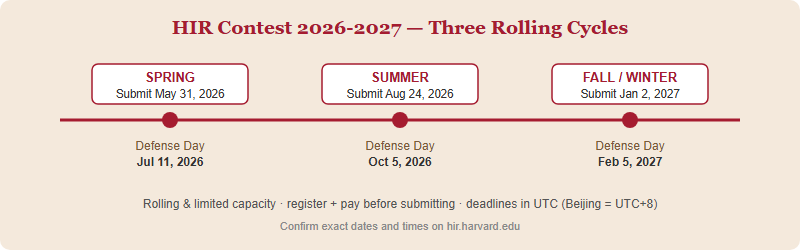
HIR structures the contest as three separate intake windows in one academic year, run on a rolling, limited-capacity basis. Each cycle has its own submission deadline and its own Defense Day — the 15-minute virtual oral defense where judges confirm you genuinely wrote and understand your essay. The cleanest way to plan is to read the calendar backwards from the Defense Day you can realistically attend.
| Cycle (2026-2027) | Submission deadline | Defense Day | Gap to defend |
|---|---|---|---|
| Spring | May 31, 2026 | July 11, 2026 | ~6 weeks |
| Summer | August 24, 2026 | October 5, 2026 | ~6 weeks |
| Fall / Winter | January 2, 2027 | February 5, 2027 | ~5 weeks |
Two operational points the dates do not show on their own. First, the contest is rolling with limited capacity, and registration plus payment is required before your submission is eligible — so the practical deadline to secure a slot can arrive before the stated date if a cycle fills. Second, HAWC runs on a UTC site, and all deadlines should be read against the official clock. China Standard Time is UTC+8, so a “January 2” cutoff in UTC has already turned to the small hours of January 2 in Beijing — confirm the exact hour and time zone on hir.harvard.edu rather than assuming an end-of-day local deadline.
This year’s themes: Junior and Senior prompts decoded
The contest splits by division — Junior (grades 7-8) and Senior (grades 9-12) — and each gets different prompts. The Junior division is given a single set theme; Senior writers choose one of three. Knowing the actual themes early lets you start reading and gathering sources weeks before you draft, which is where strong essays separate from rushed ones.
| Division | Theme | What it really asks for |
|---|---|---|
| Junior (7-8) | Inventions that Changed How We Live | A focused analysis of one invention’s social or economic ripple effects — not a biography of the inventor. |
| Senior (9-12) — A | Global Culture in the Digital Era | How digital platforms reshape identity, language, or cultural exchange across borders. |
| Senior (9-12) — B | Security in a Multipolar World | How power is balanced — or contested — among multiple states; a hard-edged international-affairs lens. |
| Senior (9-12) — C | Technology, Innovation, and Power | How a specific technology shifts who holds economic, political, or informational power. |
Whatever theme you take, the genre is the same: an 800-1,200 word analytically backed essay, written in AP Style with American spelling, that advances a clear thesis. HIR is explicit that it does not accept op-eds or opinion pieces — the contest’s signature principle is “argument, but not an agenda.” Your job is disciplined analysis of evidence, not advocacy. If you want a deeper walkthrough of how that distinction is scored, our companion guide to the HIR Academic Writing Contest and the breakdown of the 60-point rubric show exactly where analysis earns marks.
How to choose a cycle: three honest trade-offs
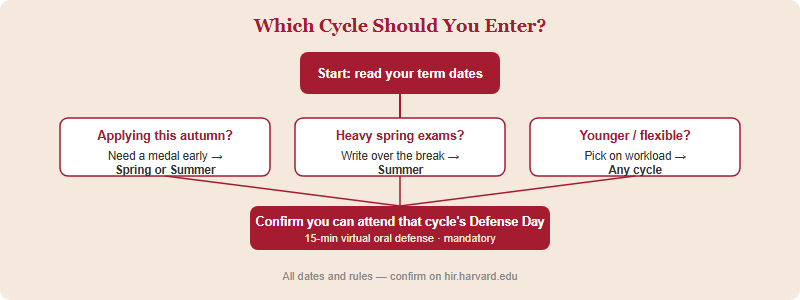
There is no “best” cycle — there is the cycle that fits your calendar and your application timeline. Three trade-offs decide it for most China-based students.
- Exam load. The Spring deadline (late May) collides with IB/AP/A-Level exams and end-of-year assessments. The Summer cycle (August submission) usually lands during the long break, leaving room to write properly. If your spring is brutal, do not force it.
- Defense Day attendance. Defense Day is mandatory and virtual. Check the gap dates above against your school term: a July or October defense may overlap travel, internships, or the start of a new semester. You must be available for that 15-minute slot.
- Application timing. If you are a rising senior applying in the autumn, an earlier medal (Spring or Summer cycle) can be listed in time; the Fall/Winter cycle’s February result arrives after most early deadlines have passed. Younger students have the luxury of choosing on workload alone.
A practical default for many students: aim for the Summer cycle. It offers the most uninterrupted writing time and a Defense Day before the busiest part of the school year. But map your own term dates first — the right answer is personal.
Build your timeline backwards from Defense Day
Strong submissions are not written the week before the deadline. Work back from the Defense Day you have chosen and block out the phases. A realistic six-to-eight-week plan for a single cycle looks like this:
- Weeks 1-2 — read and choose. Lock your division, pick your Senior theme (or frame your Junior invention), and read widely enough to find an angle no one else will take.
- Weeks 3-4 — draft. Build the 800-1,200 word argument, every factual claim paired with a citation. AP Style from the first draft saves a painful conversion later.
- Week 5 — revise and self-check. Tighten analysis against the rubric, verify sources, and run your own AI-originality sanity check (the contest screens for AI, so the writing must be genuinely yours).
- Submit by the deadline — after registration and payment clear, well before the cycle’s capacity fills.
- Weeks to Defense Day — prepare to defend. Re-read your essay until you can explain any sentence aloud. Our Defense Day preparation guide covers the questions judges ask.
Because dates can shift year to year and a cycle can close early, treat every figure here as a planning reference and verify the live deadline, registration step, and any fee on hir.harvard.edu before you commit.
FAQ
How many times can I enter in one year?
HIR allows resubmission if you explore a different theme within the same year. Re-entering the same theme is not the intended path — confirm the current rule on the official site.
Are the Junior and Senior themes the same every cycle?
The division structure (Junior 7-8, Senior 9-12) is stable, but specific themes are set by HIR and can change. Always read the current cycle’s prompts on hir.harvard.edu.
What is the deadline time zone?
The HAWC site runs on UTC. Beijing is UTC+8, so a UTC cutoff falls earlier in your local night. Check the exact hour before submitting.
Do I have to attend Defense Day?
Yes. Defense Day is a mandatory 15-minute virtual oral defense and authenticity review tied to your cycle. You must be available for your scheduled slot.
Ready to enter? →
Turn this into an actual entry — the next steps:
- How to enter the HIR contest — deadlines, word limits and the step-by-step submission
- The contest at a glance — divisions, format and the 60-point rubric in one place
- Read past winning entries — see what a scoring paper actually looks like
This is an independent guide operated by Hanlin Education for China-based international-school students. It is not affiliated with, endorsed by, or sponsored by the Harvard International Review or Harvard University. Dates, themes, fees, and rules change — confirm all current details on hir.harvard.edu. We correct any error within 7 working days of notice.