The HIR Academic Writing Contest stands apart from most student essay competitions in one concrete way: it ends with a 15-minute oral Defense Day, where judges confirm you genuinely wrote and understand your work. That single design choice — plus a tight 800-1,200 word limit, a strict AP-Style rule, and an “argument, not an agenda” standard — changes what an HIR medal signals to admissions compared with longer or self-paced contests. This guide compares HIR with the field and shows where it fits a portfolio.
What makes the HIR contest structurally different
Most writing competitions test the page. HIR tests the page and the author. It is run by the Harvard International Review — a student-run international-affairs journal — and built around analytical international-relations and global-affairs writing rather than personal narrative or creative work. The defining features, all confirmable on hir.harvard.edu:
- Length: 800-1,200 words — short enough to reward precision, not endurance.
- Style: AP Style, American spelling, formal prose; no op-eds or opinion pieces.
- Scoring: a 60-point rubric weighted toward content and analysis over surface style.
- Divisions: Junior (grades 7-8) and Senior (grades 9-12).
- Cycles: three rolling intakes per academic year.
- Authenticity: AI tools are strictly prohibited and screened, and Defense Day adds a live oral check.
If you want the full mechanics first, start with our overview of the HIR Academic Writing Contest; this article assumes you know the basics and focuses on comparison.
HIR vs the field: a side-by-side
The table below positions HIR against three contest types commonly weighed by international-school students. Treat competitor details as general orientation that changes year to year — verify any specific rule, length, fee, or deadline on each contest’s own official site before relying on it.
| Dimension | HIR Academic Writing Contest | Long academic-essay contests (e.g. John Locke type) | Newspaper student contests (e.g. NYT Learning Network type) | Selective journals (e.g. The Concord Review type) |
|---|---|---|---|---|
| Core genre | Analytical global-affairs essay | Long argumentative essay by subject | Short genre tasks (editorial, review, STEM) | Long history research paper |
| Length | 800-1,200 words | Often ~2,000 words (confirm) | Often very short (confirm) | Long-form (confirm) |
| Oral defense? | Yes — 15-min Defense Day | Varies / typically none | No | No |
| Output if recognised | Medal/commendation certificate | Prize / shortlist | Publication / honorable mention | Publication in the journal |
| Best signal | Analysis under a word ceiling + verified authorship | Sustained argument at length | Voice + concision | Deep, citation-heavy research |
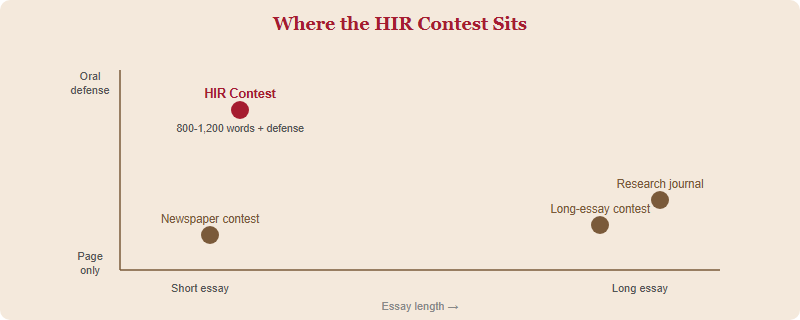
The pattern is clear. Long-essay contests reward stamina and depth; newspaper contests reward voice and economy; selective journals reward archival research. HIR sits in a distinct lane — disciplined analysis compressed into a strict word budget, then defended out loud. None of these is “better”; they test different muscles, which is exactly why they can coexist in one application.
What Defense Day signals to admissions
Admissions officers read awards skeptically, partly because they cannot see who actually did the work. The oral Defense Day is HIR’s answer to that skepticism, and it is the contest’s most underrated feature for applicants. Three signals it sends:
- Verified authorship. A medal you defended live is a medal a reader can trust you wrote — meaningful in an era when AI-written submissions make many “essay prizes” harder to interpret.
- Genuine command of a topic. Explaining your own argument under questioning demonstrates the same skill a seminar or admissions interview tests. It shows depth, not just polish.
- Composure and clarity. Fifteen minutes of defending a thesis is real-time evidence of communication ability — a transferable signal beyond any single subject.
A blunt caveat, in line with how we write about every contest: no competition guarantees admission or any specific outcome, and no honest guide will tell you otherwise. An HIR medal is one credible data point about analytical writing and verified authorship — valuable precisely because it is specific, not because it is a golden ticket.
How to slot HIR into a portfolio without overlap
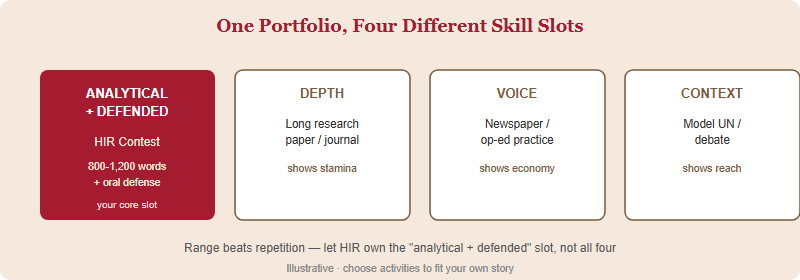
A strong activities list shows range, not repetition. Three contests in the same genre read as one interest done thrice; three that test different skills read as a versatile writer. Use HIR to fill the “analytical, defended, concise” slot and pair it deliberately:
| Your profile gap | What HIR adds | Pair it with |
|---|---|---|
| No verified-authorship credential | A defended, AI-screened result | A long research paper or journal piece for depth |
| Strong at length, weak at concision | Discipline of an 800-1,200 word ceiling | A longer essay contest to show stamina |
| Interested in international affairs / IR / PPE | A subject-aligned global-affairs essay | Model UN, debate, or a policy reading group |
| Need a clear next step after a foundation essay | A graded, defended outcome | School publications or op-ed practice (for voice) |
For students aiming at international relations, economics, or PPE-style programs, the alignment is the point: an HIR essay on a theme like “Security in a Multipolar World” sits naturally beside debate or Model UN, reinforcing a coherent academic story rather than scattering attention. To judge how competitive your essay can be, read what the graders actually reward in our breakdown of the 60-point rubric before you choose where HIR fits.
Choosing between them: a quick rule of thumb
If you have time for exactly one contest this season, decide by the skill you most need to demonstrate. Want to prove you can argue precisely and defend it? HIR. Want to prove you can sustain a long argument? A long-essay contest. Want to prove voice and economy? A newspaper contest. Want to prove archival research depth? A selective journal. Pick for the gap in your story, not for prestige alone — and confirm each contest’s current eligibility, length, fees, and deadlines on its official site before you commit.
FAQ
Is the HIR contest harder than a long-essay competition?
It is not longer, but the strict word ceiling, AP Style, and oral Defense Day make it demanding in a different way. “Harder” depends on your strengths.
Can an HIR medal guarantee university admission?
No. No contest guarantees admission. An HIR result is one credible signal of analytical writing and verified authorship, weighed alongside everything else.
Should I enter HIR and another writing contest the same year?
You can, if they test different skills. Pairing a defended short essay with a long research piece shows range; three similar contests show repetition.
Does HIR suit science or math students?
Yes, if framed analytically — themes touching technology and innovation let STEM-minded writers argue about impact and power rather than personal opinion.
Ready to enter? →
Turn this into an actual entry — the next steps:
- How to enter the HIR contest — deadlines, word limits and the step-by-step submission
- The contest at a glance — divisions, format and the 60-point rubric in one place
- Read past winning entries — see what a scoring paper actually looks like
This is an independent guide operated by Hanlin Education for China-based international-school students. It is not affiliated with, endorsed by, or sponsored by the Harvard International Review or Harvard University, nor by any other competition named for comparison. Rules, lengths, fees, and deadlines change — confirm all current details on hir.harvard.edu and each contest’s official site. We correct any error within 7 working days of notice.