In the HIR Academic Writing Contest, the single most common reason a strong-sounding essay scores in the middle is simple: the writer presents evidence but never analyses it. The 60-point rubric treats those as two different things — “use of evidence” and “analysis of evidence” are separate lines — so a paragraph stuffed with facts can still leave half its marks on the table. This guide dissects the five-move paragraph that earns both, inside the contest’s strict 800-1,200 word ceiling.
Why “use” and “analysis” are scored separately
The Harvard International Review — the student-run international-affairs journal that runs this HIR Academic Writing Contest — rewards analytical writing, not reporting. Its rubric allots a block of points to content and analysis and a smaller block to style, and within content it distinguishes how well you bring evidence in from what you do with it once it arrives. (For the full point split, see our breakdown of the HIR 60-point rubric; the exact sub-line weights live in HIR’s official Submission Guide, so confirm them on hir.harvard.edu.)
The practical consequence is the part most students miss. You can quote the perfect statistic, cite a credible source, and still score low on the analysis line — because citing a number proves you can read, not that you can think. A judge reading 800-1,200 words wants to watch you reason. Every fact you introduce is a question waiting to be answered: so what does this mean for my argument?
Think of it as two muscles. “Use of evidence” is selection and sourcing — choosing the right fact and citing it cleanly in AP Style. “Analysis of evidence” is interpretation — explaining the mechanism, weighing the counter-reading, and connecting the fact back to your thesis. Most rejected drafts over-build the first muscle and starve the second.
The five-move paragraph that wins both lines
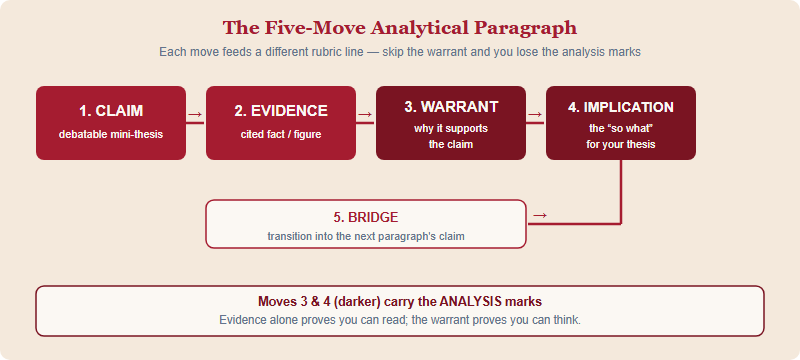
A high-scoring analytical paragraph is not a mystery; it follows a repeatable shape. We teach it to China-cohort writers as five moves — Claim, Evidence, Warrant, Implication, Bridge — and once you can name them, you can audit any paragraph in your draft for the missing piece.
| Move | Job in the paragraph | Rubric line it feeds | Typical length |
|---|---|---|---|
| 1. Claim | A debatable mini-thesis the paragraph will prove | Structure & coherence | 1 sentence |
| 2. Evidence | A specific, cited fact, figure, case, or quote | Use of evidence | 1-2 sentences |
| 3. Warrant | Why this evidence actually supports the claim (the logic) | Analysis of evidence | 1-2 sentences |
| 4. Implication | What it means for your larger argument — the “so what” | Analysis of evidence | 1 sentence |
| 5. Bridge | A transition that sets up the next paragraph | Coherence / transitions | 1 sentence (or fold into next) |
The hinge of the whole structure is Move 3, the warrant — the sentence that says here is why this fact means what I claim it means. Skip it and you have journalism; include it and you have analysis. Most middling HIR essays jump straight from Evidence to a new Claim, leaving the judge to supply the reasoning. Your job is to do that reasoning on the page so the analysis line cannot be denied.
A worked example: the same fact, two ways
Compare two versions of one paragraph from a hypothetical Senior essay under Theme B, “Security in a Multipolar World.” Both use the same evidence. Only one would score on the analysis line.
Version A (describes — scores on “use,” not “analysis”): “Global military spending reached record highs in recent years. Many states increased their defence budgets. This shows that the world is becoming more militarised.” The fact is real and could be cited cleanly. But the third sentence merely restates the fact in bigger words. There is no warrant — no reasoning about why rising budgets reshape security — so a judge has nothing analytical to reward.
Version B (analyses — scores on both lines): “Global military spending has climbed to record levels, with several middle powers posting the steepest increases [cite]. The pattern matters less for its size than its distribution: when second-tier states — not just the established powers — drive the rise, deterrence stops being a two-player calculation and becomes a crowded, harder-to-read board. For my argument, that diffusion is the real source of instability in a multipolar order — not the headline total. It also sets up the regional case I turn to next.” Same fact; now the warrant (distribution, not size) and the implication (diffusion drives instability) do visible analytical work, and the bridge points forward.
Notice what changed. Version B did not add more evidence — it added reasoning about the evidence. That is almost always the highest-yield edit you can make to a draft that already has its facts but feels flat. (The examples above are illustrative constructions to show method, not quotations from any HIR entry.)
There is a second, quieter difference worth copying. Version A’s verb is “shows”; Version B’s verbs are “matters,” “stops being,” “drives.” Weak analytical paragraphs lean on flat reporting verbs — shows, states, says, mentions — that announce a fact without interpreting it. Strong ones use verbs that do analytical work: reframes, undercuts, masks, amplifies, narrows. When you audit a draft, scan your verbs: if most of them just point at facts, your reasoning is probably thin underneath. Upgrading the verb often forces you to write the warrant you were missing, because you cannot honestly claim a fact “undercuts” something until you have explained how.
Five analysis moves that lift a flat paragraph
When a paragraph stalls after the evidence, reach for one of these reasoning moves. Each is a way to write the warrant a judge is waiting for:
- Mechanism: explain how the cause produces the effect, step by step, rather than asserting it does.
- Comparison: set the fact against a benchmark, an earlier period, or a rival case so its significance is visible.
- Counter-reading: name the obvious alternative interpretation, then show why yours is stronger — this is the fastest way to look analytical.
- Limit: state what the evidence does not prove; conceding scope makes the rest of your claim more credible.
- Stakes: connect the point to a consequence that matters for the people, system, or policy in question.
You do not need all five in one paragraph — one or two, done well, beats a checklist done shallowly. The discipline is simply to never let a cited fact sit unexamined.
Budgeting analysis inside 800-1,200 words
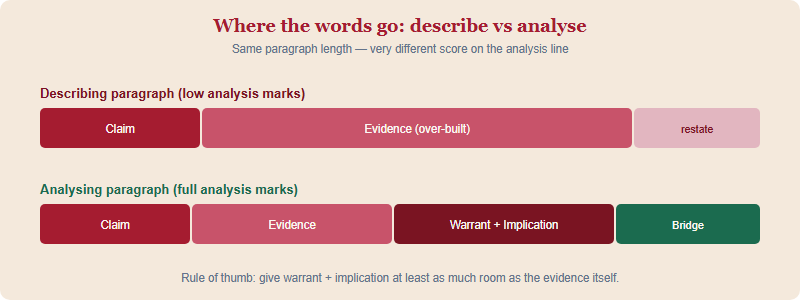
The word ceiling is what makes this hard. With only 800-1,200 words (diagrams, tables, and the authorship declaration don’t count toward that), you cannot afford a paragraph that spends its whole length describing. A useful rough discipline for the body: aim for at least as many words of warrant plus implication as you spend on evidence. If a paragraph is two-thirds fact and one-third reasoning, rebalance it.
This also protects you on a rule you cannot ignore: HIR strictly prohibits generative AI and screens for it, and an essay that is all surface description with no individual reasoning is exactly the kind of generic prose that reads as machine-made. Writing real warrants in your own voice is both how you win the analysis line and how you stay unmistakably human on the page. If you want the structural frame your paragraphs sit inside, pair this with our guide on how to structure an 800-1,200 word HIR essay, and rehearse explaining each warrant aloud for Defense Day.
A two-minute paragraph audit
Before you submit any cycle, run every body paragraph through this quick check. It is the single most efficient way to convert a “describes” draft into an “analyses” one:
- Underline the one sentence that is your warrant. Can’t find it? Write it.
- Can you delete the paragraph’s last sentence and lose no meaning? Then it restated instead of concluded — replace it with an implication.
- Does every cited fact answer “so what?” within two sentences?
- Is at least one reasoning move (mechanism, comparison, counter-reading, limit, stakes) visibly present?
- Does the paragraph end by pointing somewhere — a bridge — not just stopping?
FAQ
What’s the difference between “use of evidence” and “analysis of evidence”?
Use is selecting and citing the right fact; analysis is explaining why that fact supports your claim. The rubric scores them separately, so do both.
How many pieces of evidence does one paragraph need?
Usually one strong, well-analysed fact beats three under-examined ones — especially inside an 800-1,200 word limit. Confirm any guidance on hir.harvard.edu.
Is the five-move structure an official HIR rule?
No. It is a teaching method for hitting the rubric’s analysis lines. The official criteria and weights are in HIR’s Submission Guide.
Can I use a table or diagram instead of analysing in prose?
Diagrams and tables are allowed and don’t count toward the word limit, but they supplement analysis — they don’t replace the reasoning judges score.
Ready to enter? →
Turn this into an actual entry — the next steps:
- How to enter the HIR contest — deadlines, word limits and the step-by-step submission
- The contest at a glance — divisions, format and the 60-point rubric in one place
- Read past winning entries — see what a scoring paper actually looks like
This is an independent guide operated by Hanlin Education for China-based international-school students. It is not affiliated with, endorsed by, or sponsored by the Harvard International Review or Harvard University. Rubric details, word limits, and rules change — confirm all current details on hir.harvard.edu. We correct any error within 7 working days of notice.