If you learned to cite with footnotes or a MLA works-cited page, the HIR Academic Writing Contest will feel strange: it asks for AP Style, and AP Style has no footnotes and no in-text parenthetical citations. Instead you name your source inside the sentence — “according to a 2024 UN report” — and let the prose carry the attribution. This guide explains how that works, how to handle a reference list without wrecking your word budget, and the citation mistakes that quietly cost credibility with judges.
Why HIR essays cite differently
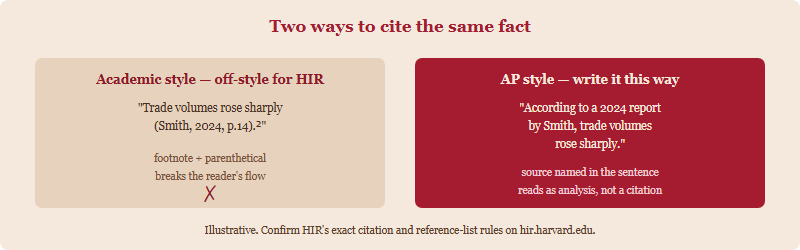
The Harvard International Review — the student-run journal that runs this HIR Academic Writing Contest — asks entrants to write in AP (Associated Press) Style, the house style of professional journalism rather than academic papers. Journalism attributes sources in the flow of the sentence because readers should never have to break off to a footnote. That single convention changes how you cite everything: the source becomes part of your argument, not a number hanging off the end of it.
This trips up a lot of international students, because most school essays reward the opposite habit — dense parenthetical citations and a long bibliography. In an HIR essay, a sentence cluttered with “(Smith, 2023, p. 14)” reads as off-style. The skill to build is smooth, credible in-text attribution: enough that a judge trusts your evidence, delivered in a way that sounds like analysis, not a reference dump.
One caveat up front, and it matters: whether HIR wants a separate reference or works-cited list appended, and whether such a list counts toward your 800-1,200 words, is a rule HIR sets — and it can change by cycle. The word count excludes diagrams, tables, and the authorship declaration, but do not assume a bibliography is free. Confirm the current requirement in HIR’s Submission Guide on hir.harvard.edu before you finalise.
How in-text attribution works in AP Style
The core move is simple: name who said it and when, then state the fact. AP Style keeps attribution short and puts it where it reads naturally — usually at the start or in the middle of the sentence. Below is the pattern applied to the kinds of sources an HIR essay leans on.
| Source type | AP-style in-text attribution (illustrative) |
|---|---|
| Report / institution | “A 2024 World Bank report found that…” |
| Named expert | “Economist Jane Doe argued in a 2023 essay that…” |
| Government body | “According to the country's statistics agency…” |
| News outlet | “Reuters reported in March 2025 that…” |
| Study / journal | “A study published in a peer-reviewed journal in 2022 showed…” |
Two AP habits are worth copying exactly. First, AP Style says “said” is the cleanest attribution verb — resist the urge to reach for “asserts,” “opines,” or “claims” unless you specifically mean to signal doubt, because loaded verbs quietly editorialise. Second, AP generally spells out numbers below 10 and uses figures for 10 and above, and it has specific conventions for percentages, dates, and titles. You do not need to memorise the whole stylebook, but knowing that AP has firm rules — and checking the ones you use — is part of writing “in AP Style” credibly.
Building a reference list without burning words
Even though AP Style itself is an in-text system, a research essay usually still needs a place a reader can verify your sources. Many HIR entrants append a short reference list at the end. Because you may not know whether that list counts toward your word limit, treat word economy as a real constraint and follow these principles:
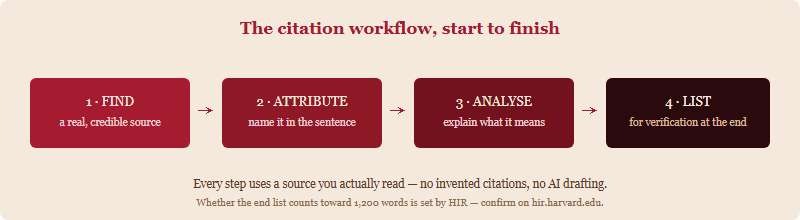
- Do the citing in the body, list for verification. Your in-sentence attribution is what a judge reads; the end list is a backstop so claims can be checked.
- Keep entries lean. Author or institution, title, publication, year, and a link if relevant — enough to find the source, no more.
- Cite fewer, stronger sources. Six well-chosen references you actually analysed beat twenty you name-dropped. Depth reads as rigour; padding reads as insecurity.
- Never invent a citation. A fabricated or “close enough” source is an integrity failure and exactly the kind of thing an AI checker or a Defense-Day question can expose.
That last point connects to a rule you cannot bend: HIR strictly prohibits generative AI and screens submissions, and AI tools are notorious for inventing plausible-looking citations that do not exist. If every source in your essay is one you personally found and read, you are safe on both fronts — the citation is real, and your authorship is defensible when a judge asks where a figure came from.
The citation mistakes that cost credibility
Judges notice sourcing, because it is the difference between an opinion and an argument. These are the errors that most often undercut an otherwise strong HIR essay:
| Mistake | Why it hurts | Fix |
|---|---|---|
| Vague attribution (“studies show,” “experts say”) | Reads as hearsay; a judge can't weigh an unnamed source | Name the specific report, person, or outlet and the year |
| Footnotes / parentheticals in an AP essay | Off-style; signals you didn't read the brief | Move the source into the sentence |
| Uncited statistics | A number with no source looks invented | Attribute every figure, or cut it |
| Over-citing | Attribution in every clause smothers your analysis | Cite the fact once; then analyse in your own voice |
| Weak or partisan sources | Undermines the neutrality judges reward | Prefer primary data and reputable, balanced sources |
The through-line is credibility. Good citation is not decoration; it is how you earn a judge’s trust so your analysis lands. This matters especially for the “argument, not agenda” standard HIR is known for — well-attributed, balanced evidence is what separates a disciplined analytical essay from an opinion piece. For how that attribution feeds the scoring lines directly, see our breakdown of the 60-point rubric.
A pre-submission citation checklist
Before you submit any cycle, run your draft through this quick pass. It catches the sourcing errors judges see most:
- Is every statistic and quote attributed to a named source with a year?
- Have you removed all footnotes and parenthetical citations in favour of in-sentence attribution?
- Did you replace vague phrases — “studies show,” “many believe” — with specific sources?
- Is your attribution verb usually the neutral “said,” not a loaded one?
- Have you confirmed on hir.harvard.edu whether a reference list is required and whether it counts toward the word limit?
- Can you personally vouch that every source is real and that you wrote every word — no AI drafting?
Clean, confident sourcing is one of the least glamorous and highest-yield edits you can make. It costs a judge nothing to trust a well-attributed essay — and everything for them to doubt an unsourced one. When your citations are tight, pair the piece with our guide on how to prepare for Defense Day, where you may be asked to defend exactly where a number came from.
FAQ
Does an HIR essay use footnotes or a bibliography?
HIR asks for AP Style, which cites in the sentence rather than in footnotes. Whether an end reference list is required or counts toward the word limit is set by HIR — confirm on hir.harvard.edu.
How do I cite a source in AP Style?
Name the source inside the sentence — “according to a 2024 report by [org]” — instead of using a parenthetical. Keep it short and let the fact follow.
How many sources should an HIR essay have?
Enough to support your claims credibly — a handful of strong, well-analysed sources beats a long, shallow list. Confirm any guidance on hir.harvard.edu.
Can I let AI format my citations?
No. HIR prohibits generative AI and screens for it, and AI often invents fake citations. Find and cite every source yourself.
Ready to enter? →
Turn this into an actual entry — the next steps:
- How to enter the HIR contest — deadlines, word limits and the step-by-step submission
- The contest at a glance — divisions, format and the 60-point rubric in one place
- Read past winning entries — see what a scoring paper actually looks like
This is an independent guide operated by Hanlin Education for China-based international-school students. It is not affiliated with, endorsed by, or sponsored by the Harvard International Review or Harvard University. Citation, reference-list, and word-count rules are set by HIR and change by cycle — confirm all current details on hir.harvard.edu. We correct any error within 7 working days of notice.