The HIR Academic Writing Contest Summer cycle closes on Aug. 31 — exactly seven weeks from today, July 13. Seven weeks is enough time to research, draft, revise and submit an 800–1,200-word analytical essay, but only if each week has one clear deliverable. This plan breaks the run-up into three phases — scoping, drafting and refinement — with a week-by-week schedule built for students juggling summer programs, standardized-test prep and family travel.
Why a seven-week plan beats a two-week sprint
An HIR essay is short — 800 to 1,200 words — which tempts strong writers into treating it as a weekend project. The 60-point rubric punishes that instinct. Thirty of the 60 points sit under Content, and the dimensions judges score there — topic selection, use of evidence, analysis of evidence, coherence — all depend on work that happens before you write a single paragraph. You cannot fake a well-scoped topic or a genuinely analytical evidence base in a late-August scramble. (If the rubric is new to you, read our full breakdown of the 60-point rubric before starting Week 1.)
There is a second reason to start now rather than in mid-August. The contest has described its review process as rolling, which means entries are not all held to be read in one batch after the deadline — earlier, cleaner submissions avoid the end-of-cycle crush entirely. Confirm the current review policy on hir.harvard.edu, but as a planning assumption, “done by Aug. 24” is a better target than “done by 11:59 on Aug. 31.”
Finally, remember what you are ultimately preparing for. Advancing in this contest means defending your essay orally at Defense Day — a 15-minute presentation and judge Q&A. An essay you researched properly over seven weeks is one you can defend from memory; an essay you assembled in a panic is one you will struggle to explain. The essay phase and the defense phase reward exactly the same thing: genuine command of your own argument.
The three phases at a glance
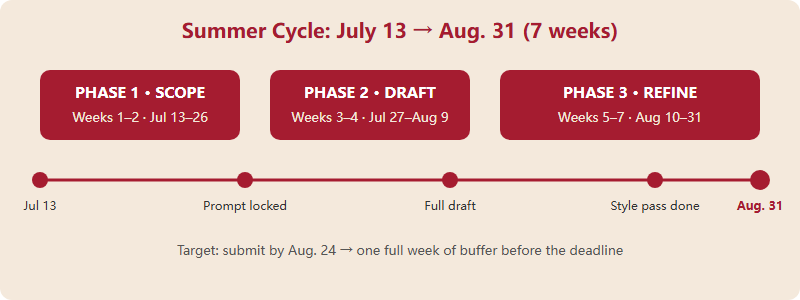
The proportions matter more than the exact dates. Notice that drafting — the part students think of as “writing the essay” — gets only two of the seven weeks. Scoping gets two full weeks because topic selection and evidence quality are scored rubric dimensions, and refinement gets three weeks because the 30 Style points and the coherence dimension are won almost entirely in revision, especially for non-native English writers.
Week-by-week schedule
| Week | Dates (2026) | Focus | Deliverable by Sunday |
|---|---|---|---|
| 1 | July 13–19 | Read the current prompts, shortlist two, do exploratory reading on both | A one-page note per shortlisted prompt: possible thesis, 3 candidate sources each |
| 2 | July 20–26 | Commit to one prompt; deep research; build evidence bank | Locked thesis sentence + 6–10 vetted sources with quotes/data logged |
| 3 | July 27–Aug. 2 | Outline and draft the first half (intro + first two body sections) | Outline + ~600 words of rough draft |
| 4 | Aug. 3–9 | Draft the second half; write the conclusion last | Complete rough draft, even if 1,400+ words |
| 5 | Aug. 10–16 | Structural revision: argument order, evidence-to-analysis ratio, cuts to length | Second draft inside the 800–1,200 window |
| 6 | Aug. 17–23 | Style pass: AP Style conventions, sentence-level clarity, transitions | Near-final draft + one outside read (teacher or peer) |
| 7 | Aug. 24–31 | Final QA, authorship declaration, submission | Submitted entry, ideally early in the week |
Two notes on using this table honestly. First, Week 2’s “locked thesis” is the single most important checkpoint in the plan. If you reach July 26 without a thesis you could state in one sentence to a skeptical judge, spend three more days on scoping and compress drafting — do not carry an unfocused topic into Phase 2. Second, Week 4 deliberately allows an overlength draft. Cutting 1,400 words to 1,150 in Week 5 produces a denser, better essay than writing to 1,150 directly; compression forces you to keep only the evidence that earns its place.
What each phase must produce
Phase 1 (scoping) produces a defensible question, not a topic area. “AI and global politics” is a topic area; a specific, arguable claim about one mechanism in one context is a question you can actually resolve in 1,200 words. The Senior division lets you choose among prompts, so use Week 1’s parallel shortlisting to pick the prompt where your evidence access is strongest — not the one that sounds most impressive. Remember the contest’s own stated principle: it rewards an argument, not an agenda. A scoped question keeps you analytical; a cause keeps you editorial.
Phase 2 (drafting) produces a complete argument, not polished prose. Write fast and flag gaps with brackets — “[need data point here]” — rather than stopping to hunt mid-draft. Your evidence bank from Week 2 should supply most of what the brackets ask for. If a bracket cannot be filled from your bank, that is a signal the claim may need to be narrowed, not that you need another research detour.
Phase 3 (refinement) produces the score. This is worth saying bluntly: two essays with the same ideas can land many rubric points apart based on structure, transitions, coherence and style — dimensions that are explicitly scored. Week 5 is macro surgery (reorder, cut, rebalance), Week 6 is micro polish (AP conventions, sentence rhythm, word choice), and Week 7 is verification. Keep the phases separate; students who try to polish sentences while restructuring paragraphs do both badly.
Fitting the plan around a real summer
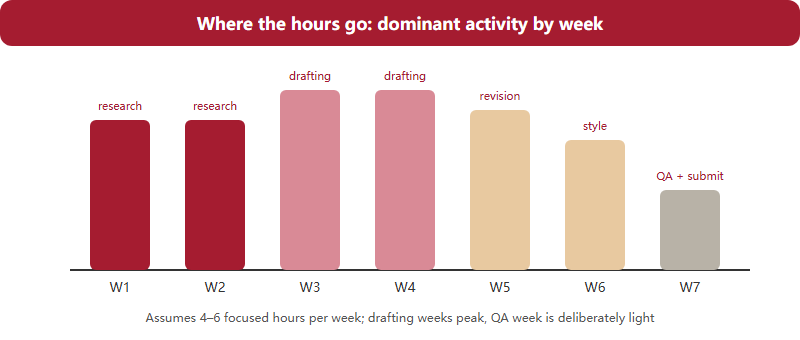
Most China-based international-school students are not spending July at a desk. The plan above assumes roughly 4–6 focused hours per week, and it survives interruptions if you protect the checkpoints rather than the daily routine. Practical adjustments:
- Summer program away from home? Front-load Phase 1 before you leave. Research needs library and database access; drafting needs only your evidence bank and a laptop.
- TOEFL/SAT sitting in August? Swap Weeks 5 and 6 around your test date. The style pass is the most fragmentable work — it can be done in 30-minute sessions.
- Starting late? If you find this plan on Aug. 1, run a compressed 2+1+1 version of the same phases and drop the outside-read step, not the scoping week. A rushed but well-scoped essay beats a polished ramble on every Content dimension.
- Considering waiting for the Fall–Winter cycle instead? That is legitimate — the next window closes in early January 2027 — but be honest about whether autumn (application season, school exams) will really give you more free hours than this summer. For most Grade 11 and 12 students it will not.
The Week 7 checklist
By Aug. 24 the essay itself should be finished. The final week is verification, not writing:
- Confirm the word count sits inside 800–1,200 under the contest’s counting rules (the stated range excludes items such as charts and the declaration — verify the exact counting method on hir.harvard.edu).
- Complete the authorship declaration honestly. The contest prohibits AI-written work and screens for it; your declaration and your draft history are your protection, so keep dated drafts.
- Run one final AP Style pass on dates, numbers and titles.
- Submit early in the week, then archive your drafts, evidence bank and source list — if your essay advances, that bank becomes the raw material for your Defense Day preparation.
If you are still deciding whether this contest fits your profile at all, start with our complete guide to what the HIR Academic Writing Contest is, then come back to Week 1 of this plan. Seven weeks is plenty — if you start this week.
FAQ
Is seven weeks really enough for a competitive HIR essay?
Yes, at 4–6 focused hours per week. The essay is only 800–1,200 words; the constraint is thinking quality, not volume. Students who start in mid-August struggle most on the scored Content dimensions.
Should I submit early or wait until Aug. 31?
Aim for the week of Aug. 24. The contest has described review as rolling, and an early submission means technical problems on deadline day cannot cost you the cycle. Confirm current policy on hir.harvard.edu.
Can I keep polishing after I submit?
Plan as if you cannot. Treat your Week 7 submission as final, and direct any leftover energy toward archiving your research for a possible Defense Day invitation.
What if my draft is way over 1,200 words in Week 4?
That is by design. Cutting an overlength draft in Week 5 usually raises quality, because you delete the weakest evidence first. A 1,400-word rough draft is a healthy Phase 2 outcome.
Ready to enter? →
Turn this into an actual entry — the next steps:
- How to enter the HIR contest — deadlines, word limits and the step-by-step submission
- The contest at a glance — divisions, format and the 60-point rubric in one place
- Read past winning entries — see what a scoring paper actually looks like
This is an independent guide operated by Hanlin Education for China-based international-school students. It is not affiliated with, endorsed by, or sponsored by the Harvard International Review or Harvard University. Deadlines, rules and review policies change; always confirm current details on hir.harvard.edu. Factual errors reported to us are corrected within 7 working days.