Before you submit to the HIR Academic Writing Contest, run a structured final check: verify the essay sits inside the 800–1,200-word window under the contest's counting rules, complete a dedicated AP Style pass, fill out the authorship declaration truthfully, and confirm every formatting requirement on hir.harvard.edu. This checklist walks through each step in order — it is the difference between an essay judged on its argument and one docked for avoidable mechanical errors.
Why a separate QA step exists at all
The 60-point rubric splits into 30 Content points and 30 Style points. That second number should change how you think about your final week: nearly half the available score rewards execution — clarity, convention, polish — rather than ideas. A brilliant argument delivered in a manuscript with inconsistent dates, a word count over the limit or a rushed declaration hands back points that took weeks of research to earn. (For the full scoring breakdown, see our decode of the 60-point rubric.)
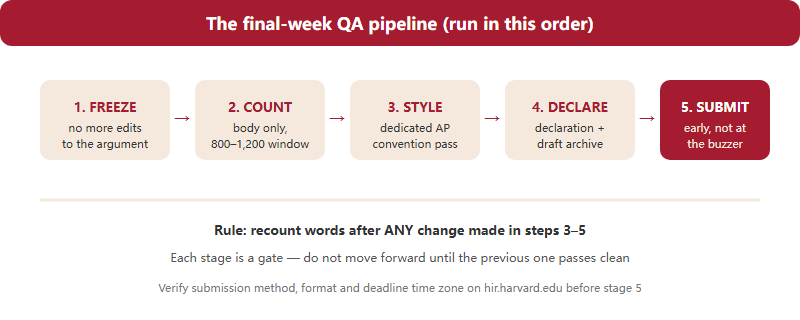
QA is also not the same as revision. Revision improves the essay; QA verifies compliance. By the time you run this checklist, the argument should be frozen — you are checking the container, not the contents. Mixing the two is how last-minute “small improvements” introduce new errors the night before a deadline. If you are working toward the Summer cycle's Aug. 31 close, schedule this checklist for the final week, after your last substantive edit.
Step 1: Verify the word count — and what counts
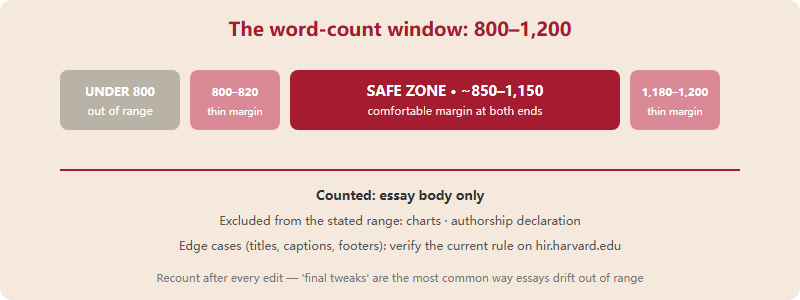
The contest asks for an analytical essay of 800 to 1,200 words. Two boundary questions trip up entrants, and both deserve care:
- The floor matters as much as the ceiling. An essay at 750 words is out of range just as surely as one at 1,300. Under-length essays usually signal under-developed analysis — if you are below 800, the fix is deeper analysis of your existing evidence, not padding.
- Know what is excluded. The stated range excludes supporting items such as charts and the declaration rather than everything in your file. Do not guess at edge cases — check the current counting rules on hir.harvard.edu before you rely on being “just inside” the limit. If your count sits within roughly 20 words of either boundary, treat that as a red flag and adjust until you have comfortable margin.
Practical method: paste the essay body alone — no title, no charts, no declaration text — into a fresh document and record that number. Then recount after any subsequent edit, however small. Students routinely fall out of range during “final tiny tweaks” made after their last official count.
Step 2: The AP Style pass
The contest specifies AP Style — the Associated Press convention set used by most English-language newsrooms. For students trained on MLA or APA school essays, AP has several habits that feel wrong at first and are therefore the most commonly missed. Run these checks as a single dedicated pass, reading only for convention, not meaning:
| Check | AP convention | Common school-essay habit to fix |
|---|---|---|
| Numbers | Spell out one through nine; use numerals for 10 and above | Spelling out “fifteen” or writing “5” in running text |
| Dates | Abbreviate most months with a specific date: Aug. 31, 2026 | Writing “August 31st” or “31/8/2026” |
| Serial comma | HIR's own style guide asks for the Oxford comma in lists longer than two items, overriding AP's usual omission | Dropping the serial comma because a general AP handout says to |
| Titles of officials | Capitalize formal titles only directly before a name | Capitalizing “the President” in every mention |
| Attribution | Attribute facts and quotes in running text | Footnotes and parenthetical citations from MLA/APA habits |
| Percent and money | Spell out percent (HIR overrides AP here); follow the current AP Stylebook for money | Mixing “%”, “percent” and “pct.” within one essay |
Two cautions. First, AP Style is a living standard — the Stylebook updates annually — so where your school library has a recent edition, prefer it over half-remembered rules from the internet. Second, consistency beats perfection: a judge reading 1,100 words will forgive a rare obscure-rule miss far more readily than an essay that abbreviates a month in one paragraph and spells it out in the next. In-text attribution deserves special attention because it doubles as an evidence-quality signal under the Content rubric — our companion piece on what the HIR contest is and how it is judged covers where sourcing sits in the overall evaluation.
Step 3: The authorship declaration and the AI rule
The contest requires individually authored work, prohibits AI-written essays and screens submissions for authenticity, with an authorship declaration as part of the entry. Treat this step with the same seriousness as the essay itself:
- Read the declaration before your final week, not at the moment of submission. Know exactly what you are attesting to, and confirm the current wording and any accompanying integrity rules on hir.harvard.edu.
- Keep your paper trail. Dated drafts, your research notes and your evidence log are the natural record that the work is yours. If any question ever arises, a folder of timestamped drafts showing the essay evolving over weeks answers it better than any statement could.
- Understand what the rule protects. An essay that advances leads to Defense Day — a 15-minute oral defense in front of judges who will probe your reasoning in live Q&A. Work you did not genuinely author is work you cannot defend for 15 minutes. The integrity rule and the defense format are two halves of the same design; our Defense Day preparation guide shows how directly the questioning tests ownership of the argument.
- Grammar tools sit in a gray zone. Where exactly the line falls between a spell-checker and prohibited assistance is defined by the contest, not by this guide — check the current policy rather than assuming.
Step 4: File, format and logistics
The least glamorous checks are the ones that fail loudest on deadline day:
- Submission mechanics. Confirm the current submission method, file format requirements and any entry fee directly on hir.harvard.edu — these operational details are set by the organizer and can change between cycles, so this guide deliberately does not restate them.
- Division check. Junior division covers grades 7–8 and Senior covers 9–12; make sure your entry is going into the correct one for your grade at submission.
- Deadline and time zone. The Summer cycle closes Aug. 31. Deadlines have a time zone attached — verify which one on the official site and convert to Beijing time yourself rather than assuming midnight local. A deadline stated in a U.S. time zone lands the following afternoon or evening in China, but never rely on that arithmetic without checking the stated zone.
- One clean read-aloud. After every mechanical check, read the essay aloud once, slowly. The ear catches dropped words and broken sentences that four silent proofreads miss.
The five most common last-day errors
From watching students prepare contest essays across many competitions, the same handful of failures recur on submission day — all preventable by starting QA a week early:
- The post-count edit. A “one-sentence improvement” after the final word count pushes the essay out of range. Fix: recount after every change, without exception.
- The mixed style sheet. Half the essay follows AP conventions, half follows the MLA habits of a school assignment, because the style pass was done piecemeal across several days. Fix: one continuous pass, one sitting.
- The unread declaration. Signing an attestation at 11:40 p.m. without reading it. Fix: read the declaration at the start of final week.
- The time-zone assumption. Treating “Aug. 31” as Aug. 31 anywhere on Earth. Fix: find the stated zone on the official site and put the converted Beijing-time deadline in your calendar — then target several days earlier anyway.
- The single-device gamble. The only copy of the final essay lives on one laptop that chooses deadline night to update its operating system. Fix: cloud backup plus one exported copy in the required format, done at the start of final week.
FAQ
Does the 800–1,200 word count include my charts and declaration?
The stated range excludes items such as charts and the declaration. For edge cases like titles or captions, verify the current counting rule on hir.harvard.edu rather than guessing.
Do I really need AP Style if my argument is strong?
Yes. Style carries 30 of the 60 rubric points, and AP Style is the specified convention. A dedicated one-sitting style pass is the cheapest score improvement available in your final week.
Can I use grammar-checking software before submitting?
The contest prohibits AI-written work and screens for authenticity. Where routine spell-checking ends and prohibited assistance begins is defined by the contest — check the current integrity policy on hir.harvard.edu.
What time on Aug. 31 does the Summer cycle actually close for students in China?
The deadline's time zone is set by the organizer — confirm it on hir.harvard.edu and convert to Beijing time yourself. Safer still: submit days early and make the question irrelevant.
This is an independent guide operated by Hanlin Education for China-based international-school students. It is not affiliated with, endorsed by, or sponsored by the Harvard International Review or Harvard University. Submission mechanics, counting rules and deadlines change; always confirm current details on hir.harvard.edu. Factual errors reported to us are corrected within 7 working days.