The fastest way to lift an HIR Contest essay from a well-written summary to a genuine argument is to borrow an analytical framework from international-relations scholarship: levels of analysis, structured comparison or mechanism tracing. Each gives you a repeatable method for turning evidence into analysis — the rubric dimension where most student essays bleed points — and each fits comfortably inside the contest's 800–1,200-word limit if you commit to one and only one.
Why “analysis” is where essays are won and lost
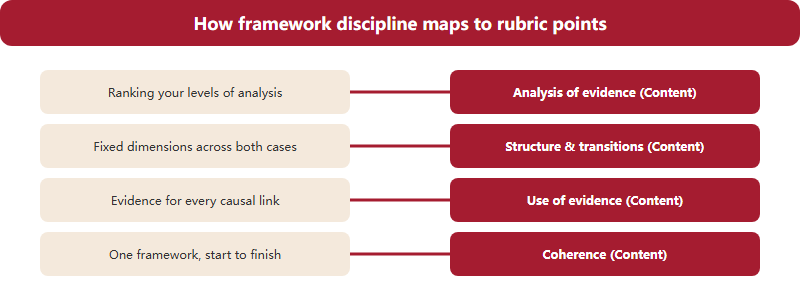
The contest's 60-point rubric allocates 30 points to Content, and among its scored dimensions sit two that students routinely conflate: use of evidence and analysis of evidence. The first asks whether you brought relevant, credible material; the second asks what you did with it. A student can assemble excellent evidence and still score poorly on analysis, because quoting a statistic and then restating it in different words is description, not analysis. (See our full rubric breakdown for how the six Content dimensions divide the 30 points.)
The contest's own editorial principle — it wants “an argument, but not an agenda” — points at the same gap from the other side. An agenda tells the reader what to feel; an argument shows the reader how a conclusion follows from evidence through explicit reasoning. What separates the two, in practice, is whether the writer has a method for reasoning. That is precisely what an analytical framework is: a pre-built structure that forces every piece of evidence to answer the question “so what?”
Professional international-affairs writing leans on a small number of such frameworks. Three of them scale down beautifully to a 1,200-word student essay. None requires university coursework — only discipline in applying one consistently.
Framework 1: Levels of analysis
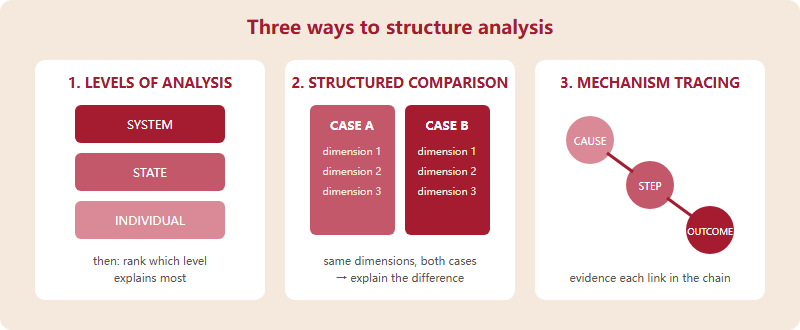
The levels-of-analysis approach, a staple of IR scholarship since Kenneth Waltz's classic three-image formulation, examines a question at distinct levels: the individual (leaders, decision-makers), the state (domestic institutions, politics, economy) and the international system (power distribution, institutions, interdependence). Its power in a short essay is that it converts a vague “why did X happen?” prompt into three sharp, answerable sub-questions — and then lets you argue which level matters most.
How it works in 1,200 words: after your introduction, give one compact section to each level, then spend your final section arguing explicitly that one level carries the most explanatory weight. That last move is what makes this a framework for argument rather than a book report structure: you are not just cataloguing causes, you are ranking them and defending the ranking.
Best suited to: “why” prompts — why a conflict escalated, why a policy failed, why a technology reshaped diplomacy. Watch out for: the temptation to give all three levels equal, neutral treatment. An essay that ends “all three levels matter” has no thesis. Commit.
Framework 2: Structured comparison
Structured, focused comparison — associated in political science with Alexander George's case-study method — takes two cases and examines both against the same set of dimensions. The discipline is in the word “same”: comparing Case A's economics with Case B's politics is anecdote-stacking, not comparison. Pick two or three dimensions before you write, apply each to both cases, and then do the analytical work: explain what accounts for the differences you found.
How it works in 1,200 words: a short setup justifying the case pairing (why these two are comparable at all), one section per dimension covering both cases, and a closing section that converts the pattern of similarities and differences into your thesis. The comparison table you build in your notes usually should not appear in the essay — its logic should be visible in the prose.
Best suited to: prompts about divergent outcomes (why one country's policy worked and a neighbor's failed), and any theme where a contrast makes an abstract trend concrete. Watch out for: case selection bias. If you chose the two cases because they fit your conclusion, a Defense Day judge will find that in about ninety seconds. Choose cases a skeptic would accept as a fair pairing — this is exactly the kind of methodological probing to expect in the 15-minute oral defense, so build your answer now (see our Defense Day preparation guide).
Framework 3: Mechanism tracing
Mechanism tracing — process tracing, in the scholarly literature — answers “how” rather than “why” or “which.” Instead of asserting that cause X produced outcome Y, you break the causal chain into its intermediate steps and bring evidence for each link. It is the most demanding of the three frameworks per word, and the most persuasive when done well, because it leaves a skeptical reader nowhere to hide: to reject your conclusion, they must name which specific link fails.
How it works in 1,200 words: state the claimed chain up front in your introduction — X led to Y through steps 1, 2 and 3 — then give one section per link, each anchored by its strongest single piece of evidence. Close by addressing the most plausible alternative explanation and showing why your chain fits the evidence better. That final move directly feeds the analysis-of-evidence and coherence dimensions of the rubric.
Best suited to: prompts about how a technology, institution or policy produced its effects; anything where the interesting question is the pathway rather than the verdict. Watch out for: chains longer than three links. In 1,200 words, four or more links means each gets a superficial paragraph — trim the chain or narrow the claim.
Choosing your framework — and committing
| Framework | Question type it fits | Word-budget shape | Biggest failure mode | Defense Day probe to expect |
|---|---|---|---|---|
| Levels of analysis | “Why did X happen?” | 3 level sections + 1 ranking section | Refusing to rank the levels | “Why is your chosen level more decisive than the others?” |
| Structured comparison | “Why did outcomes diverge?” | Setup + 2–3 dimension sections + synthesis | Cherry-picked cases | “Why these two cases and not others?” |
| Mechanism tracing | “How did X produce Y?” | Chain statement + 1 section per link + rival explanation | Too many links, thin evidence per link | “Which link is weakest, and what evidence would break it?” |
Match the framework to the prompt's grammatical shape, not to which framework sounds most sophisticated. A “why” prompt bends naturally to levels of analysis; a divergence prompt begs for comparison; a “how” prompt wants tracing. Senior-division entrants choosing among multiple prompts can run this logic in reverse — pick the prompt whose shape fits the framework you can execute best with the evidence you can actually access. (New to how prompts and divisions work? Start with our complete guide to the contest.)
Then commit. The most common framework error in student essays is hybridization: two paragraphs of levels, a stray comparison, half a mechanism. Each framework is a promise to the reader about how the essay will reason; breaking the promise midway reads as incoherence — and coherence is itself a scored rubric dimension.
A worked micro-example
Suppose a Senior-division prompt asks about the global consequences of a new technology. Watch how the same evidence behaves under each framework. Under levels of analysis, a statistic about adoption rates becomes evidence at the state level (why some governments accelerated adoption) and is weighed against system-level pressure (competitive dynamics between powers). Under structured comparison, the same statistic becomes one dimension in a two-country contrast, and the analytical payload is explaining the gap. Under mechanism tracing, it becomes evidence for one link — adoption — in a chain running from invention to geopolitical effect, and its job is to hold that link against a rival explanation.
Same fact, three different analytical uses. That is the entire lesson: evidence does not speak for itself, and the rubric's analysis dimension exists to reward the students who make it speak. Pick the framework that fits your prompt, announce it implicitly through your structure, apply it without wavering for 1,000 words, and you will have written the thing the contest says it wants — an argument, not an agenda.
FAQ
Do judges expect me to name my framework explicitly?
No. The framework should be visible in your structure, not announced with jargon. “This essay uses process tracing” spends words a 1,200-word limit cannot spare; clean section logic shows the same thing.
Are these frameworks only for Senior-division (grades 9–12) entrants?
No. Junior entrants (grades 7–8) writing on the set prompt can use simplified versions — especially structured comparison, which is the most intuitive of the three at any age.
Can I combine two frameworks in one essay?
At 800–1,200 words, almost never. Hybrid essays typically execute both halves thinly and lose coherence points. Commit to one; mention alternatives only when rebutting them.
Do I need to have read Waltz or George to use these methods?
No. The frameworks are described fully here and in any introductory IR text. What judges evaluate is the quality of your application, not citations to methodology literature.
This is an independent guide operated by Hanlin Education for China-based international-school students. It is not affiliated with, endorsed by, or sponsored by the Harvard International Review or Harvard University. Contest rules, rubric details and deadlines change; always confirm current details on hir.harvard.edu. Factual errors reported to us are corrected within 7 working days.