The fastest way to sink an HIR essay is to answer the theme instead of narrowing it. “Global Culture in the Digital Era” — one of the three Senior-division themes in the HIR Academic Writing Contest — is a topic the size of a continent, and an 800-to-1,200-word essay can only defend a small, sharp claim inside it. This guide walks the funnel that turns that vast theme into a single thesis you can prove on the page and hold up under questioning on Defense Day.
Why a broad theme is a trap, not a gift
The Harvard International Review — the student-run international-affairs journal that runs this HIR Academic Writing Contest — publishes broad Senior themes on purpose: they want to see how you frame a problem, not whether you can recite one. For 2026 the three Senior themes are (A) Global Culture in the Digital Era, (B) Security in a Multipolar World, and (C) Technology, Innovation, and Power; the Junior division writes to a single theme instead. Confirm the exact wording for your cycle on hir.harvard.edu, because themes rotate.
The trap is that a theme this wide feels like freedom, so students try to cover it. They write a tour — social media, streaming, language loss, misinformation, K-pop, algorithmic feeds — and touch everything while proving nothing. Judges reading to a rubric that rewards depth of analysis over breadth of coverage give that essay a middling score, because there is no single claim to test. The 1,200-word ceiling is not a limit on your ambition; it is the contest telling you exactly how narrow to go.
The discipline, then, is subtraction. A strong HIR essay does not ask “what is global culture in the digital era?” It asks a question so specific that a smart reader could disagree with your answer — and then it spends every paragraph making that answer harder to dismiss.
The five-step scoping funnel
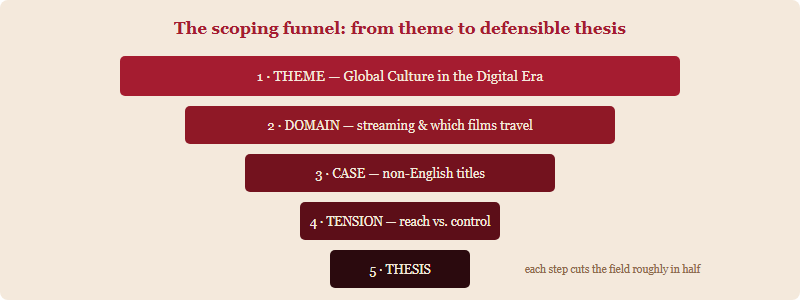
Turning a theme into a thesis is a repeatable narrowing process. We teach China-cohort writers to move down five levels, cutting the field roughly in half at each step, until a debatable claim is all that remains.
| Level | What you decide | Example (Theme A) |
|---|---|---|
| 1. Theme | The given prompt — do not argue at this level | Global Culture in the Digital Era |
| 2. Domain | One slice of the theme you can actually source | How streaming platforms shape which national films travel |
| 3. Case / lens | A specific case, region, or discipline lens | Non-English titles on global streaming catalogues |
| 4. Tension | The genuine conflict or trade-off inside the case | Global reach vs. local creative control |
| 5. Thesis | Your debatable answer to that tension | Global platforms widen a film's audience while narrowing its authorship |
Notice how the claim at Level 5 is something a thoughtful reader could push back on — that is the test. If nobody could disagree with your thesis (“the internet has changed culture”), you have a summary, not an argument, and the analysis lines on the 60-point rubric will have nothing to reward. A defensible thesis names a tension and takes a side.
Three angles that fit Theme A well — and one to avoid
Because Theme A sits at the intersection of culture, technology, and power, some angles produce arguable, well-sourced essays and some collapse into description. Here are three lenses that tend to travel, with the tension each one hands you:
- The distribution lens. Who decides which culture crosses borders now — studios, states, or algorithms? Tension: visibility is not the same as influence. A film can be everywhere and still be shaped by a platform's recommendation logic rather than its makers.
- The preservation lens. Does the digital era protect minority languages and traditions or accelerate their erosion? Tension: the same tools archive and dilute. Avoid a doom narrative; the arguable version weighs both directions.
- The sovereignty lens. When cultural life moves onto foreign-owned platforms, what happens to a state's ability to govern its own public sphere? Tension: cultural reach becomes a form of soft power — and dependency.
The angle to avoid is the mood essay: “social media is changing how young people see the world.” It is true, unfalsifiable, and impossible to defend, because there is no claim a judge can test and no counter-position for you to beat. If you cannot state the opposing view in one sentence, your thesis is not yet arguable.
The Defense-Day test: scope for the room you’ll be in
Scoping is not only about the essay — it is about surviving the fifteen minutes after it. Finalists present and take an oral defense from judges, so a thesis you cannot explain and defend live is a liability no matter how it reads on paper. This is the single best reason to go narrow: you can defend a specific claim about non-English films on streaming platforms; you cannot defend “the internet changed culture,” because the follow-up questions are infinite.
Before you commit to a scope, run the three-question stress test a judge is likely to ask, and make sure your thesis has answers:
| Judge is likely to ask | A narrow thesis can answer | A broad thesis cannot |
|---|---|---|
| “What’s your strongest counter-argument?” | Names one rival reading and rebuts it | Has too many to choose from |
| “What evidence would change your mind?” | Points to a specific, findable fact | Cannot specify — the claim is untestable |
| “Why does this matter beyond your case?” | Scales one clear mechanism outward | Was already everywhere, so has nowhere to go |
If your thesis answers all three cleanly, it is scoped well. If any answer is vague, narrow one more level and test again. For the full walkthrough of the presentation itself, see our guide on how to prepare for HIR Defense Day.
A worked scope, start to finish
Here is the funnel run once, so you can copy the motion. Start at the theme and refuse to write until you reach a claim with a visible opponent.
Theme: Global Culture in the Digital Era. Domain: narrow to how streaming platforms decide which national cinemas reach global audiences — a slice you can actually find evidence for. Case: non-English-language titles that broke out internationally through a global platform. Tension: the platform gave those films an audience no traditional distributor could, but it also shaped what got made next through data, thumbnails, and runtime norms. Thesis: “Global streaming platforms expand the audience for non-English cinema while quietly narrowing its authorship, trading local creative control for global reach.”
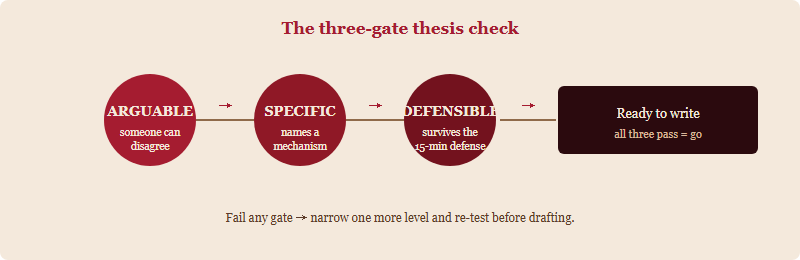
That claim is arguable (someone can reasonably say the trade is worth it or does not happen), specific (it names a mechanism, not a mood), and defensible (you can answer the three stress-test questions). It also fits 1,200 words, because you are proving one exchange — reach for authorship — not surveying an era. Note the analytical verbs: “expand,” “narrowing,” “trading.” A thesis built on flat verbs like “affects” or “changes” usually hides a claim that is still too broad.
A first-party scoping checklist
Before you write a single body paragraph, put your candidate thesis through this list. It is the fastest way to catch a claim that is still too big to defend:
- Can you state the opposing view in one sentence? If not, your thesis is not arguable yet.
- Does the thesis name a mechanism or trade-off — not just a topic? “X shapes Y by doing Z” beats “X and Y.”
- Could you find real, citable evidence for it from a library or reputable source, without inventing data?
- Can you answer all three Defense-Day stress questions above?
- Does it fit 1,200 words — are you proving one claim, not surveying a field?
- Is it written in your own analysis, with no AI-generated drafting? HIR strictly prohibits generative AI and screens for it.
Scope well and the rest of the essay gets easier: the structure almost writes itself once the claim is narrow. When you are ready to build the piece around your thesis, pair this with our guide to the 60-point rubric so every paragraph is aimed at a line that scores.
FAQ
How narrow should an HIR thesis be?
Narrow enough that a smart reader could disagree and you could prove one mechanism in 800-1,200 words. If nobody can argue back, go narrower.
Do I have to use one of the given Senior themes?
Yes — Senior writers choose among the three published themes for their cycle. Confirm the current wording and rules on hir.harvard.edu.
Can I write about a specific country or film?
Yes, a specific case usually scores better than a broad survey, as long as your thesis draws a wider, arguable point from it.
Will judges ask me to defend my scope?
Likely. Finalists take a 15-minute oral defense, so choose a thesis you can explain and defend live, not just on paper.
Ready to enter? →
Turn this into an actual entry — the next steps:
- How to enter the HIR contest — deadlines, word limits and the step-by-step submission
- The contest at a glance — divisions, format and the 60-point rubric in one place
- Read past winning entries — see what a scoring paper actually looks like
This is an independent guide operated by Hanlin Education for China-based international-school students. It is not affiliated with, endorsed by, or sponsored by the Harvard International Review or Harvard University. Themes, word limits, and rules change by cycle — confirm all current details on hir.harvard.edu. We correct any error within 7 working days of notice.