The Harvard International Review (HIR) Academic Writing Contest strictly prohibits ChatGPT and other AI tools, screens every essay through multiple AI checkers, and layers an authenticity review onto the 15-minute Defense Day. A high AI score can mean disqualification. For honest writers the real risk is not getting caught cheating — it is failing to prove that genuinely human work is human. This guide decodes the rule and shows how to build a paper trail that defends your authorship.
What the AI rule actually covers
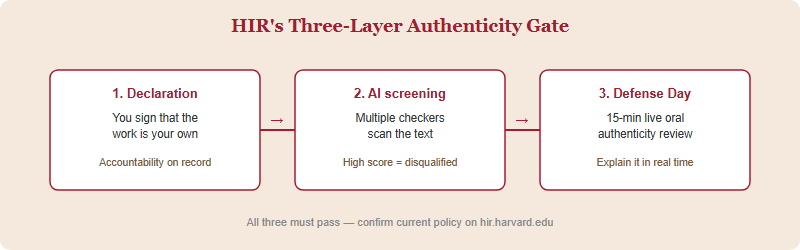
HIR’s policy, as stated on hir.harvard.edu, is unambiguous: the use of AI tools and software in producing your essay is not allowed, submissions are run through AI detection, and high AI-likelihood scores lead to disqualification. The contest also requires an authorship declaration and treats Defense Day as an additional authenticity check. Read together, these create a three-layer integrity gate.
| Integrity layer | What it checks | What it means for you |
|---|---|---|
| Authorship declaration | Your signed statement that the work is your own | You are formally accountable for every word |
| AI detection screening | Multiple AI checkers scan the submitted text | The writing must read as authentically human |
| Defense Day review | A live 15-minute oral defense and authenticity assessment | You must explain and stand behind your essay in real time |
The crucial point: these layers reinforce each other. Even a clean detector score will not save an essay you cannot explain aloud, and a confident defense will not rescue text flagged as machine-generated. The only reliable strategy is to write it yourself and keep the evidence that you did. For how the oral layer works in detail, see our Defense Day preparation guide.
Why honest human writing sometimes trips detectors
AI detectors are probabilistic, not infallible. They estimate how “predictable” text is, and certain habits of careful student writing can read as machine-like — a known limitation, not a verdict on your honesty. Understanding the false-positive triggers lets you write naturally while staying clearly human.
- Over-uniform sentences. Paragraph after paragraph of similar length and rhythm flattens the “burstiness” that detectors associate with human prose. Vary sentence length deliberately.
- Generic, hedged phrasing. Stock transitions and vague summary sentences (“In today’s interconnected world…”) are exactly what models overproduce. Specific claims and concrete examples read as human.
- No distinctive voice or stance. An essay with a real analytical thesis — your angle on the evidence — is harder to mistake for generated filler. This is also where the rubric rewards you.
- Non-native fluency patterns. Highly polished writing by a second-language author can occasionally read as “too clean.” The fix is not to write worse; it is to keep your own examples, your own structure, and a defensible paper trail.
None of this means dumbing down your prose. It means writing with specificity and a genuine argument — the same qualities the contest’s “argument, not an agenda” standard and the 800-1,200 word ceiling already demand. Good, distinctive writing is the best detector-defense there is.
Build a verifiable authorship trail
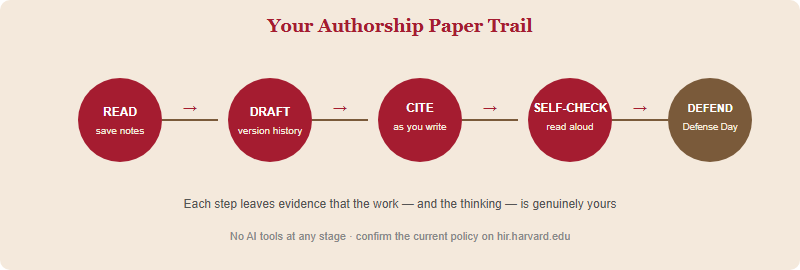
If your work is ever questioned, contemporaneous evidence is what protects you. Treat the paper trail as part of the assignment, not an afterthought. Practical steps any student can take:
| Practice | What it proves | How |
|---|---|---|
| Draft in version history | The essay evolved over time, by you | Write in a tool that keeps revision history; let it autosave across days |
| Keep your research notes | You gathered and read the sources yourself | Save annotated links, quotes, and an outline before drafting |
| Log your sources as you go | Every factual claim traces to a real source | Cite while writing, not at the end; HIR prefers hyperlinked citations |
| Re-read until you can teach it | You understand every line for Defense Day | Practice explaining each paragraph aloud, in your own words |
A revision history that shows messy early drafts, deleted paragraphs, and gradual sharpening is powerful evidence — far more convincing than a single perfect file that appeared at once. It also makes Defense Day easier, because you will remember the choices you made and why.
Where the line sits: research tools vs writing tools
Students often ask where ordinary tools end and prohibited AI begins. HIR’s rule targets AI producing your essay, but you should always read the current official wording before relying on any interpretation. As a conservative working principle:
- Generally fine: a standard spell-checker, a dictionary or thesaurus, a citation formatter, and reading published human-written sources for research.
- Risky or off-limits: generating sentences, paragraphs, outlines, or arguments with a chatbot; “rewriting” or “paraphrasing” your text through an AI tool; or asking AI to summarise sources you then lift.
- When unsure: do not guess. If a tool uses generative AI to produce or reshape your words, treat it as prohibited and confirm on hir.harvard.edu.
The safest mental model: the contest wants to know how you think under a word limit. Anything that puts a machine between your thinking and the page works against both the rule and the rubric. To see how original analysis is rewarded rather than punished, revisit the contest overview.
A pre-submission integrity checklist
Before you submit any cycle, run this quick self-audit. It costs ten minutes and removes the most common authenticity risks:
- Every factual claim has a citation to a reliable source, hyperlinked where possible.
- Sentence lengths and rhythm vary; no long stretch of uniform, generic prose.
- The essay carries a distinct thesis and your own examples — not stock framing.
- You can explain every paragraph aloud without re-reading it.
- Your draft history, notes, and source list are saved in case authorship is reviewed.
- You used no generative AI at any stage, and your authorship declaration is truthful.
Because integrity rules and detection methods evolve, confirm the exact AI policy, declaration wording, and any consequences on hir.harvard.edu before you enter — and never infer the rule from how other competitions handle AI.
FAQ
Can I use Grammarly or a spell-checker?
A basic spell-checker is normally fine, but tools that generate or rewrite text using AI are risky. Read HIR’s current wording and, when unsure, avoid the feature.
What if a detector falsely flags my human essay?
This can happen. Your defense is a saved draft history, research notes, and a confident Defense Day — which is why building that trail matters from the start.
Does the authorship declaration carry consequences?
It makes you formally accountable for the work. Treat it seriously and confirm the exact terms and penalties on hir.harvard.edu.
How does Defense Day catch AI use?
By asking you to explain and defend your essay live. If you genuinely wrote and understood it, the 15-minute review is straightforward.
Ready to enter? →
Turn this into an actual entry — the next steps:
- How to enter the HIR contest — deadlines, word limits and the step-by-step submission
- The contest at a glance — divisions, format and the 60-point rubric in one place
- Read past winning entries — see what a scoring paper actually looks like
This is an independent guide operated by Hanlin Education for China-based international-school students. It is not affiliated with, endorsed by, or sponsored by the Harvard International Review or Harvard University. AI policies, declaration terms, and detection methods change — confirm all current details on hir.harvard.edu. We correct any error within 7 working days of notice.