Most international students treat revision as “read it again and fix typos.” For the HIR Academic Writing Contest, that loses marks you already earned. A first draft and a 60-point-ready essay are different objects, and the gap between them is a structured revision process — not one more read-through. This guide gives China-based ESL writers a five-pass system that fixes the right thing in the right order, cleans AP Style and American spelling, and keeps you safely on the human side of HIR’s strict AI ban.
Why revise in passes (and never all at once)
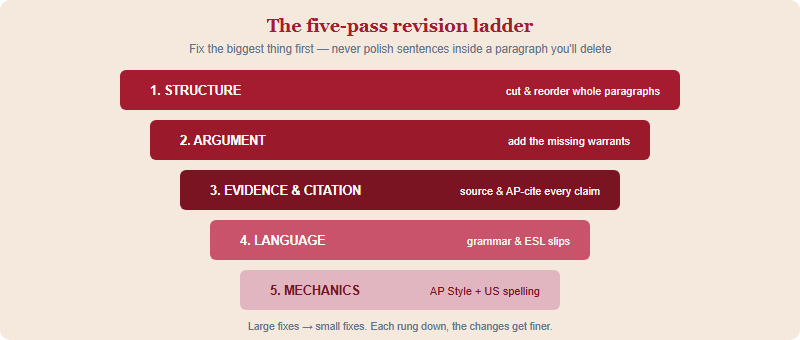
When you try to fix structure, argument, grammar, and spelling in a single read, you fix nothing well — your attention scatters and you end up polishing sentences inside paragraphs that should be deleted. The fix is to revise in layers, largest problem first. Reorganising a paragraph you later cut is wasted effort; correcting a comma in a sentence you later rewrite is wasted effort. Big structural decisions must come before small surface ones.
This matters even more for the HIR contest because of its 800-1,200 word ceiling. A first draft almost always runs long and unfocused; revision is mostly subtraction. If you sharpen sentences before you cut whole sections, you will fall in love with prose you need to delete. Decide what stays before you decide how it reads.
A note on tools first, because it shapes everything below: HIR strictly prohibits generative AI and screens submissions, with high AI-generation scores leading to disqualification. So this entire process is human revision — you, a printout, and a checklist. Do not route any pass through a tool that rewrites or generates text. Confirm the exact AI policy on hir.harvard.edu before you enter, and see our breakdown of what the contest involves if you are new to it.
The five-pass revision ladder
Run these passes in order. Each pass has one job; resist the urge to jump ahead to grammar while you are still deciding structure.
| Pass | Focus | The one question you ask | Rubric area helped |
|---|---|---|---|
| 1. Structure | Order & thesis | Does every paragraph earn its place and serve the thesis? | Structure & coherence |
| 2. Argument | Analysis depth | Does each fact get reasoned about, not just stated? | Analysis of evidence |
| 3. Evidence & citation | Sourcing & AP Style | Is every claim sourced and cited correctly? | Use of evidence |
| 4. Language | Grammar & ESL slips | Is each sentence clear, correct, and varied? | Style |
| 5. Mechanics | AP Style & American spelling | Does it follow AP conventions and US spelling? | Style |
Pass 1-2: get the bones and the argument right
Pass 1 — Structure. Print the draft. In the margin of each paragraph, write its job in three words (“introduces the tension,” “gives counter-case,” “concludes”). If you cannot name a paragraph’s job, it has none — cut or merge it. Then check the order: does the argument build, or does it circle? This is also where you make the hard cuts to get under 1,200 words. For the underlying frame, compare your draft against our guide to structuring an 800-1,200 word HIR essay.
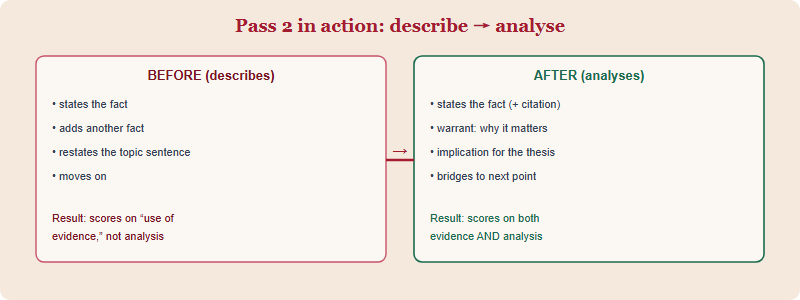
Pass 2 — Argument. Now go paragraph by paragraph and find the warrant — the sentence explaining why your evidence supports your claim. ESL writers, under the pressure of writing in a second language, often default to describing facts rather than interpreting them; this pass is where you add the “so what.” If a paragraph states a fact and moves on, write one or two sentences of reasoning. This single pass usually does more for your score than all the grammar fixes combined, because it feeds the rubric’s analysis line.
Pass 3-5: sourcing, language, and AP mechanics
Pass 3 — Evidence & citation. Highlight every factual claim. Each one needs a reliable source, cited in AP Style — HIR prefers hyperlinked citations to digital sources, while non-digital sources must still be cited properly. If a claim has no source, either find one or soften the claim. Our guide on sourcing your argument in AP Style covers the citation mechanics in detail.
Pass 4 — Language. Now, and only now, fix grammar and clarity. Below are the slips we see most often from China-cohort writers; scanning specifically for these is faster than a vague “check the grammar.”
| Common ESL slip | Quick fix in revision |
|---|---|
| Missing or wrong articles (a / an / the) | Read each noun aloud; decide specific (the) or general (a/none) |
| Subject-verb agreement on long sentences | Find the real subject, match the verb, ignore the words between |
| Run-on sentences joined by commas | Split into two sentences or use a proper connector |
| Uniform sentence length (all long or all short) | Vary rhythm; follow a long sentence with a short one |
| Vague connectors (“moreover,” “in addition” everywhere) | Use precise links: “because,” “yet,” “as a result” |
| Translating an idiom literally from Chinese | Replace with plain, literal English; clarity beats flourish |
Pass 5 — Mechanics. The final, narrow pass: AP Style conventions and American spelling. Switch “-ise” to “-ize” where US usage calls for it, “colour” to “color,” “centre” to “center”; check number style, titles, and punctuation against AP’s newest edition. Confirm the exact style expectation on hir.harvard.edu, and remember diagrams, tables, and the authorship declaration sit outside your word count — so a clarifying table is a legitimate way to save words for analysis.
The ESL trap: don’t over-polish into “AI English”
Here is the counter-intuitive warning that matters most for non-native writers. The instinct is to sand every sentence until the prose is flawless and uniform. Resist it. HIR screens for AI-generated text, and the writing that trips detectors is often exactly the smooth, generic, evenly-cadenced English that an over-polished ESL draft can drift toward. Your goal is clear, correct, and recognisably yours — not anonymous perfection.
It helps to separate two things you might call “good English.” One is correctness — articles, agreement, tense, spelling. The other is texture — the specific word choices, examples, and turns of thought that mark a real person reasoning on the page. Fix correctness ruthlessly; protect texture. The danger for ESL writers is using a tool to manufacture texture you did not write, which both breaks the AI rule and strips out the human fingerprint judges and detectors look for. A slightly imperfect sentence that is unmistakably yours is worth more here than a perfect one that could have come from anywhere.
Practical guardrails as you revise:
- Keep your own examples and framing. A specific, slightly idiosyncratic argument reads human; stock phrasing reads machine.
- Let some variation stand. Natural human prose has uneven rhythm. You are fixing errors, not erasing personality.
- Never run a pass through a generative tool. A basic spell-checker is usually fine, but anything that rewrites or generates sentences is both against the rules and a fast route to generic text. When unsure, do it by hand.
- Save your trail. Keep dated drafts, notes, and your source list. If authorship is ever reviewed, that history — plus a confident Defense Day — is your proof.
Because you will defend this essay live, revision and Defense Day prep are really one project: every warrant you add in Pass 2 is a question you can now answer aloud. Rehearse explaining your sharpened paragraphs using our Defense Day preparation guide, and check your finished draft against the 60-point rubric one last time before you submit.
A final pre-submission pass
When the five passes are done, run this short final check. It catches the things that slip through when you have read your own work too many times:
- Word count is within 800-1,200 (excluding diagrams, tables, and the authorship declaration).
- Every paragraph has a nameable job and a visible warrant.
- Every claim is sourced and AP-cited; hyperlinks work.
- Spelling is American throughout; AP conventions are consistent.
- You used no generative AI, your declaration is truthful, and you can defend every line aloud.
- You have re-confirmed format, AI policy, and deadlines on hir.harvard.edu for your cycle.
FAQ
How many times should I revise an HIR essay?
Plan at least the five focused passes above plus a final check — more for a first attempt. Revise in layers, biggest problem first, not all at once.
Can I use Grammarly or autocorrect to fix my English?
A basic spell-checker is usually fine, but tools that rewrite or generate text risk both the AI ban and generic prose. When unsure, revise by hand and confirm the policy on hir.harvard.edu.
Will polishing my English make it look AI-written?
It can if you flatten everything into uniform, generic prose. Fix errors but keep your own examples, framing, and natural rhythm.
Which revision pass matters most for my score?
Usually the argument pass, where you add reasoning to each fact. It feeds the analysis line, which carries more weight than surface polish.
Ready to enter? →
Turn this into an actual entry — the next steps:
- How to enter the HIR contest — deadlines, word limits and the step-by-step submission
- The contest at a glance — divisions, format and the 60-point rubric in one place
- Read past winning entries — see what a scoring paper actually looks like
This is an independent guide operated by Hanlin Education for China-based international-school students. It is not affiliated with, endorsed by, or sponsored by the Harvard International Review or Harvard University. AI policy, AP Style expectations, word limits, and deadlines change — confirm all current details on hir.harvard.edu. We correct any error within 7 working days of notice.