Getting shortlisted for the HIR Academic Writing Contest changes the job entirely. You stop being a writer and become a presenter: finalists deliver a 15-minute virtual presentation and oral defense to judges, which means your carefully edited essay now has to survive being explained and questioned live. This guide gives you a slide-by-slide architecture, a defensible time budget, and a map of the questions judges tend to ask — so you walk into the session with a plan instead of hope.
What Defense Day actually is — and what to confirm
The Harvard International Review — the student-run international-affairs journal behind this HIR Academic Writing Contest — invites finalists to a 15-minute presentation and oral defense held in virtual sessions. Beyond that, the operational specifics (whether slides are required or optional, the exact split between speaking and questions, platform, and scheduling) are set by HIR for each cycle. Treat everything below as a rehearsal framework, not an official rulebook, and confirm the current format on hir.harvard.edu before you build anything.
Here is the mindset shift that matters most: Defense Day is not a re-reading of your essay. Judges have already read it. The fifteen minutes exist to test whether the thinking is yours — whether you can defend the argument, handle a counter-point, and reason on your feet. That is also why HIR’s ban on generative AI extends into the defense: a live conversation is very hard to fake if the words on the page were not your own. If you wrote the essay yourself, Defense Day is your advantage, not your threat.
A time budget for fifteen minutes
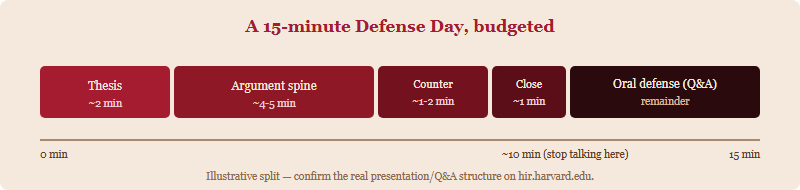
Assume, until HIR tells you otherwise, that the fifteen minutes are shared between a presentation and questions — so do not plan to talk for the full window. A safe working split is to prepare roughly eight to ten minutes of presentation and leave the rest for defense. Rehearse to the shorter end; nerves make people speed up, but a judge cutting you off because you over-ran is a bad first impression.
| Segment | Rough time | Your goal |
|---|---|---|
| Thesis & stakes | ~2 min | State the claim and why it matters — no throat-clearing |
| Argument spine | ~4-5 min | Walk 2-3 pillars, each with one piece of evidence and its analysis |
| Counter-argument | ~1-2 min | Name the strongest objection and answer it before a judge does |
| Close | ~1 min | Restate the claim, one sentence on implications |
| Oral defense (Q&A) | remainder | Reason out loud; concede honestly; stay on your thesis |
The single most common finalist mistake is spending twelve minutes re-narrating the essay and leaving no room to actually defend it — which is the part judges are scoring. Build your presentation so that if you had to stop at the eight-minute mark, the argument would still be complete.
A slide architecture that mirrors your essay
If slides are permitted, keep them minimal — they are a map for the judge, not a teleprompter for you. A workable set is six to eight slides, one idea each, echoing the structure of your essay so a judge can follow the connection between what they read and what they are hearing. Text on a slide should be a headline, not a paragraph; the analysis lives in your voice.
| Slide | Content | What it is NOT |
|---|---|---|
| 1. Title | Essay title, division, your first name only if instructed | A wall of text |
| 2. Thesis | Your one-sentence claim, verbatim | A vague topic label |
| 3-5. Pillars | One argument each: claim + the key evidence | Your paragraphs pasted in |
| 6. Counter | The strongest objection + your rebuttal in a line | Skipped — judges will raise it anyway |
| 7. So what | Implications / why the claim matters | A summary of everything again |
| 8. References | Your key sources, briefly | An afterthought |
One discipline saves more finalists than any design tip: never read your slides. Judges can read faster than you can speak, and a presenter reading text aloud signals a script rather than command of the material. Put a headline on the slide and say the reasoning out loud — the same warrant-and-implication reasoning that earns marks in your essay, now performed. If you want to see how that reasoning is built at the paragraph level so you can speak it fluently, revisit the 60-point rubric, which rewards the same analysis live that it rewards on the page.
The questions judges actually ask
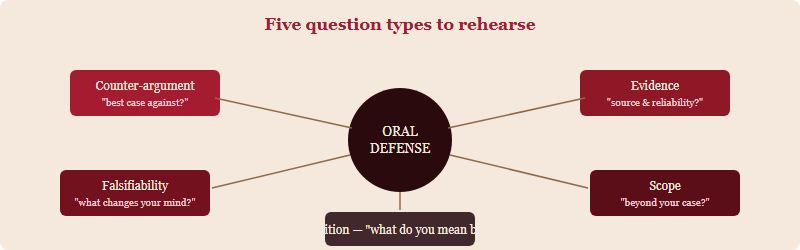
The oral defense is not random. Most questions fall into a handful of predictable types, and you can prepare a genuine answer to each before the session. Rehearse saying these out loud — the goal is not a memorised script but a reflex for reasoning under a little pressure.
- The counter-argument probe: “What’s the best case against your thesis?” Have one ready and rebut it. Never pretend your argument has no weaknesses.
- The evidence probe: “Where does that figure come from, and how reliable is it?” Know your sources well enough to speak to them — this is where clean sourcing pays off.
- The falsifiability probe: “What would change your mind?” A strong answer names specific evidence; “nothing” is the wrong answer.
- The scope probe: “Does this hold beyond your one case?” Scale your mechanism carefully; concede limits honestly.
- The definition probe: “What exactly do you mean by [key term]?” Have crisp definitions for the two or three load-bearing words in your thesis.
There is a right way to handle a question you cannot fully answer: think out loud, concede what you do not know, and reason toward the best available answer. Judges are testing how you think, not whether you are infallible. A candid “I don’t have data on that, but here’s how I’d reason about it” beats a confident guess that collapses on the follow-up.
A one-week rehearsal plan
Presentation nerves shrink with reps. If you have roughly a week before your session, this schedule turns a shaky first run into a steady one:
- Day 1-2: Draft the deck (or speaking notes). Write your thesis and counter-argument slides first; they anchor everything.
- Day 3: Full run-through out loud, timed. Cut whatever pushes you past ten minutes of talking.
- Day 4: Have someone play judge and fire the five question types at you. Note where you froze.
- Day 5: Rebuild the two or three answers that were weakest; re-time the presentation.
- Day 6: Practice your video setup — camera, microphone, quiet room, stable connection, screen-share if you are using slides.
- Day 7: One calm final run. Sleep; do not cram new material.
For the broader preparation checklist — mindset, what to bring, and how the defense connects back to your written argument — pair this with our full guide on how to prepare for HIR Defense Day. The essay got you into the room; the rehearsal is what wins it.
FAQ
How long is HIR Defense Day?
Finalists deliver a 15-minute virtual presentation and oral defense. The internal split between talking and questions is set by HIR — confirm it on hir.harvard.edu.
Do I need slides for Defense Day?
Whether slides are required or optional is HIR’s call each cycle. If allowed, keep them minimal — a headline per slide, not your paragraphs. Verify on the official site.
What do judges ask in the oral defense?
Expect probes on your counter-argument, your evidence and its sources, what would change your mind, scope, and key definitions. Prepare a real answer to each.
What if I can’t answer a question?
Reason out loud and concede honestly. Judges score how you think, so a candid, logical attempt beats a confident guess that unravels.
Ready to enter? →
Turn this into an actual entry — the next steps:
- How to enter the HIR contest — deadlines, word limits and the step-by-step submission
- The contest at a glance — divisions, format and the 60-point rubric in one place
- Read past winning entries — see what a scoring paper actually looks like
This is an independent guide operated by Hanlin Education for China-based international-school students. It is not affiliated with, endorsed by, or sponsored by the Harvard International Review or Harvard University. Defense Day format, timing, and rules are set by HIR and change by cycle — confirm all current details on hir.harvard.edu. We correct any error within 7 working days of notice.