The fastest way to write a forgettable HIR essay is to pick a theme — say “Technology, Innovation, and Power” — and start writing about all of it. The HIR Academic Writing Contest gives you a broad theme but also publishes 13 eligible subject categories, and the smartest move is to use one of those categories as a lens to cut a giant theme down to a single, defensible topic. This guide shows international students how to choose that lens and scope a topic you can actually argue in 800-1,200 words.
Theme vs category vs topic: three different things
Students conflate these and then drift. They are distinct layers, and naming them fixes most scoping problems:
- Theme — the broad container HIR sets for the cycle. Seniors (grades 9-12) typically choose among options such as Global Culture in the Digital Era, Security in a Multipolar World, and Technology, Innovation, and Power; the Junior division (grades 7-8) has its own theme, e.g. Inventions that Changed How We Live. Always confirm the current cycle’s exact themes on hir.harvard.edu.
- Category — the subject domain your essay sits in. HIR’s eligible categories give you 13 disciplinary lenses to choose from (listed below).
- Topic — the specific, narrow question you actually argue. This is what you invent, by crossing a theme with a category and then sharpening.
A theme is a country; a category is a road into it; a topic is the single street you walk. The contest is won at the topic layer — and the category is the tool that gets you there. If you have not yet locked your division and theme, start with our guides on Junior vs Senior division and the HIR contest overview, then come back to scope the topic.
The 13 categories — and what each rewards
Per hir.harvard.edu, the eligible subject categories are the following. Each one carries a different kind of argument; choosing deliberately is half the battle.
| Category | What an essay here tends to reward | Watch out for |
|---|---|---|
| Agriculture | Food security, supply chains, climate-yield links | Staying descriptive about farming |
| Business | Market structure, strategy, corporate power | Reading like a case-study summary |
| Cybersecurity | Threat models, deterrence, digital sovereignty | Jargon without a clear stake |
| Defense | Strategy, alliances, force posture | Becoming a weapons catalogue |
| Education | Access, policy, human-capital effects | Personal-anecdote drift |
| Employment & Immigration | Labour markets, mobility, demographics | Over-broad “globalisation” claims |
| Energy & Environment | Transition, resource politics, climate policy | Restating well-known crisis facts |
| Finance & Economy | Macro forces, currencies, financial power | Charts without interpretation |
| Public Health | Systems, pandemics, health governance | Medical detail over policy analysis |
| Science & Technology | Innovation, governance of tech, power shifts | Gadget enthusiasm, no argument |
| Space | Orbital governance, security, commercial space | Sci-fi framing over real policy |
| Trade | Tariffs, blocs, supply-chain politics | Listing agreements without a thesis |
| Transportation | Infrastructure, logistics, connectivity power | Engineering detail over analysis |
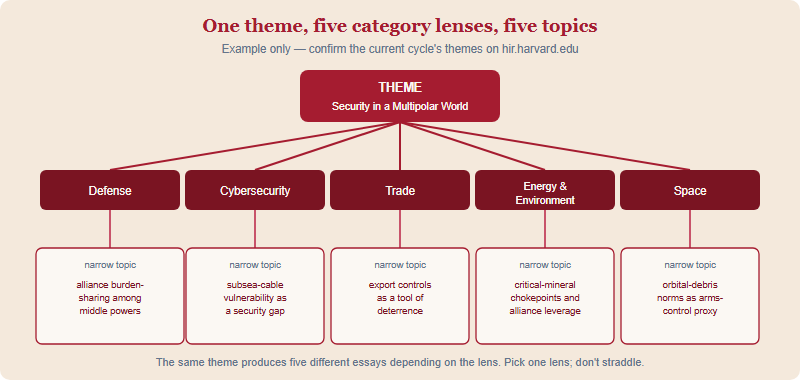
Two practical truths fall out of this list. First, several categories overlap any given theme — “Security in a Multipolar World” can be entered through Defense, Cybersecurity, Trade, Energy & Environment, or Space. Second, the less-crowded categories (Agriculture, Transportation, Space) are often where a sharp international student finds a defensible, distinctive angle that the field over-looks.
A four-step funnel from theme to defensible topic
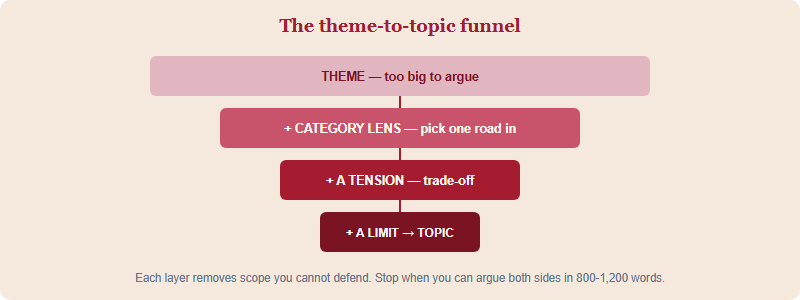
Use this sequence once you know your theme. It moves you from a continent-sized subject to a street you can defend in 15 minutes:
- Step 1 — Pick one category lens. Read the theme, then choose the single category whose questions you find most interesting. Interest is not a luxury here; on Defense Day you must talk about this for 15 minutes, so genuine curiosity is a strategic asset.
- Step 2 — Name a tension. Inside that lens, find a real conflict or trade-off — security vs openness, growth vs equity, speed vs control. A defensible thesis lives on a tension, not a fact.
- Step 3 — Bound it. Add a limiter: a region, a time window, a specific actor, or a single mechanism. “Cyber threats” is unwriteable; “subsea-cable vulnerability as a security gap for island states” is a topic.
- Step 4 — Stress-test it. Ask: can I argue both sides? Can I find evidence in AP-citable sources? Can I defend it aloud? If any answer is no, widen or narrow by one notch.
Step 4 deserves a special emphasis because of how this contest ends. Unlike most writing competitions, HIR finalists face a 15-minute oral Defense Day, so your topic is not just something you write — it is something you must hold up under live questioning. The simplest test: before you commit, try to spend two minutes explaining your topic aloud to someone who disagrees with you, and have them push back. If you find yourself reaching for the one fact you memorised and then going quiet, the topic is too thin or too one-sided. A topic built on a genuine tension gives you somewhere to go when a judge presses, because you already know the strongest version of the opposing view. We walk through that live test in detail in our guide to preparing for HIR Defense Day — choose a topic that survives it, not just one that reads well on the page.
Which lenses travel for China-based international students
A first-party note from coaching China-cohort writers: the strongest essays use a discipline lens the student can actually source and defend, not the one that sounds most impressive. A few patterns we see repeatedly:
- Lean into what your curriculum already gives you. Economics and Business students often write sharper Finance & Economy or Trade essays because they can read the data critically. Bio/chem students do well in Public Health or Energy & Environment. Use the subject you can interrogate, not just describe.
- Use a regional vantage point as an asset, not a crutch. An Asia-Pacific or China-adjacent angle (supply chains, critical minerals, regional connectivity) can make a topic distinctive — but the argument must still be analytical and balanced, never an advocacy piece for one side. HIR rewards “argument, not an agenda,” which we unpack in our argument-not-agenda guide.
- Mind sourcing reach. Because citations must follow AP Style and ideally hyperlink to reliable sources, choose a lens where you can reach credible English-language evidence. A brilliant topic you cannot source well will stall at the evidence line.
- Match the lens to the division. Junior writers (grades 7-8) working the “inventions” theme usually do best with a concrete Science & Technology or Transportation angle they can explain plainly; Seniors can carry more abstract Defense, Finance, or Cybersecurity arguments.
None of this guarantees a result, and you should never pick a category just to seem strategic — pick the one whose questions you would happily defend out loud. That instinct, more than any trick, is what separates a topic that survives Defense Day from one that collapses under the first follow-up question.
Five scoping mistakes that sink good ideas
- Straddling two categories. An essay that is half Defense and half Trade rarely satisfies either. Commit to one lens.
- Choosing a topic with no real opposing view. If everyone agrees, there is nothing to argue — and nothing for the rubric’s analysis line to reward.
- Picking the theme’s most obvious headline. The crowded angle invites comparison with hundreds of similar essays; a precise sub-question stands out.
- Scoping so narrow you run out of evidence. Bound it, but leave enough sourced material to fill 800-1,200 words of analysis.
- Confirming nothing officially. Themes, categories, and divisions can change by cycle — verify the current set on hir.harvard.edu before you commit weeks to a draft.
Once your topic survives the funnel and the stress-test, you are ready to build the essay around it — see how to structure an 800-1,200 word HIR essay and how the 60-point rubric scores the analysis your scoped topic makes possible.
FAQ
How many subject categories does the HIR contest have?
HIR lists 13 eligible categories, from Agriculture to Transportation. Confirm the current list on hir.harvard.edu, as it can change by cycle.
Do I pick a category or a theme?
Both, in order: choose your division’s theme, then use one category as a lens to narrow it into a specific, defensible topic.
Should I choose a less-popular category to stand out?
It can help, but only if you can source and defend it. A distinctive lens you genuinely understand beats a safe one you can’t analyse.
Can my topic blend two categories?
Lead with one lens for focus. You can reference an adjacent category for evidence, but a topic that straddles two often loses analytical sharpness.
Ready to enter? →
Turn this into an actual entry — the next steps:
- How to enter the HIR contest — deadlines, word limits and the step-by-step submission
- The contest at a glance — divisions, format and the 60-point rubric in one place
- Read past winning entries — see what a scoring paper actually looks like
This is an independent guide operated by Hanlin Education for China-based international-school students. It is not affiliated with, endorsed by, or sponsored by the Harvard International Review or Harvard University. Themes, categories, divisions, and rules change — confirm all current details on hir.harvard.edu. We correct any error within 7 working days of notice.