Independent Preparation Guide Disclaimer: This is an independent preparation guide not affiliated with or endorsed by Harvard International Review or Harvard University. It is not an official Harvard College programme.
When preparing for the Harvard International Review (HIR) Academic Writing Contest, students often struggle with the final component of their essay: the policy recommendation. A common pitfall is writing a detailed analysis of a global issue—such as digital cultural homogenization or supply chain security—and then appending a generic call to action that does not logically follow from the evidence presented. For the 2026-27 contest cycles, where Senior Division themes include Global Culture in the Digital Era, Security in a Multipolar World, and Technology, Innovation, and Power, judges look for coherence between the problem identified and the solution proposed. This article addresses how to ensure your policy recommendation connects directly to the specific mechanism you explained, rather than serving as an unrelated afterthought.
The Disconnect Between Analysis and Recommendation
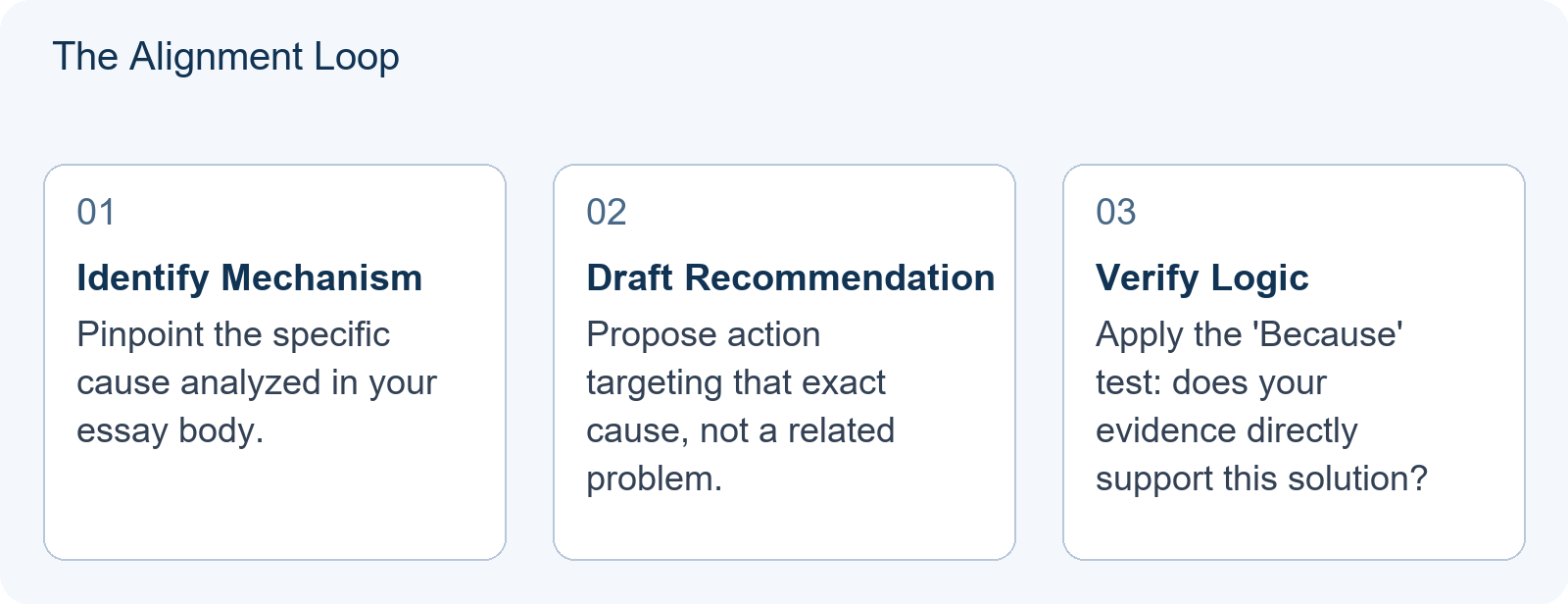
In academic writing competitions like HIR, the body of the essay establishes a causal link or a descriptive pattern. The conclusion must then leverage this established logic to suggest a remedy. If your analysis focuses on how algorithmic bias reinforces existing power structures in technology, but your recommendation calls for “increasing international cooperation,” the connection is weak. The reader cannot see how cooperation specifically addresses algorithmic bias. Successful entries treat the recommendation as the inevitable next step of the argument. The proposal must target the exact variable or relationship you spent 800-1,200 words proving was problematic.
This challenge is particularly acute for students who have developed strong research skills but have not yet learned to translate analysis into prescription. The HIR contest evaluates both content and style, with logical coherence serving as an implicit foundation for both categories. A disconnected recommendation undermines the very analysis it should crown, suggesting that the writer either does not understand the implications of their own evidence or has resorted to generic conclusion templates. For guidance on identifying whether your essay suffers from a broader structural problem—such as describing facts rather than building an argument—see When Your HIR Essay Is a Fact Tour: A Three-Layer Test for Answering the Prompt.
Worked Teaching Illustration: Aligning Scope and Solution
[Teaching Illustration—Fictional Scenario for Pedagogical Purposes]
To demonstrate this alignment, consider a hypothetical teaching example based on the Senior Division theme Global Culture in the Digital Era. Suppose a student argues that streaming platforms prioritize content from English-speaking markets, leading to the marginalization of local languages in Southeast Asia. The analysis details market share data and user engagement metrics showing a decline in regional content visibility.
A superficial recommendation might be: “Governments should subsidize local film industries.” This addresses production capacity but does not directly engage with the digital distribution bottleneck identified in the analysis. Subsidies may increase local content production, but they do not necessarily change how algorithms rank or display that content on global platforms. The mechanism identified was platform-level algorithmic prioritization, not production-level funding shortage. However, production subsidies could indirectly affect distribution if tied to requirements for platform placement or if they enable creators to negotiate better terms—pathways the essay would need to explicitly trace.
An aligned recommendation would be: “Regulatory frameworks should require transparency in algorithmic ranking criteria for non-English content, allowing users to opt into regionally curated feeds.” This proposal directly targets the mechanism (algorithmic prioritization) described in the analysis. It uses the evidence provided (marginalization due to platform design) to justify a specific intervention (transparency and user control). This logical tightness is what distinguishes high-scoring HIR essays from average ones.
Important caveat: Transparency requirements alone do not change algorithmic behavior. They enable external monitoring and user choice, but actual harm reduction depends on implementation details (who audits, how often, with what enforcement), evaluation metrics, and tradeoffs (potential chilling effects on innovation, compliance costs for smaller platforms). A complete essay would acknowledge these gaps.
The student who wrote this aligned version could defend it during HIR Defense Day in Your Second Language: A Spoken-English Playbook for China-Based Finalists (2026) by explaining exactly how transparency requirements alter the information environment that currently disadvantages local content. The student with the superficial version would struggle to explain why subsidies affect platform algorithms, because they do not directly—a gap the student would need to bridge with additional argumentation.
Contrasting Case: When Broad Themes Require Specific Actions
[Teaching Illustration—Fictional Scenario for Pedagogical Purposes]
Conversely, consider a mismatch in the Security in a Multipolar World theme. Imagine an essay analyzing how cyberattacks on critical infrastructure are increasingly state-sponsored but deniable. The analysis proves that traditional military deterrence fails because attribution is difficult—victims cannot retaliate against actors they cannot identify, and public accusations without proof damage diplomatic credibility.
If the student recommends “strengthening national cybersecurity defenses,” the recommendation is partially relevant but incomplete. Defenses reduce harm from attacks but do not address the attribution problem that prevents deterrence from functioning. The recommendation is not categorically irrelevant—defenses may be necessary complementary measures—but it does not engage the core analytical finding about deterrence failure.
A better-aligned recommendation would focus on “establishing international norms for rapid, independent attribution of cyber incidents,” which directly addresses the denial problem. By linking the solution to the specific weakness in current deterrence models (attribution), the essay demonstrates deeper analytical rigor. Even here, the student should acknowledge that attribution norms do not eliminate state-sponsored attacks; they merely reduce the deniability window, with effectiveness depending on technical capacity and political will.
This contrast illustrates a broader principle: the specificity of your recommendation should match the specificity of your analysis. If you identified a precise mechanism, your solution must target that mechanism. If you identified a broad trend, your recommendation can be more general—but broad trends alone rarely earn high marks in HIR, where the rubric rewards nuanced, evidence-based argumentation. For techniques on narrowing broad themes into defensible theses, see HIR Theme A for China-Based Writers: Finding Local Angles on Global Culture in the Digital Era.
Diagnostic Check: The “Because” Test
Students can use a simple diagnostic tool called the “Because” test to verify logical coherence between their recommendation and analysis. After drafting the conclusion, insert the word “because” between the recommendation and the main thesis. For example: “We recommend algorithmic transparency because our analysis showed that opaque ranking systems marginalize local cultures.” If the sentence makes logical sense without forcing new information, the connection is coherent. If it requires adding entirely new premises, the recommendation is disconnected.
This method helps identify gaps in reasoning before submission. It ensures that every element of the policy proposal is supported by the preceding paragraphs. However, the “Because” test checks logical coherence, not real-world effectiveness. A recommendation can be perfectly coherent yet practically unworkable. Additional evaluation of feasibility, tradeoffs, and implementation pathways is necessary for complete argumentation.
A secondary diagnostic asks whether your recommendation could apply to a different essay with a different analysis. If the answer is yes, your recommendation is likely too generic. “Strengthening national cybersecurity defenses” could conclude almost any essay about digital security; “requiring algorithmic transparency for non-English content” applies specifically to essays about algorithmic marginalization of local languages.
Integrating Evidence Types into Recommendations
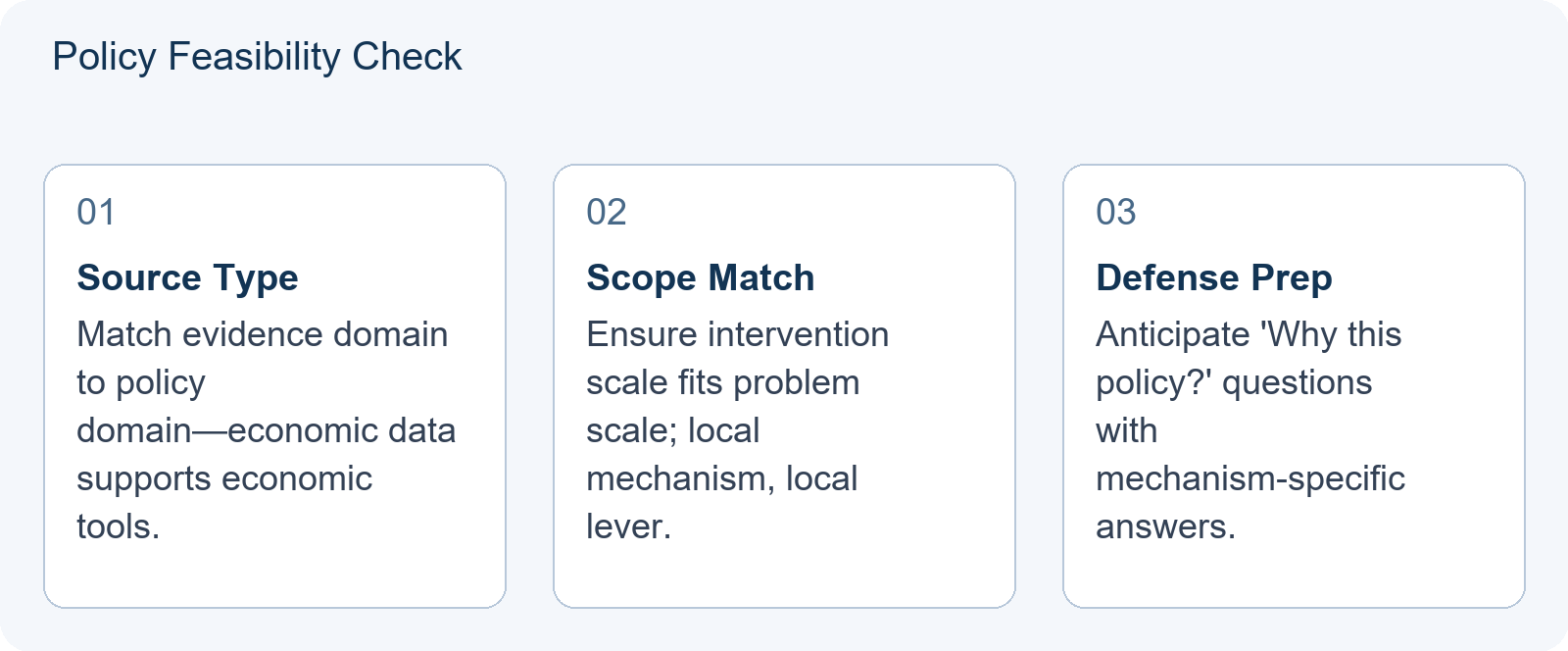
HIR essays rely on credible sources such as reports from the UN, World Bank, or major think tanks. Your recommendation should reflect the nature of this evidence. If your data comes from economic models, your policy suggestion should address economic feasibility. If your evidence is sociological, the policy should address social behavior or institutional culture.
For instance, if citing a study on youth unemployment in post-conflict zones, a recommendation to “increase foreign aid” might be less effective than “implement vocational training programs linked to private sector apprenticeships,” if the cited study emphasized skills mismatches over funding shortages. Matching the type of evidence to the type of solution strengthens the persuasive impact. The HIR contest requires AP Style for editorial conventions (spelling, capitalization, numbers, titles), while citations should follow a recognized academic format with full bibliographic information. Your recommendation should acknowledge the evidentiary basis explicitly: “Given findings that skills mismatches account for a significant share of youth unemployment in post-conflict settings, donor programs should consider apprenticeship bridges rather than unconditional transfers.”
Preparing for Defense Day Questions
Finalists in the HIR contest participate in Defense Day, where they answer questions about their work. Judges frequently ask, “Why did you choose this specific policy?” If your recommendation is disconnected from your analysis, you will struggle to defend it. However, if your proposal flows logically from your findings, you can easily explain the rationale. Preparation should include rehearsing these connections aloud, ensuring you can articulate why the proposed action solves the specific problem defined in the essay.
Practice with a peer or mentor who has not read your essay. Ask them to identify your recommendation and your core mechanism. If they cannot connect the two, neither will a judge. This external validation step catches logical gaps that familiarity with your own argument might obscure.
From Diagnosis to Next Steps
Students who apply the “Because” test and find their recommendation disconnected have several paths forward. They may need to revise the recommendation to match their analysis, or they may need to expand their analysis to support the recommendation they prefer. Either approach is valid, but the revision must be thorough. A common error is to tweak the recommendation slightly while leaving the analysis unchanged—this often produces a different-sounding but equally disconnected conclusion.
For students preparing for the 2026-27 HIR cycles, the critical skill is not merely writing well-researched analysis but ensuring that every paragraph serves the eventual policy recommendation—or, if the essay’s purpose is descriptive rather than prescriptive, ensuring that purpose is clear and consistently executed. Not every HIR essay need propose policy; descriptive analysis may be valid depending on the prompt and the writer’s argument. For essays that do propose recommendations, research should be selective: evidence that does not illuminate your target mechanism should be set aside, however interesting it may be. The discipline of scope—saying enough about the right thing rather than everything about a broad topic—separates medalists from participants.
Frequently Asked Questions
Can I propose multiple policy recommendations?
It is generally better to focus on one strong, well-supported recommendation that directly addresses the core argument. Multiple shallow suggestions dilute the impact and make it harder to defend during the oral presentation. If the problem genuinely requires multiple interventions, present them as coordinated components of a single strategy, with each component linked to a distinct part of your analysis.
What if my analysis shows no clear solution?
If the problem is complex, acknowledge the limitations. Propose a small, feasible step or a framework for future research rather than a grand, unsupported fix. Honesty about complexity is valued in academic writing. Alternatively, ensure your essay’s purpose is clearly descriptive rather than prescriptive, and that this purpose is signaled early and maintained throughout.
Do I need to cite sources for my recommendation?
If your recommendation relies on specific precedents, data, or theoretical frameworks mentioned earlier, reference them. If it is a novel idea derived from your analysis, clearly state the logical derivation from your previous points. The HIR rubric rewards evidence-based argumentation throughout, including the conclusion. Note that AP Style governs editorial conventions (spelling, capitalization, numbers), while citations should follow a recognized academic format with full bibliographic information.