If a Defense Day judge asks what would change your mind, answer in 45–60 seconds with three parts: the evidence that would count, where that evidence would come from, and exactly how far your thesis would move. The goal is a bounded revision, not a full retreat. For the Fall/Winter 2026 cycle, the HIR contest page lists Defense Day as 5 February 2027 and says finalists may be invited to a 15-minute presentation and oral defense.
Why the question tests command of the thesis
A Defense Day conversation is not a viva on everything you know about international affairs. It is a check on whether you can stand behind a specific analytical claim. The contest page describes HIR writing as analytical international-affairs articles rather than op-eds or collections of facts. That distinction matters here. An op-ed can survive on conviction; an analysis has to specify a mechanism, a scope and a set of conditions under which the claim would fail.
“What would change your mind?” is a compact way of asking for those conditions. It is not an invitation to perform doubt, and it is not a trap designed to make you abandon your essay. If you say nothing could change your mind, you imply the claim is not testable. If you say any study would change it, you imply there was no thesis in the first place. The strong answer keeps the thesis visible while exposing its joints.
The question below is a teaching illustration. HIR’s public contest information describes the presentation and oral defense format; the question here is an original practice prompt. Prepare the structure rather than memorised wording. The essay-level version of the same skill is steelmanning the objection in the essay itself: state the strongest opposing case before you answer it.
A worked 45–60 second answer
The claim, the counterfactual and the answer below are invented for practice. They are not an official HIR prompt, a reported judge question or a real student case.
Suppose your essay argues: “National data-localisation rules in Southeast Asia have raised compliance costs for small digital firms without a measurable improvement in breach-notification times, and the burden falls hardest on firms without in-house counsel.” The judge asks: “What evidence would change your mind?”
“Three things would move me. First, comparable regulator data across the economies I discuss, tracking small firms before and after enforcement, not just large firms. If it showed compliance costs below about 1% of revenue and breach-notification times falling from 30 days to 12 after the rule, I would drop the ‘without measurable improvement’ half of my claim. Second, I would want the comparison to separate firms with in-house legal teams from those without, because my distributional point is about firms that cannot absorb fixed costs. Third, I would check whether the improvement came from the rule or from a simultaneous breach-disclosure law. If the gain survives those checks, I would narrow the thesis to the distributional claim I would still defend: the compliance burden is uneven, and any improvement has to be shown to reach firms without in-house counsel. I would not defend the original blanket claim.”
The answer works because it does not treat “changing your mind” as a single switch. It identifies a trigger—a pre/post panel of small firms across the relevant economies—a source—regulator data and a comparison that controls for firm capacity—and a limit—drop the improvement clause and keep the distributional claim. It also names a confound, the simultaneous disclosure law, without pretending to know its effect.
Notice what the answer does not do. It does not say “I would change my whole thesis,” which would erase the essay. It does not invent a precise statistic from memory. It does not turn the question into a lecture on epistemology. And it does not concede more than the evidence would justify: a fall in notification times would defeat one clause, not the observation that compliance costs are unevenly distributed.
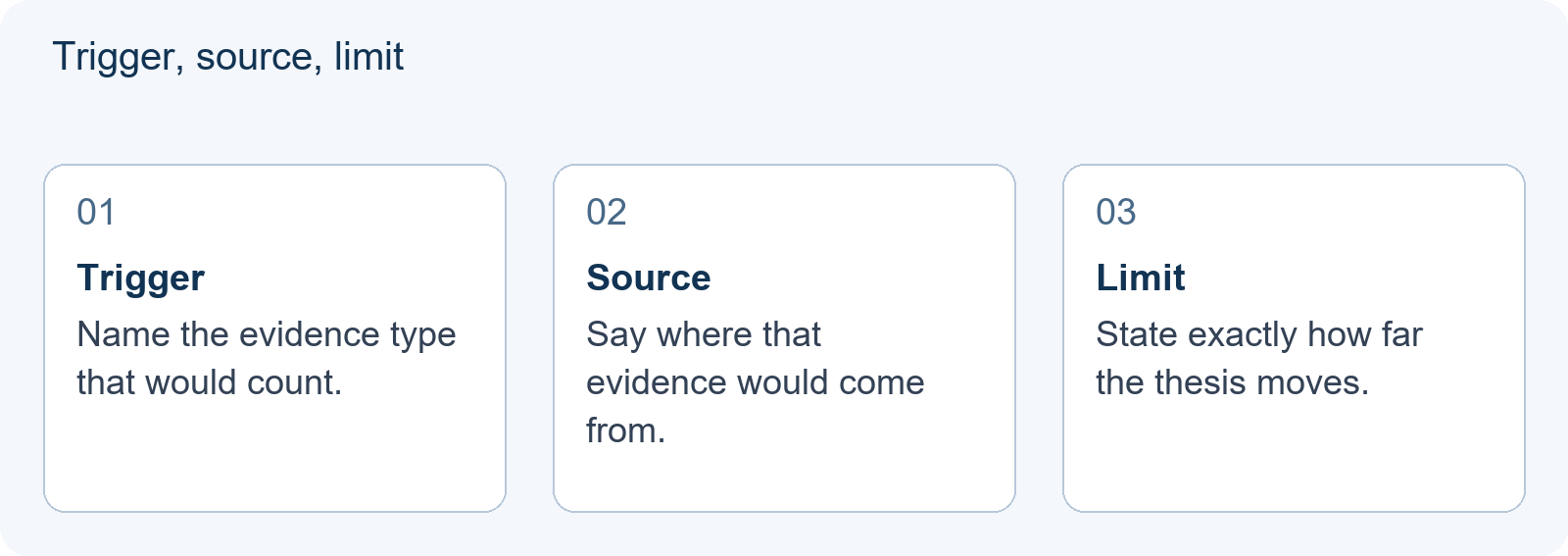
The three-part check: trigger, source, limit
Before rehearsal, write one sentence for each part. If you cannot fill a part, the answer is not ready.
| Part | Question it answers | Weak version | Strong version |
|---|---|---|---|
| Trigger | What evidence would count? | “If I saw data…” | “A pre/post enforcement panel of small firms across the economies I discuss.” |
| Source | Where would it come from? | “Studies” | “Regulator annual reports and a peer-reviewed telecom-policy panel.” |
| Limit | How far does the thesis move? | “I would change my view.” | “I would drop the improvement clause and keep the distributional claim.” |
The limit is the part finalists skip. Without it, a concession sounds like surrender; with it, the judge hears control. Use the essay’s own terms in the limit sentence. Do not introduce a new thesis at minute twelve of a 15-minute defense.
Answer shapes that fail, and one that holds
A weak answer can be structurally incomplete even when the speaker knows the material. The table below shows what each shape signals and how to repair it.
| Answer shape | What the judge may infer | Repair |
|---|---|---|
| Full retreat: “Any study would change my thesis.” | The essay had no stable claim. | Name which clause moves and which survives. |
| Stonewall: “Nothing would change my mind.” | The claim is not testable. | Name one evidence type that would count. |
| Philosophy detour: “All knowledge is provisional.” | You are avoiding the question. | Return to your own claim in one sentence. |
| Source bluff: “There is a 2023 World Bank report that proves…” | You may be inventing evidence. | Say what source type you would check and why. |
| Calibrated: trigger, source, limit. | You know the load-bearing parts. | Keep it under 60 seconds. |
The calibrated row is not a trick for sounding careful. It is the shortest honest description of how an analytical claim works. A thesis with no possible counter-evidence is a belief; a thesis that collapses at the first counter-example was never bounded. The middle answer is the one that lets the judge see both the claim and its conditions.
Do not invent a source on the spot
Under time pressure, it is tempting to name a report you half-remember. Resist that. Hanlin Courses’ 18 July 2026 summer guide notes that judges examine authenticity more closely at the Defense Day interview stage. That is a preparation observation from the report, not a published HIR rule, but it points to a real risk. A vague but honest answer—“I would check regulator annual reports and a peer-reviewed telecom-policy panel; I do not have the figure memorised”—is safer than a confident citation you cannot describe.
Keep a short list of sources you actually used, with the claim each one supports. The HIR Citation Link Audit: Keep Hyperlinked Evidence Alive to Defense Day (2026-27) is the pre-defense version of this habit: if a link is dead or a source does not say what you remember, fix the record before the conversation, not during it.
Rehearse against your submitted essay, not a generic script
The answer must be consistent with what you actually wrote. If your essay says “without measurable improvement,” do not concede “it improved” without stating which clause is moving. If your essay is stronger than your evidence, decide in advance how to distinguish what you argued from what you would argue with better data. That is not a retreat; it is the difference between defending a sentence and defending a position.
Build the answer from your own claims using an HIR Defense Day Q&A: Build an Evidence Backup Sheet From Your Own Claims. For each main claim, write the source, the date, the population and the one condition that would weaken it. Then rehearse the counterfactual aloud. If you freeze completely, the HIR Defense Day: A Fallback Protocol for Questions You Cannot Answer (2027) covers the prior skill; this article assumes you can speak and need to bound the concession.
A 20-minute rehearsal drill
Use one claim and one counterfactual. Do not rehearse ten questions badly.
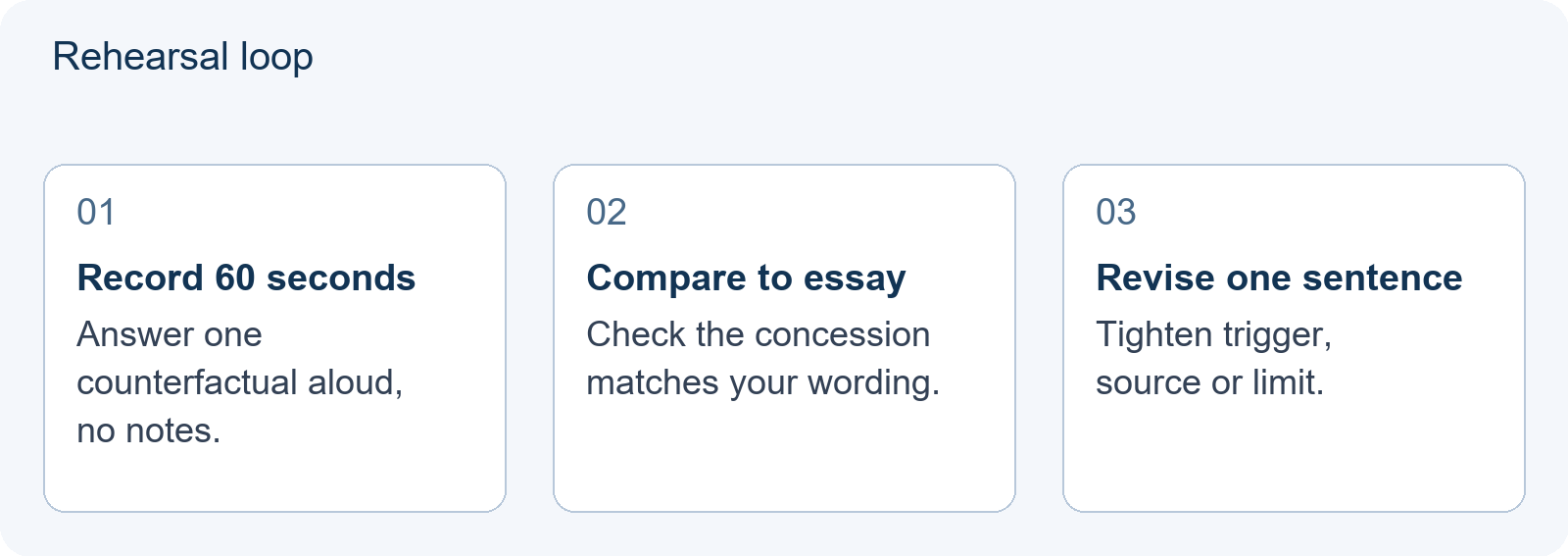
- Minute 0–3: record. Answer aloud once, without notes. Stop at 60 seconds.
- Minute 3–8: mark. Transcribe or replay. Underline the trigger, circle the source and bracket the limit. If any part is missing, rewrite only that part.
- Minute 8–14: stress-test. Swap the evidence type. If the trigger were a survey instead of a regulator panel, would the limit change? If yes, your limit is too vague. If no, say why the thesis is robust to that evidence.
- Minute 14–20: compress. Deliver the answer in 45 seconds, then in 30. Keep the limit sentence intact; cut preamble.
Run the drill twice on different days. The second run should sound less polished and more precise. Precision is the signal that you know which part of the argument is load-bearing.
What to bring to a rehearsal
If you are preparing, a rehearsal is useful when it is specific. Bring one claim sentence copied from your essay, one counterfactual question you fear, the two or three sources you actually used, and a note on which clause you would drop if the evidence went against you. Ask for rehearsal of answer structure and evidence recall, not a script to memorise. A rehearsal can coach the trigger–source–limit move; it cannot promise an invitation, a score or an award, and it should not invent judge questions.
This is an independent preparation guide. It is not affiliated with or endorsed by Harvard International Review or Harvard University. HIR is not a Harvard University-run admissions programme. The schedule and format details above come from the HIR contest page. Hanlin Courses’ 29 September 2026 report on the 2026 HIR summer results and the next Fall/Winter cycle describes the Defense Day as online, while its 18 July 2026 summer guide describes a virtual 15-minute session and closer authenticity review at the interview stage. Use the HIR contest page for the dates and 15-minute format; treat the Hanlin reports as practical descriptions of the online setting.
Defense Day checklist
- One claim sentence, copied exactly from your essay.
- One trigger, one source and one limit, each in a single sentence.
- One confound you would check before revising.
- One honest sentence for a figure you cannot recall.
- One 45-second version and one 30-second version.
The question is not asking whether you are the kind of person who changes their mind. It is asking whether your argument has joints you can point to. Prepare those joints, and a concession becomes evidence of control rather than a collapse.
Frequently Asked Questions
When is HIR Defense Day for the Fall/Winter 2026 cycle?
HIR lists Defense Day as 5 February 2027. Finalists may be invited to a 15-minute presentation and oral defense. Hanlin Courses’ 29 September 2026 report describes the session as online; check the organizer’s current instructions for your cycle.
Is “What would change your mind?” an official HIR judge question?
No. It is a teaching illustration of a counterfactual question type, not a published HIR judge prompt. Prepare the trigger–source–limit structure rather than a script.
Should I concede my thesis if I cannot answer with certainty?
No. Name the evidence that would count, the source you would check and the specific clause that would move. A bounded concession protects the load-bearing part of the thesis; a full retreat or a claim that nothing could change your mind both weaken the defense.