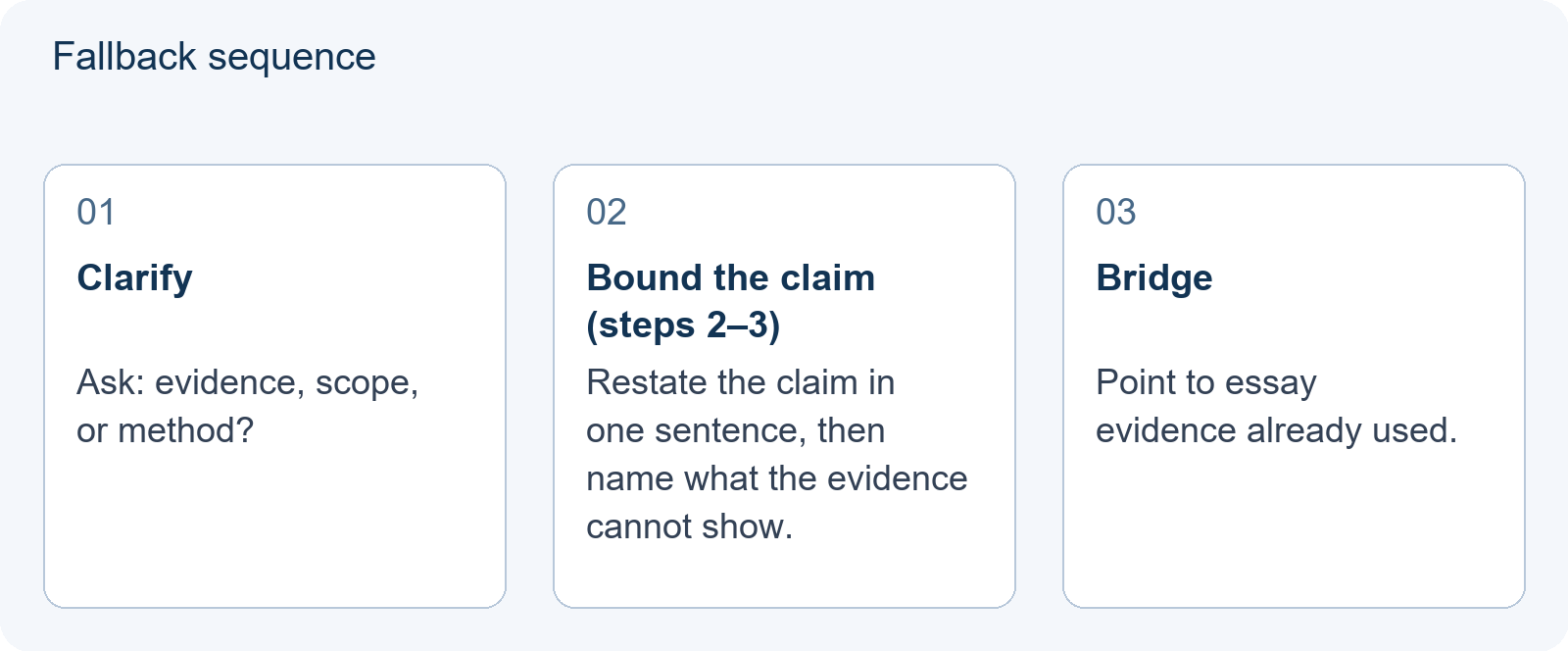
For the live Fall-Winter cycle, the essay deadline is 2 January 2027 and Defense Day is 5 February 2027, according to Hanlin editorial cycle notes verified on 2 November 2026. If you are preparing for HIR Defense Day, the practical answer to an unexpected judge question is not to improvise a new argument. Use a short fallback sequence: clarify what the question is actually challenging, restate the claim your essay really makes, name the relevant limit, and bridge to evidence already in the submitted essay. That sequence keeps the live answer tied to the text the judges have read and reduces the risk of introducing a claim you cannot support.
This article is an independent preparation guide. It does not reproduce official judge questions or scoring guidance. The protocol below is a teaching framework for handling uncertainty, not a script for a particular panel.
What the fallback protocol is not
The first safeguard is to reject three false solutions. The protocol is not an official question list: no public list of actual judge questions is supplied here, and a guessed list would only encourage rehearsal of the wrong thing. It is not a scoring script. Hanlin’s verified cycle notes describe the HIR rubric as 60 points: 12 rows scored 1-5, Content 30 and Style 30. That rubric gives you a reason to protect consistency with the submitted essay, not to perform a new essay orally. It is also not permission to invent evidence. If a question exposes a gap, the strongest move is usually a bounded concession followed by a return to what the essay actually established.
The protocol is also not a licence to argue with every question. Some questions are invitations to clarify; some are warnings that your essay overreached; some are tests of whether you can separate a limited claim from a sweeping one. The fallback sequence works because it slows the first few seconds enough to classify the question before answering it.
The four-step fallback sequence
Step 1: Clarify the target. Ask a short question that identifies what is being challenged: the reliability of a source, the interpretation of a finding, the scope of a claim, or the method behind a comparison. For example: “Are you asking whether the source is independent, or whether my essay uses it to support a causal claim it cannot support?” This is not stalling. It prevents you from answering a different question from the one asked.
Step 2: Restate the essay’s actual claim. Use one sentence and keep it narrower than a slogan. “My essay argues that reported trips fell after the charge and that the survey points in the same direction; it does not claim that the charge alone caused every part of the decline.” The purpose is to separate your claim from a stronger claim the question may have attached to it. If you cannot state the claim in one sentence, that is a preparation problem to fix before Defense Day, not a reason to invent a new thesis live.
Step 3: Name the relevant limit. A limit is not a confession that the essay is worthless. It is a precise statement of what the evidence does not establish. “The essay does not audit the authority’s raw counts, so it cannot rule out reporting error.” Naming the limit shows that you understand the difference between evidence and proof. It also makes any concession smaller and more credible.
Step 4: Bridge to evidence already used. Point to the paragraph, table, source or comparison that supports the bounded claim. “The evidence I used is the annual count table in paragraph 3 and the household survey table in paragraph 4; the comparison city is a check, not a causal control.” The bridge should not introduce a new statistic, a new source or a new thesis unless you can clearly label it as additional context. If you prepared an evidence-backup sheet, this is where it earns its value; the guide to HIR Defense Day Q&A: Build an Evidence Backup Sheet From Your Own Claims addresses that pre-Defense Day preparation.
Teaching illustration: an unexpected source challenge
This is a hypothetical teaching illustration, not an actual contest transcript. Imagine a finalist’s essay argues that a congestion charge in a hypothetical city reduced peak-hour car trips. The essay uses two pieces of evidence: annual traffic counts from the city transport authority and a household travel survey. A judge asks: “Your main source is the transport authority. How do you know the counts were not manipulated to justify the charge?”
A weak answer would either deny any problem (“The authority is official, so the data are reliable”) or collapse into a new thesis (“Actually, the charge did not cause any reduction”). The fallback answer is narrower. First, clarify: “Are you asking whether the authority has an incentive to misreport, or whether my essay relies on the authority for both the outcome and the policy date?” Second, restate the claim: “My essay claims that reported peak-hour trips fell after the charge and that the survey shows a similar direction of change. It does not claim that the authority is independent or that the charge caused every part of the fall.” Third, name the limit: “The essay cannot rule out reporting error because it does not audit the raw counts, and the two sources are not fully independent.” Fourth, bridge: “The evidence I actually used is the annual count table and the survey table; the conclusion is limited to the reported direction of change, and the comparison city is used only as a check.”
That answer does not win by being clever. It wins by being stable. It concedes the precise weakness, keeps the claim the essay can defend, and returns to evidence the judges can locate in the submitted text. The same pattern works for a question about a missing comparison, an outdated source or a term that the essay defined too loosely.
When to concede, qualify or defend
The fallback sequence does not mean conceding everything. Use the question’s target to choose a stance.
| Question targets | Best stance | Useful move |
|---|---|---|
| Evidence reliability, date or sample | Concede any overstatement; defend the limited evidential use. | Say what the source can and cannot show; point to the paragraph where it is used. |
| Interpretation or alternative explanation | Qualify if the alternative is plausible; defend if your reading is tied to the essay’s explicit reasoning. | Distinguish your claim from a stronger claim you did not make. |
| Scope: population, time or place | Concede overgeneralisation; restate the bounded claim. | Name the population and period in one sentence. |
| Method, causal identification or comparison | Qualify if the design cannot isolate the mechanism; defend if the question attacks a claim you did not make. | Separate correlation, mechanism and conclusion. |
A concession should be as narrow as the weakness. If the question targets evidence, concede the evidential limit, not the entire argument. If it targets scope, restate the population and period. If it targets method, separate correlation from mechanism. If it targets interpretation, defend only the reading that your essay actually argues and explicitly supported.
A practice drill for the week before Defense Day
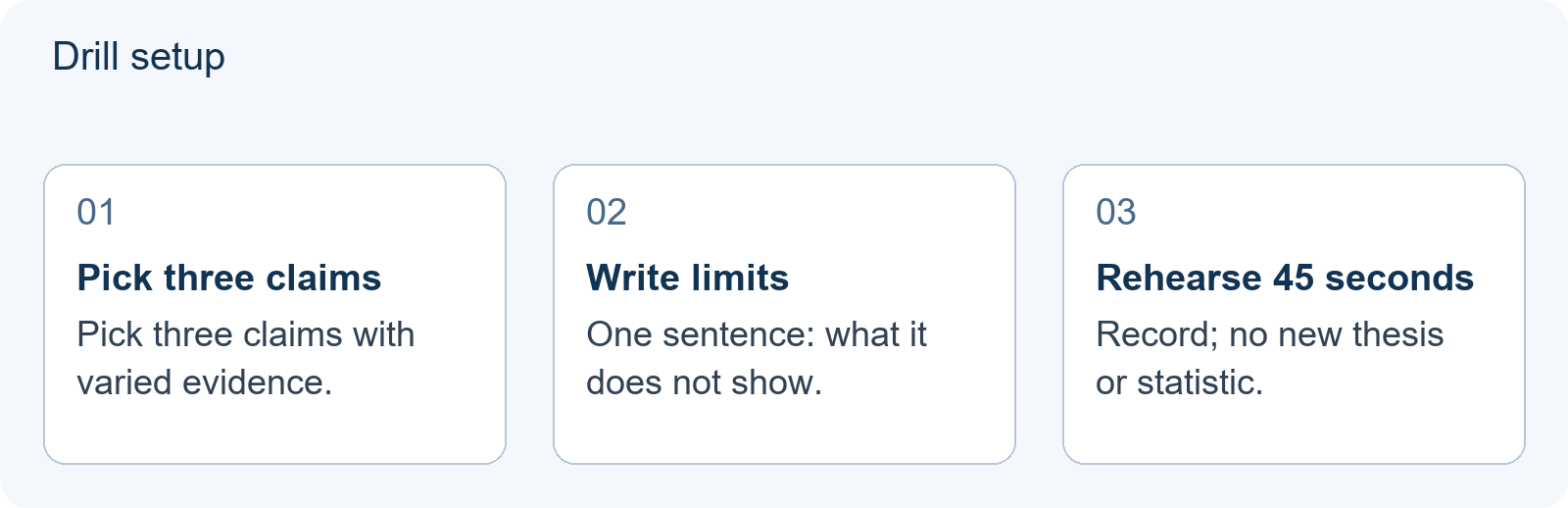
Pick three major claims from the submitted essay. They should use different kinds of support: one source-based claim, one comparison, and one causal or explanatory claim. For each claim, write three lines on a single page. First, the claim in one sentence. Second, a one-line limit: what the evidence does not establish. Third, a bridge phrase: where the evidence sits in the essay. Keep the lines short enough to say aloud without reading.
Then rehearse a 45-second fallback answer for each claim. The 45-second target is a practice constraint, not an official time limit. Record the answer and check four things: Did you clarify the question before answering? Did you restate the essay’s claim rather than a new one? Did you name a limit without collapsing the whole thesis? Did you point to evidence already in the essay? If the recording contains a new statistic, a new source or a new thesis, cut it and repeat. The drill is designed to make the fallback sequence automatic under mild pressure, not to script every possible question.
For delivery, especially if English is not your first language, rehearse the same three lines until the transitions are boring. The HIR Defense Day in Your Second Language: A Spoken-English Playbook for China-Based Finalists (2026) covers spoken delivery; the content fallback here addresses what to do when the question itself is unexpected. Keep the two separate in practice so that a delivery problem does not become a content problem.
Keep consistency with the submitted essay
Defense Day is not the place to repair a weak literature review by inventing a new source, and it is not the place to replace the essay’s thesis with a more impressive one. The submitted essay has already been shaped by the cycle’s rules. Hanlin’s verified cycle notes list these style requirements: percent spelled out, the Oxford comma, no footnotes, hyperlinked citations, and 800-1,200 words excluding figures. Those rules affect the text the judges have read; a live answer that introduces a different definition, a new statistic or a stronger causal claim can create a contradiction between the essay and the defence.
Consistency does not mean repeating the essay word for word. It means that any answer should be recognisably a development of the submitted claim. If a judge asks about a source you did not use, say so plainly: “That source is not part of my essay’s evidence; my claim rests on the two sources in paragraphs 3 and 4.” If a judge asks about a limitation you did not discuss, name it and connect it to the claim you did make. The guide on Which Sources Actually Count: Building a Clickable Evidence List for an HIR Essay From China is useful before submission; after submission, the relevant question is narrower: can you locate the evidence you already used and state its limits without rewriting the argument?
This is also why a last-minute search for new evidence is usually a bad trade. New material can make the live answer less consistent with the text under discussion. If you must mention additional context, label it as context and keep the burden of proof on the essay’s existing evidence. The goal is not to appear omniscient; it is to appear reliable about your own work.
Final checklist and how to use a rehearsal well
Before Defense Day, prepare a one-page fallback card with five items: the three claims you will defend, one limit sentence for each, the exact evidence location for each, two bridge phrases you can say aloud, and one sentence that politely declines to invent an answer. The card should fit on one side of a page. If it needs a second page, it is probably a second essay.
- Can you state each major claim in one sentence without adding a new thesis?
- Can you name one limit for each claim without abandoning the claim?
- Can you point to the paragraph, table or source where the evidence appears?
- Can you clarify a question before answering it?
- Can you say “That is outside the evidence I used” without becoming defensive?
If you arrange a mock Q&A or a consultation, make the request specific. A useful request is: “Please ask me one unexpected source-reliability question about claim two and one scope question about claim three, then tell me whether I introduced a new thesis or statistic.” Bring the submitted essay, the three claim-limit lines and the evidence locations. That is a better use of a rehearsal than a generic request for feedback, because it tests the exact fallback behaviour you will need under pressure.
The protocol will not make every question easy. It gives you a way to stay honest when a question is harder than your preparation. In the live Fall-Winter cycle, with the essay deadline on 2 January 2027 and Defense Day on 5 February 2027, the final weeks are better spent making three claims stable than memorising answers to questions nobody has supplied.
General event background is available at Event background.
This is an independent preparation guide, not affiliated with, endorsed by, or sponsored by the Harvard International Review.
Frequently Asked Questions
What should I do if I do not understand a judge’s question on Defense Day?
Ask a short clarifying question that identifies the target: evidence, interpretation, scope or method. Then restate the claim your essay actually makes, name the relevant limit, and bridge to evidence already in the submitted essay. Do not guess at a new argument just to fill the silence.
Should I defend every claim if it is challenged?
No. Concede an overstatement if the question identifies one, qualify the claim when the issue is scope or method, and defend only the bounded claim your essay actually supported. A narrow concession followed by a return to your evidence is usually stronger than defending a claim you did not make.
Can I introduce new evidence during Defense Day?
The safest default is to stay with evidence already in the submitted essay. If you mention additional context, label it as context rather than presenting it as new proof, and do not invent a statistic, source or thesis. Keep the answer tied to the claim the judges have already read.