An HIR evidence-fit check asks whether the cited source licenses the inference your sentence makes, not merely the fact inside it. A credible statistic can support a fact and still fail to support a causal, comparative or evaluative claim. For the Fall/Winter 2026 cycle, with submissions due Jan. 2, 2027, treat source-claim fit as a revision gate before polishing prose.
This article is an independent preparation guide. It is not affiliated with or endorsed by the Harvard International Review or Harvard University.
The HIR contest page describes the contest as seeking analytical international-affairs articles rather than op-eds or collections of facts. Both divisions follow an 800-1,200 word range excluding specified non-body elements, use AP style, and require reliable sources with hyperlinks for factual claims; AI tool use is prohibited. Those rules tell you what to submit. They do not tell you whether a particular citation supports a particular inference. That is the narrower job of evidence fit.
Why a credible source and a supported claim are two different tests
A draft can stall without having a sourcing problem in the ordinary sense. The links work, the institutions are serious, and the numbers are transcribed correctly. The problem is one level up: the writer has checked that the source is trustworthy and has not checked that it is relevant to the specific move the paragraph is making.
These are separate audits. A credibility audit asks whether the publisher is reliable and the figure current. An evidence-fit audit asks a narrower question: if this source is entirely correct, does my sentence follow? A national statistical table can be beyond reproach and still fail the second audit, because a table of national averages cannot, by itself, establish that a policy caused a change, that a mechanism operated, or that a group outside the table was affected.
The HIR contest page draws the boundary clearly: it seeks analytical articles, not op-eds and not collections of facts. The Hanlin course report on the 2026 HIR summer results and the Fall/Winter cycle, published Sept. 29, 2026, makes the same point from a teaching angle: HIR writing needs a clear viewpoint developed through research and analysis, not a summary of a broad theme. That is a coaching judgment from a preparation provider, not an official rule, but it describes the failure mode this article addresses. A fact tour is usually a stack of accurate sentences whose inferences have no warrant behind them.
If your draft already reads like a When Your HIR Essay Is a Fact Tour: A Three-Layer Test for Answering the Prompt, source-fit checking is one repair. You do not need to replace every source. You need to find the sentences where the citation is doing more work than the source can bear.
The three links inside a single HIR sentence
Take any analytical sentence in a draft and pull it apart into three components.
| Component | Question to ask | Possible failure |
|---|---|---|
| Source fact | What does the cited document actually state, in its own terms? | The writer paraphrases the source into a stronger claim than it made. |
| Writer’s interpretation | What do I want the reader to accept? | The verb is causal or evaluative while the source is descriptive. |
| Warrant | Why does this fact license this interpretation? | The missing assumption stays in the writer’s head and never reaches the page. |
The source fact is what the cited document states: a measured quantity, a finding, a quoted position, a documented event. The writer’s interpretation is the claim you want the reader to accept, usually causal, comparative or evaluative, and where the verb can do the work: drove, undermines, reflects, made possible. The warrant is the reason the fact is allowed to support the interpretation. A warrant can remain invisible, because to the writer it feels obvious.
Warrants are where evidence fit is decided. If the fact is a correlation and the interpretation is causal, the warrant must explain why the correlation is not selection, reverse causation or a shared cause. If the fact is a national average and the interpretation is about a region, the warrant must show that the region resembles the average, or the claim must be narrowed. If the fact is a firm-level survey and the interpretation is about workers, the warrant must connect the two units. If the fact is a count and the interpretation is about a rate, the warrant must supply the denominator.
The revision problem is not a shortage of warrants in the world. It is that a warrant can stay in the writer’s head and never reach the page, so the reader supplies a different one — or none.
A worked teaching illustration: an accurate number, an unsupported conclusion
Teaching illustration only — invented for this exercise, not an official prompt, not a real cited source, and not a model of a winning entry.
Suppose a draft contains this passage:
In the five years after Country A launched a national digital-payments system, the share of adults holding a transaction account rose from 41 percent to 63 percent, according to the central bank’s 2024 financial-inclusion survey. Digital payments therefore lifted nearly a quarter of the adult population out of financial exclusion and gave them a stake in the formal economy.
The first sentence is a reportable fact with a plausible source. The change is 22 percentage points, which the second sentence rounds to ‘nearly a quarter.’ The second sentence is where fit breaks down, and it breaks in three places at once.
- Causal leap. The cited survey reports account ownership at two dates. It does not identify why ownership changed; branch expansion, identity-document reform, phone penetration and urbanisation are all live alternatives.
- Conceptual substitution. Holding a transaction account is not the same thing as having ‘a stake in the formal economy.’ The survey measures account ownership; the sentence measures something else and borrows the number for it.
- Dormancy. Accounts can be opened and unused. Unless the source reports active use, ‘lifted out of exclusion’ claims more than the instrument records.
Nothing here is a sourcing error. The number may be perfectly accurate. The paragraph fails because the citation is doing work it was never designed to do. The same discipline applies when the inference is causal rather than descriptive: see HIR Essay Causation: Separating a Trend From an Explanation for a fuller treatment of trend-versus-explanation problems.
The repair is not to throw away the statistic. The repair is to decide which claim the paragraph actually needs. If the thesis needs a causal claim, the paragraph must either add evidence that isolates the mechanism or weaken the claim to association. If the thesis needs a claim about participation in the formal economy, the paragraph needs a different measure, not a more confident sentence.
The three-question source-fit check
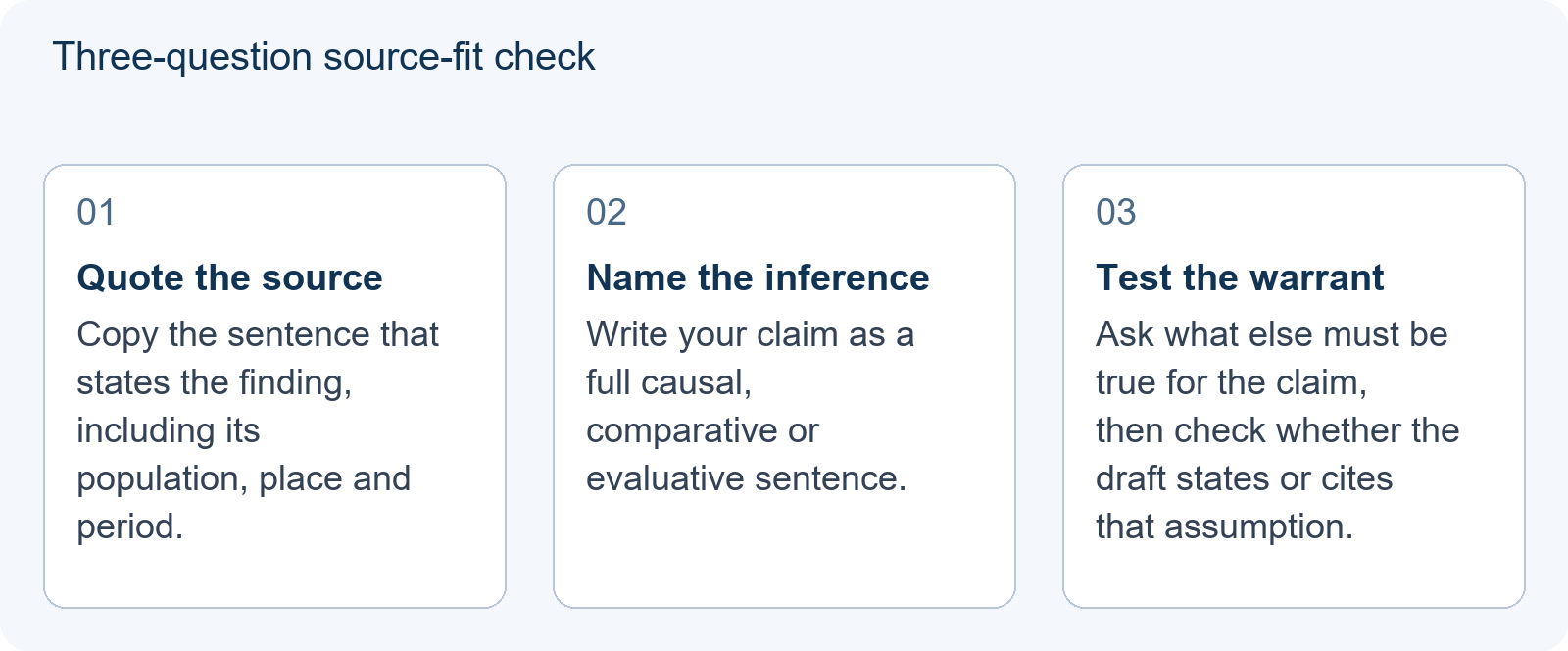
Applied to each sentence that carries an inference, these three questions locate the gap quickly.
1. What exactly does the source measure, in which population, place and period?
Re-read the source’s own wording rather than the draft’s paraphrase. In the teaching illustration, the source measures adults nationally at two dates, on account ownership. Note what is absent — usage, income, formality of employment — because absence is where overreach enters. A source can be excellent and still narrow. The question is not whether it is respectable; the question is whether it measures the thing your sentence needs.
2. What else must be true for my claim to follow?
The claim is that digital payments caused the rise and that the rise constituted inclusion. For that to follow, the payments system must be the operative cause, and account ownership must be a reasonable proxy for participation. Both are assumptions, not findings. The second assumption is conceptual, not statistical: it concerns what account ownership means for a person’s economic life. The first is causal: it concerns what produced the change.
3. Which assumption is carrying the argument, and is it stated or cited?
Identify which assumption carries more weight than the rest. Here it is the causal one. If the paragraph states that assumption openly and defends it, the reader can weigh it; if the sentence hides it behind ‘therefore,’ the reader is asked to accept an argument the citation never supplied. Naming the load-bearing assumption is what turns a vague worry into a revision decision.
Repair moves once fit fails
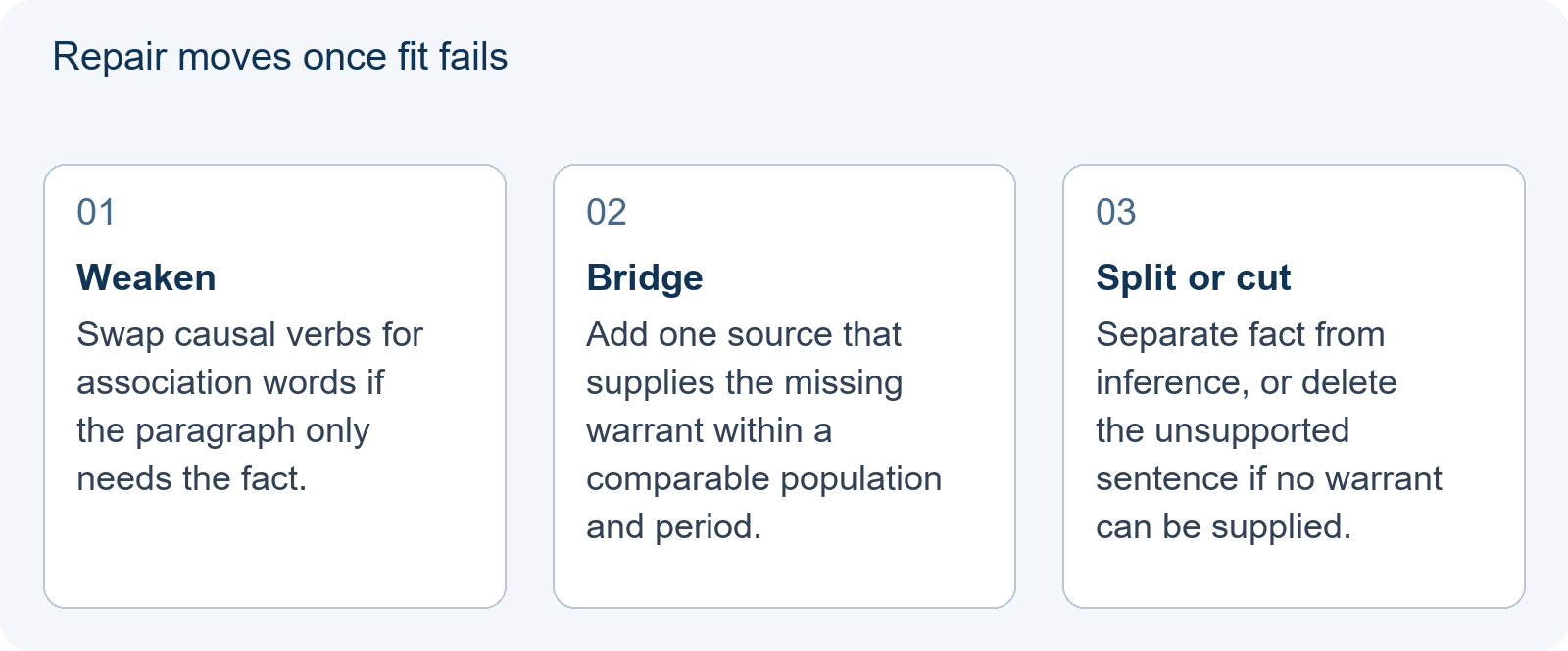
There are four practical repairs. They are not equally good in every paragraph; choose by asking whether the claim is load-bearing for the thesis and whether credible evidence for the missing step exists within the same population and period.
Weaken the claim
Swap causal verbs for association words. ‘Drove’ becomes ‘accompanied’ or ‘was associated with.’ This repair uses few added words, but it can cost argumentative force. Use it when the paragraph needs the fact but does not need the stronger inference. Then check that the softened sentence still supports your thesis rather than merely decorating it.
Add a bridge source
A bridge source supplies the missing warrant. If the claim is that a payments system increased account ownership, the bridge might be a study that compares regions with different rollout timing, or a policy evaluation that addresses alternative explanations. The bridge must connect the same population, place and period closely enough to be relevant. A source about a different country or a different measure may be interesting without bridging this gap. When credible accounts conflict, source-fit work also requires showing which account your sentence follows; see HIR Essay Source Disagreement: Writing When Credible Accounts Conflict.
Split fact from inference
Keep the supported fact in one sentence and mark the inference as an interpretation in the next. This can be a clean repair for an 800-1,200 word essay because it preserves the evidence while making the argument’s status visible. The reader can then see which part is measured and which part is argued.
Cut the unsupported sentence
Cutting is the fallback when no warrant can be supplied within the word limit. It is not a failure. A shorter paragraph with a supported claim can be clearer than a longer paragraph whose key sentence depends on an unstated assumption. If the cut removes a load-bearing claim, revise the thesis or find a different line of evidence; do not simply restore the overclaim in smoother prose.
Where the problem is a numerical one, the denominator question can decide the repair. If the source fact is a count, share or rate and the interpretation silently changes the base, fix the base before revising the sentence.
Fitting the repair inside 800-1,200 words and AP style
HIR’s word range is tight enough that repair choices have consequences. A bridge source may require a sentence of explanation; a split may require a transition; a weakened claim may require adjusting the thesis sentence. Budget for those words during revision rather than treating them as free.
AP style matters here too. Follow AP’s number and date conventions, and use the form ‘percent’ consistently. The contest page requires reliable sources and hyperlinks for factual claims, so when you weaken a sentence, do not accidentally strip the link from the fact that remains. The hyperlink should follow the factual sentence, not the interpretation.
The Sept. 29, 2026 Hanlin course report also notes that encyclopedic and social-media sources are not recommended as the main evidence base. That is useful at the credibility-audit stage, but it does not settle fit. A reliable source can still be the wrong source for the inference. Conversely, a source need not be famous to supply a warrant if it is relevant, transparent and used within its limits.
The same report lists evaluating sources for credibility and accuracy, and developing a research plan, as parts of Hanlin’s HIR course outline. That is a course description, not a scoring promise. Its practical use for revision is simple: separate the credibility question from the fit question, then make the fit repair visible in the paragraph.
Pre-submission checklist
- Circle every verb in your draft that implies causation, comparison or evaluation.
- For each circled verb, write the source’s exact measure, population, place and period in the margin.
- Write the missing assumption in one sentence. If you cannot, you have found an unsupported inference.
- Choose a repair: weaken, bridge, split or cut. Do not leave the original sentence unchanged.
- Re-read the repaired sentence against the source, not against your memory of the source.
- Keep the hyperlink on the factual sentence that survives, and confirm the interpretation is clearly marked as interpretation.
- Re-count the body against the 800-1,200 word limit after the repair, since bridges and splits add words.
- Confirm AP style in the revised sentence, including ‘percent,’ dates and attribution.
- After the fit repair, run a HIR Rubric Calibration: A Three-Pass Self-Scoring Clinic Before You Revise (2026-27) to check whether the revised paragraph still serves the essay’s criteria.
The HIR contest page lists the Fall/Winter 2026 submission deadline as Jan. 2, 2027, and Defense Day as Feb. 5, 2027. Registration and payment precede submission, but the contest page alone does not establish regional registration closing dates. Those dates belong in your schedule; they do not change the evidence-fit question. A sentence either has a warrant or it does not.
Before you revise for elegance, audit for fit. Name the source fact, state the interpretation, and write the warrant in plain language. If the warrant is missing, repair the claim rather than decorating it. That is the difference between using a source and merely citing one.
General event background is available at Event background.
Frequently Asked Questions
If my source is credible, doesn’t that mean my HIR claim is supported?
No. Credibility and fit are separate tests. A reliable source can still fail to support a causal, comparative or evaluative claim if it only measures something narrower, such as a single-year average or a firm-level survey. The check is whether the source, if entirely correct, makes your specific sentence follow.
Can I keep an accurate statistic if I remove the causal verb?
You can, provided the softened sentence still matches what the source measured. Changing ‘drove’ to ‘accompanied’ or ‘was associated with’ narrows the claim to the evidence, but you should keep the hyperlink on the factual sentence and re-read the surrounding argument to confirm it still supports your thesis rather than merely decorating it.
Does a missing warrant mean I should delete the paragraph?
Not automatically. Weakening, adding a bridge source, splitting fact from inference and cutting are all viable repairs. Cutting is the fallback when no warrant can be supplied within the word limit. Choose based on whether the claim is load-bearing for your argument and whether credible evidence for the missing step exists within the same population and period.