This is an independent preparation guide, not affiliated with or endorsed by Harvard International Review or Harvard University.
The Harvard International Review (HIR) Academic Writing Contest challenges students to analyze complex global issues within 800–1,200 words. A common analytical failure is treating an observed trend as if it were, by itself, an explanation. When writing about topics like Technology, Innovation, and Power or Security in a Multipolar World, students often identify two phenomena that move together and conclude that one causes the other—without ever establishing the mechanism that links them or ruling out alternative explanations. This article addresses that specific reasoning failure, walks through teaching illustrations that contrast weak and stronger causal claims, and provides a diagnostic table you can apply to your own draft.
Why Trend ≠ Explanation
A trend is a pattern you can observe: more countries adopting facial-recognition systems, or a rise in regional trade agreements after a currency crisis. An explanation is an argument about why that pattern exists and what produced it. In HIR judging, essays are assessed on research-based insights and coherent argumentation. A draft that lists trends without ever converting them into explanations will read as descriptive rather than analytical. The specific skill this article targets is learning to spot the moment when you have stopped at the trend and need to push further into mechanism and evidence.
Teaching Illustration 1: Digital Culture and Preservation (Weak Causal Claim)
This is an original teaching illustration, not an official HIR past-paper question or researched student submission.
Suppose a Senior Division writer addressing Global Culture in the Digital Era notices two trends: (1) streaming platforms have dramatically increased access to foreign films in Country X, and (2) local-language film production in Country X has also risen over the same decade. The weak draft asserts: “Streaming services cause cultural homogenization, which triggers a backlash of preservation efforts.”
Where the reasoning fails: The draft assumes a causal chain—streaming → homogenization → preservation—without showing that streaming caused homogenization in Country X, or that preservation efforts were a reaction to homogenization rather than, say, a government subsidy program launched for unrelated economic reasons. The trend (both phenomena rising) is mistaken for the explanation.
A stronger revision: “While streaming expanded foreign-film access in Country X after 2015, local-language production rose primarily because of a 2016 national film fund that subsidized domestic studios. The two trends are correlated but driven by independent causes: platform expansion on one side, industrial policy on the other.” This version cites a specific mechanism (the subsidy program) and separates the two trends rather than forcing them into a single causal story.
Contrast Case: When the First Assumption Fails (Correct Approach)
This is an original teaching illustration, not an official HIR past-paper question or researched student submission.
Consider a writer examining the same two trends—increased streaming access and rising local film production—but who resists the initial temptation to construct a causal narrative. Instead of asserting that one phenomenon explains the other, this writer asks: what would I need to observe to establish causation?
The writer identifies three requirements: (1) a temporal sequence showing that streaming expansion preceded the production increase, (2) a mechanism explaining how streaming could plausibly affect production decisions, and (3) elimination of alternative explanations such as policy changes or market shifts. Finding only correlation and temporal overlap, the writer reframes the argument: “The simultaneous growth of streaming access and local production in Country X suggests a complex media ecosystem rather than a simple causal relationship. Streaming may create market conditions for local content, but production decisions respond to subsidy structures and audience segmentation that predate platform entry.”
Why this contrast matters: The first illustration shows how to rescue a weak causal claim by adding mechanism and addressing confounders. This second illustration shows how to avoid the error entirely—by treating correlation as a starting point for investigation rather than evidence of causation. Both skills are necessary: recognizing when you have overclaimed causation, and building arguments that do not need such rescue.
Diagnostic Table: Identifying the Reasoning Failure in Your Draft
| Warning Pattern in Your Draft | Specific Reasoning Failure | Revision Action |
|---|---|---|
| “X increased, and then Y increased.” | Unmechanized causal claim: temporal order mistaken for causation | Replace with: “X contributes to Y through [mechanism], as demonstrated by [source].” If no mechanism exists, state the correlation and its limitation. |
| “Countries that do X experience Y.” | Confounding variable ignored: shared characteristics may explain both | Address the confounder: “While X correlates with Y, controlling for Z reveals…” or “The relationship disappears when Z is held constant.” |
| “Technology causes social change.” | Missing mediator: human agency or policy omitted | Specify the mediator: “Policy decisions shape how technology impacts society, as seen in…” Name who acts and how. |
| “This trend shows that…” [conclusion about causation] | Trend mistaken for explanation: description substituted for argument | Separate observation from inference. State the trend, then build the explanatory argument with mechanism and evidence. |
A Usable Practice Decision
Apply this three-step sequence to any paragraph in your draft where you make a causal claim:
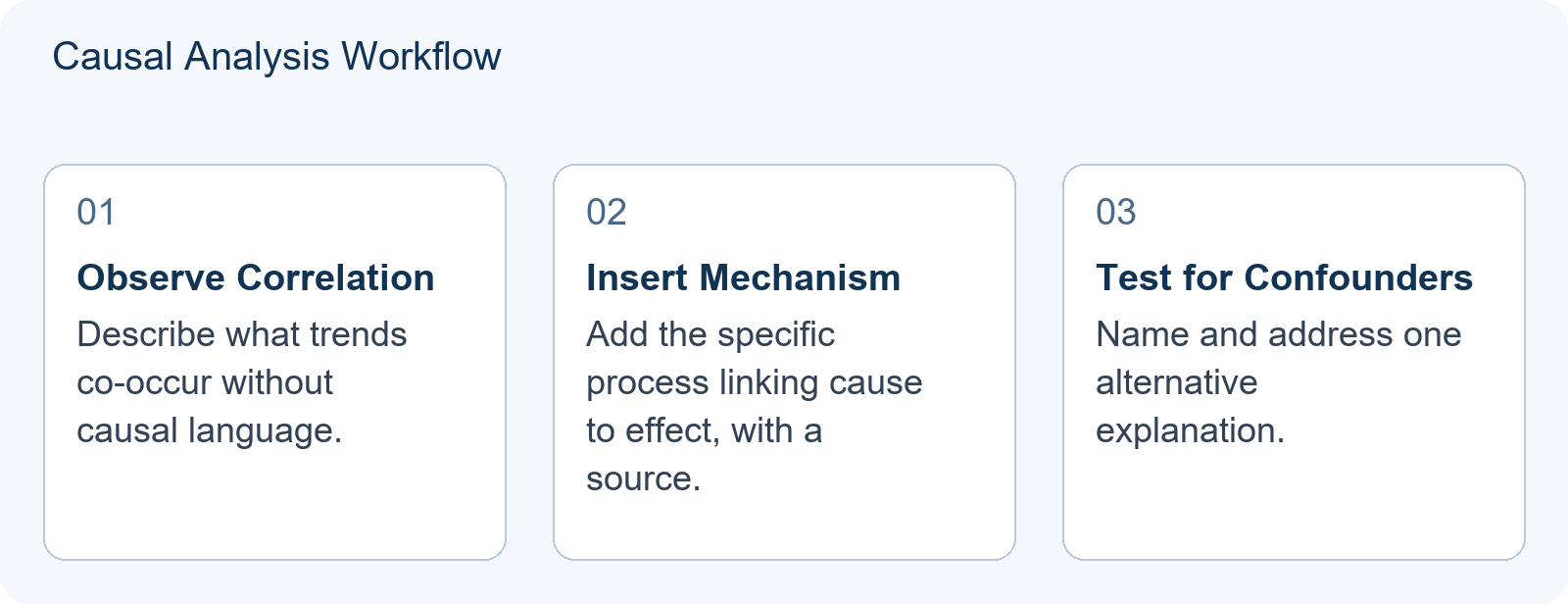
- Strip to correlation: Rewrite the claim to describe only what co-occurs, removing all causal language. If you cannot do this, your evidence was never strong enough to support causation.
- Insert mechanism: Add a specific process or intermediate step that connects cause to effect, with a source. If you cannot find one, reframe as correlation and note the limitation.
- Test for confounders: Name one alternative explanation that could produce the same observed pattern. Address it briefly to show analytical maturity.
This sequence converts a trend observation into a defensible analytical claim—the skill HIR content scoring rewards.
Connecting to Broader Preparation
Causal reasoning is one component of a strong HIR essay. For guidance on structuring arguments that avoid the opposite problem—describing facts without answering the prompt—see When Your HIR Essay Is a Fact Tour: A Three-Layer Test for Answering the Prompt. For techniques on using historical evidence with proper analytical framing, review Historical Analogies in an HIR Essay: A Four-Test Method for Using the Past as Evidence (2026-27). If you are refining a draft after receiving feedback, HIR Essay Feedback: What to Improve After a Bronze or Silver Result offers targeted revision strategies.
What to Demonstrate Next
A learner should be able to take any paragraph in their HIR draft, identify whether it contains an unmechanized causal claim, and revise it using the three-step sequence above. The specific skill to demonstrate is not merely avoiding the phrase “causes”—it is replacing assumed causal links with evidence-backed mechanisms, while explicitly acknowledging confounding variables that a simpler narrative would ignore.
Frequently Asked Questions
Does HIR require original research?
No. HIR expects students to synthesize existing credible sources into a coherent argument. The competition does not require new primary research.
Can I use Wikipedia for background?
Wikipedia can help identify key concepts during early research, but it should not be cited as a primary source in your final essay. Use it to find leads to authoritative sources.
What if my topic lacks clear causal data?
State the demonstrated correlation explicitly, describe the mechanism you can evidence, and acknowledge where current data is insufficient. This honest framing—showing what you can and cannot claim—strengthens analytical credibility rather than weakening it. Avoid hypothesizing ‘potential mechanisms’ without source support; instead, build your argument on verified connections and clearly mark its limits.