This is an independent preparation guide, not affiliated with or endorsed by Harvard International Review or Harvard University.
The Harvard International Review Academic Writing Contest gives students 800–1200 words to engage with sweeping global themes: digital culture, multipolar security, or technology and power. The real challenge is not the word limit itself, but the gap between a theme and a question your essay can actually answer. This article shows how to move from a broad topic to a defensible scope, using two worked hypothetical cases and one common misstep.
Why Scope Is the Decisive Skill
HIR themes are intentionally open. A senior division prompt like “Technology, Innovation, and Power” could describe the entire modern world. The judges do not expect comprehensive coverage. They expect a focused argument with evidence. Students who treat the theme as a topic to summarize usually produce scattered essays. Students who find a specific question within the theme can build coherent, persuasive arguments.
The skill is narrowing: not finding more to say, but deciding what to leave out. This is what we mean by HIR essay scope.
Worked Example 1: A Successful Narrowing
Suppose a student starts with the senior theme “Security in a Multipolar World.” The first instinct might be to discuss rising tensions between major powers, cybersecurity, and energy security all at once. That is a topic, not a question.
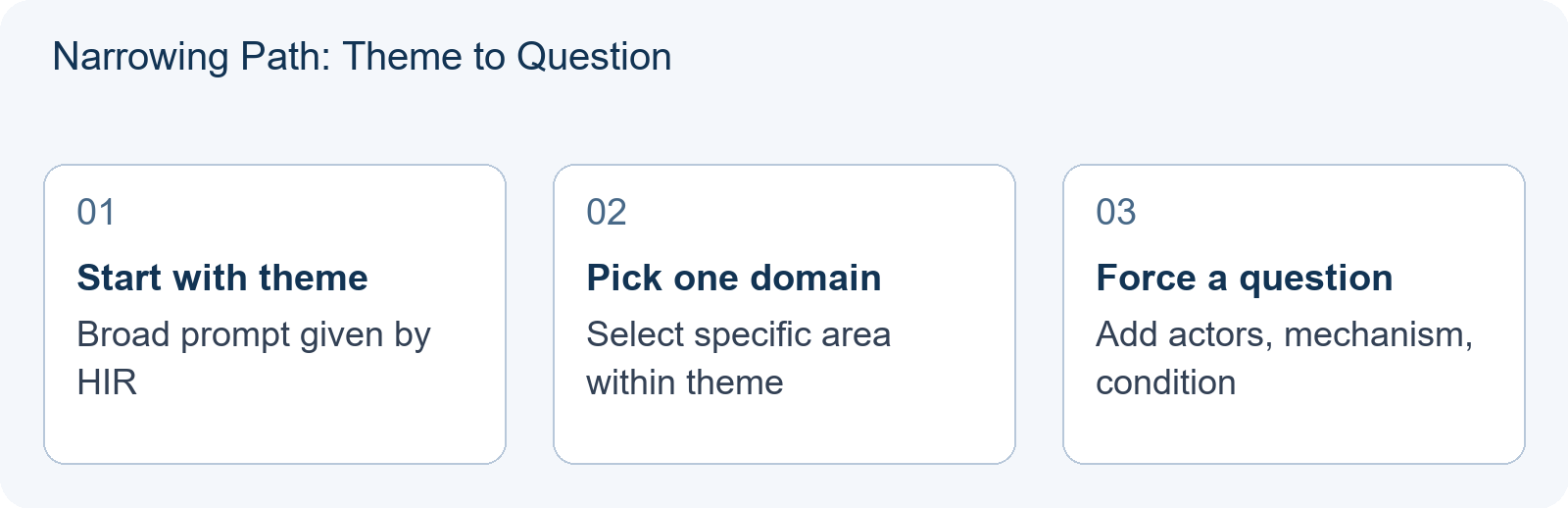
Here is how the narrowing might proceed:
- First refinement: Focus on cybersecurity rather than all security domains.
- Second refinement: Ask which actors matter most—states, corporations, or non-state groups?
- Third refinement: Choose a specific tension: how do differing national regulations on data localization affect cooperation against ransomware?
The resulting question: Do conflicting data-localization laws between the European Union and India weaken their ability to coordinate responses to cross-border ransomware?
This question is answerable in 1200 words. It requires comparing two specific regulatory frameworks, identifying a concrete mechanism of friction, and evaluating whether that friction actually prevents cooperation. The student can cite specific EU directives, Indian data protection legislation, and documented ransomware cases. The scope is narrow enough to defend with evidence, yet connected enough to the theme to satisfy the prompt.
Teaching illustration: This case demonstrates a repeatable narrowing path from theme to research question. It is not an official past-paper question or marking criteria.
Worked Example 2: Where a Shortcut Fails
Now consider a different approach to the same theme. A student notices that semiconductor supply chains are frequently discussed in relation to multipolar security. They decide to write about whether Taiwan’s dominance in advanced chip manufacturing creates geopolitical vulnerability.
This seems specific. It names a place, a technology, and a risk. But it is still a topic, not a question. The essay might describe the concentration of manufacturing, list potential threats, and conclude that vulnerability exists. Without a precise question, the argument drifts between description and speculation.
A more productive revision would ask: Under what conditions would a disruption to TSMC’s production of 3nm chips in 2026 significantly affect European automotive supply chains within six months?
This revised question demands specificity about mechanisms, timelines, and thresholds. It forces the student to define “significantly,” identify the actual supply chain links, and assess whether alternative suppliers could compensate. The original version allowed the student to stop at observation; the revised version requires argument.
Teaching illustration: This contrast shows how a seemingly specific topic can still fail the question test. The revised version is a hypothetical model for practice, not an published contest prompt.
Diagnostic: Topic or Question?
Use this table to test whether your idea is ready to write.
| Feature | Topic (too broad) | Question (workable) |
|---|---|---|
| Can you state it as a yes/no or how/why question? | No; it names a subject area | Yes; it demands an answer |
| Does it specify actors, mechanisms, or timeframes? | Vague on who does what | Identifies concrete elements |
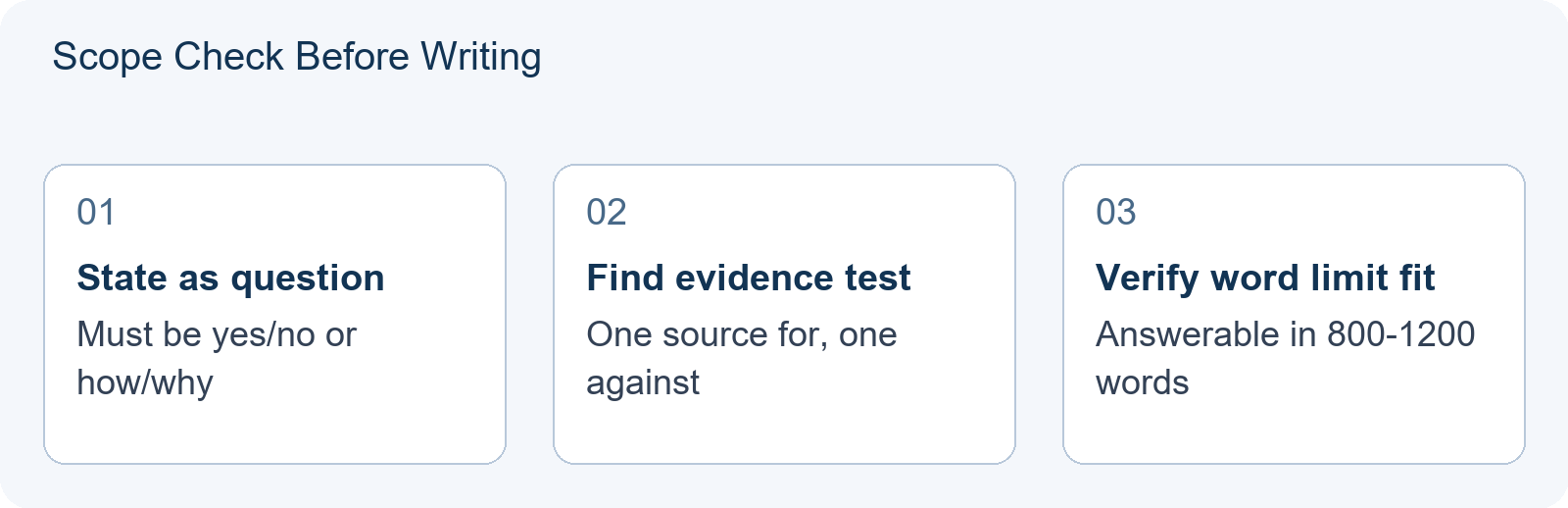
| Could you answer it in 1200 words with cited evidence? | Would require a book | Fits within the limit |
| Does it allow for disagreement? | Often merely descriptive | Invites genuine debate |
If your idea matches the left column, continue narrowing. If it matches the right, you are ready to research and outline.
A Practical Sequence for Practice
Here is a suggested preparation sequence you can apply to any HIR theme:
- Free-write for ten minutes on everything the theme makes you think of. Do not filter.
- Circle the one intersection that surprises you—where two ideas meet that you did not expect.
- Force a question: Write “How does X affect Y under condition Z?” and fill in the blanks from your circled idea.
- Test with the diagnostic table above. Revise until all four criteria are met.
- Find one piece of evidence that would support an answer and one that would complicate it. If you cannot find either, your question may still be too abstract.
This sequence is designed to prevent the common failure mode of choosing a question that sounds impressive but cannot be executed. The evidence test in step five is particularly important: if you cannot locate concrete sources, your scope may be too narrow or your assumptions may be unfounded.
Connecting to Related Guidance
For concrete techniques on closing your argument effectively once you have scoped your question, see How to End an HIR Essay: A Conclusion That Lands Your Thesis Without Turning Into an Op-Ed (2026-27). If you are working with the Technology, Innovation, and Power theme and need to see how scoping applies to that specific prompt, refer to HAWC Theme C Decoded: Turning Technology, Innovation, and Power Into a Defensible 1,200-Word Argument. For a parallel treatment of the Security in a Multipolar World theme, consult HAWC Theme B Decoded: How to Scope a Security in a Multipolar World Essay.
What to Demonstrate Next
After working through this article, you should be able to take any HIR senior theme and produce a specific, answerable research question that meets four conditions: it is stated as a genuine question, it specifies concrete actors or mechanisms, it can be answered with evidence within the word limit, and it allows for reasoned disagreement. This skill—controlling scope—is what separates a topic summary from a competitive HIR essay.
Frequently Asked Questions
How narrow should my HIR essay question be?
Narrow enough that you can answer it with specific evidence in 800-1200 words, but not so narrow that the answer is obvious without research. A good test: can you find at least one source that supports your answer and one that complicates it? If yes, your scope is likely appropriate.
Can I change my question after I start researching?
Yes, and you often should. Research frequently reveals that your initial question is unanswerable, already answered, or less interesting than a variation. The narrowing process is iterative. Revisit the diagnostic table after your first few hours of research to confirm your question still works.
What if my question seems too small for the grand HIR theme?
Small is usually better than big in HIR essays. A focused question on a specific mechanism—how two countries’ regulations interact, or how one technology spread through one industry—allows you to demonstrate analytical depth. You can always connect back to the broader theme in your introduction and conclusion without trying to cover it all.