End an HIR essay with roughly 100 to 150 words that do three jobs: restate your thesis at the strength your evidence has earned, say what follows if you are right, and name the development that would prove you wrong. Do not finish with a call to action. The Evaluation Rubric in HIR’s submission guide has a row for the introduction but none for the conclusion, which is exactly why a weak ending can quietly cost marks under other rows.
The ending has no row of its own
The submission guide linked from the contest page on hir.harvard.edu scores entries on rows rated from 1 to 5, grouped under Content and Style. Content includes a row for Topic and a row for Introduction, whose top descriptor rewards an opening that “pulls the reader in with a ‘hook’” and sets up the argument. There is no row called Conclusion. Our rubric walkthrough covers the Content rows in detail.
That absence is not permission to coast. Because nothing scores the ending on its own terms, a weak ending is scored through the rows it damages, and the final paragraph is where a reader forms a last impression of your tone, your evidence and your argument at once. The table maps the six endings we see most often in drafts to the row most likely to absorb the cost. The mapping is our editorial reading of the guide’s descriptors: HIR says it cannot give detail beyond the scores its graders provide.
| Ending | What it sounds like | Row most likely to absorb the cost | The repair |
|---|---|---|---|
| The echo | The introduction again, lightly reworded | Overall Coherence of Argument: the reader learns nothing new about what was shown | Restate the claim as the evidence left it, narrower or firmer, but changed |
| The call to action | “The world must act now, before it is too late.” | Tone: the guide’s lower descriptors describe a piece that reads as an op-ed | Replace the demand with a consequence of your claim |
| The late fact | A new statistic or event in the final lines | Use of Evidence, plus the separate Citations row under Style: every factual claim needs a cited source, and this one arrives with no analysis | Move it into the body with its hyperlink, or cut it |
| The shrug | “Only time will tell.” | Overall Coherence of Argument: the thesis dissolves where it should be clearest | Name the development that would settle the question |
| The leap | Two case studies end in a claim about the whole world | Analysis of Evidence: conclusions should follow logically from the evidence provided | Scope the implication to what your cases can carry |
| The final objection | A serious counterargument raised in the last paragraph | Structure / Transitions, and Overall Coherence of Argument: the essay ends on the other side’s point | Handle objections earlier, where you have room to answer them |
Three jobs, about 150 words
A strong ending is short because it has only three jobs.
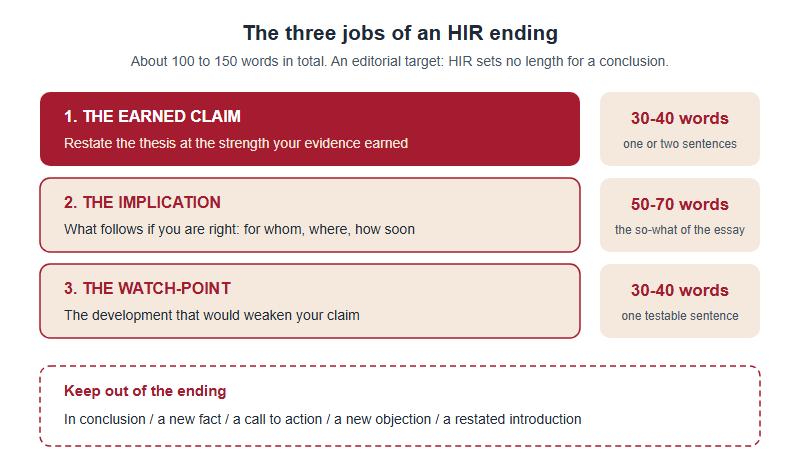
Job 1 is the earned claim. Restate the thesis at the strength your evidence supports. If the body showed a mechanism at work in two of three cases, the ending says so; it does not quietly upgrade that to “always.” This is where a reader checks whether the argument held together, which is the question the Overall Coherence of Argument row asks.
Job 2 is the implication. Say what follows if you are right: for whom, where and on what timescale. This is the “so what” of the essay, and it is analysis rather than advocacy because it is a consequence of your claim, not a wish about the world. It is also where an under-appreciated topic, which the contest page explicitly asks for, shows why it deserved attention.
Job 3 is the watch-point. Name the development that would weaken your claim, in one sentence. It shows the nuance the contest page calls critical, and it turns your ending into something a reader could check against events rather than a slogan to accept.
Two practical notes. HIR sets no length for a conclusion, so 100 to 150 words is our editorial target, not a rule. And the ending counts: the guide excludes only diagrams, tables of data and the authorship declaration from the 800-1,200 word limit.
Implication, recommendation, agenda: where the line sits
The contest page is direct. HIR does not accept op-eds; articles “are expected to have a thesis but should not have an agenda”; and submissions “should also not be merely a collection of facts.” That last clause matters for endings. A conclusion that commits to nothing is not neutral. It is an argument that stopped before it finished.
The harder question is whether an ending can discuss policy at all. In our reading it can, provided the option is derived from your analysis and conditioned on a goal you state. What turns an option into an agenda is not the topic but the grammar: a demand with no conditions, a single permissible answer, or values the essay never argued for.
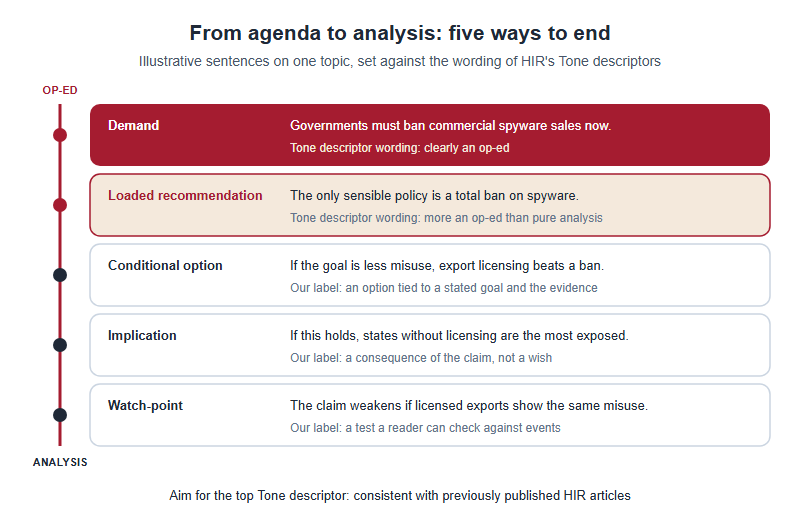
The quickest test is a verb audit. Search your final paragraph for must, should, need to, it is imperative and only by. Each one is a flag, not an automatic error. Rewrite it as a claim about consequence or trade-off, using would, is likely to, points toward or depends on, and check that the sentence still says something a reader could dispute. If it does, you have kept your position and dropped the op-ed register.
One ending, rebuilt
Imagine an essay arguing that limited repair capacity, not sabotage, is the underrated risk to undersea internet cables serving small island states, with two cited outages as its evidence. Here is the ending most first drafts produce:
“In conclusion, undersea cables are extremely important and they are under growing threat. The international community must act urgently to protect them, because the internet is essential for everyone. Only by working together can we keep the world connected.”
Three failures from the table are present — the echo, the call to action and the leap to “everyone” — along with an announcement and a slogan. Now the rebuild:
“Neither outage examined here began with sabotage, and neither lasted because of it. Both lasted because the nearest repair ship was weeks away. If that pattern holds, the most exposed states are small ones served by a single cable and a shared repair operator, and the more useful question for their governments is not who might cut a cable but how quickly anyone could fix one. The argument would weaken if outages stayed long even where a repair ship was close, which would point to damage severity rather than repair capacity.”
The first two sentences do Job 1, restating the claim as the evidence left it. The third does Job 2, naming who is exposed and which question follows for them. The last does Job 3. There is no “must,” and yet the ending is more pointed than the original, because it commits to something a reader could test. Note also what it does not do: it adds no new figure, so nothing in it needs a citation the body has not already supplied.
A ten-minute ending audit, and the Defense Day payoff
- The echo test. Cover everything except your first and last paragraphs. If the last one could be swapped with the first without anyone noticing, rewrite it.
- The tone test. Run the verb audit on the final paragraph only.
- The evidence test. Circle every fact in the ending. Each should already appear in the body with its hyperlink; anything new moves up or goes.
- The falsifiability test. Find the sentence in your ending that could turn out to be wrong. If there is none, Job 3 is missing.
- The announcement test. Delete “In conclusion” and “To sum up,” then read the paragraph again. Nothing breaks.
- The word test. Recount your total after revising the ending, since it sits inside the 800-1,200 word limit.
There is a second reason to get this right if you are aiming at the Fall-Winter cycle, which HIR’s contest page lists as closing Jan. 2, 2027. Finalists defend their essays live at Defense Day, and “so what?” is among the most predictable questions any analytical argument invites. A finished Job 2 is your prepared answer to it, and a finished Job 3 answers “what would change your mind?” Our Defense Day preparation guide covers the rest of that conversation, and our complete guide to the contest explains the cycles and divisions.
Frequently asked questions
Does HIR score the conclusion separately?
No. The submission guide rubric has an Introduction row but no Conclusion row, so endings are judged through rows such as Tone and Coherence.
Can an HIR essay end with a policy recommendation?
HIR wants a thesis without an agenda. An option tied to a stated goal and your evidence reads as analysis; a bare demand reads as an op-ed.
How long should the conclusion be?
HIR sets no length for it. We suggest about 100 to 150 words, and the conclusion counts toward the 800 to 1,200 word limit.
Can I add a new statistic in the last paragraph?
Avoid it. Every factual claim needs a hyperlinked citation, and a fact introduced at the end has no room left to be analyzed.
This is an independent guide operated by Hanlin Education for China-based international-school students. We are not affiliated with, endorsed by, or sponsored by the Harvard International Review or Harvard University; the HIR is a student-run journal, not an official Harvard University publication. Rubric wording, word limits and cycle dates are set by the organiser and can change — confirm current details on hir.harvard.edu. The mapping of endings to rubric rows is our own editorial reading. Errors are corrected within 7 working days of being reported.