Your Junior Division invention is too broad for the 800-1,200-word HIR limit if you cannot state, in one sentence, which group’s behavior changed, through what mechanism, and with which two independent kinds of evidence. In the Fall/Winter 2026 cycle both divisions work inside the same 800-1,200-word requirement, so the test is not whether the invention is important but whether its causal story is analyzable at that length.
This is an independent preparation guide to the HIR Academic Writing Contest. It is not affiliated with or endorsed by Harvard International Review or Harvard University, and HIR is not a Harvard University admissions program.
Why the word limit, not the invention’s fame, controls scope
The HIR contest distinguishes a Junior Division for Grades 7-8 and a Senior Division for Grades 9-12. The current Harvard International Review contest submission guidelines (accessed 16 November 2026) set 800-1,200 words for both divisions, excluding specified non-body elements, and describe the target as an analytical international-affairs article rather than an op-ed or a collection of facts. The same guidelines require AP style, reliable sources with hyperlinks for factual claims, and prohibit AI tool use. Those are constraints on the finished object, and they matter at the scoping stage because a topic that needs three thousand words of setup cannot be repaired by better sentences.
A Hanlin Courses article, “2026 HIR Harvard International Review Writing Summer Contest Results Released! The Next Fall/Winter Cycle Is Under Way” (29 September 2026), makes a related point from a coaching angle: the Junior Division is described as inviting writers to start from a specific invention and analyze its impact on human life, but because the article is only 800-1,200 words, the working advice is to narrow the angle and define a question before drafting. That is a teaching judgment, not an official rule, and it is the judgment this article builds on.
A 900-word draft leaves roughly 720 words for the body once a short opening and conclusion are removed. If your plan requires explaining the invention’s origin, its inventor, two decades of adoption, three separate effects and a policy recommendation, that budget buys about 100 words per item. That leaves little room for a sourced causal claim in any one item.
For the difference between picking an invention and testing whether the picked invention is workable, see HIR Junior Division: Pick an Invention You Can Support With Evidence (2026-27). This article assumes the invention is already chosen and asks a narrower question: is it small enough to argue?
What “too broad” means in this article
Breadth here is not about how famous the invention is. A world-historical invention can be a fine Junior topic if the writer isolates one mechanism. Conversely, an obscure local device can be unmanageably broad if the writer tries to cover its design, its manufacturer, its users, its critics and its future in 900 words.
Treat scope as a four-part contract. One: a single invention, or a single component or feature of it. Two: a single mechanism, meaning the specific thing the invention changed about how people act, such as cost, access, speed, risk or required skill. Three: two or three consequences that follow from that mechanism and can each be evidenced. Four: one international-affairs stake, meaning a reason the change matters across borders or across comparable societies, which keeps the article within the contest’s international-affairs framing.
If you need the word “and” to join two mechanisms, you have two essays. If you need “and also” three times in your thesis sentence, you have a survey. The check is linguistic before it is evidentiary: read your working thesis aloud and count the causal verbs. One mechanism should carry the sentence.
A teaching illustration: the same invention at two widths
The two versions below are invented teaching examples written for this article. They are not official prompts, not past contest questions, and not descriptions of any real submission. Substitute your own invention and the shape of the problem stays the same.
Version A, too broad. Working thesis: “A low-cost solar lantern changed rural electrification, children’s education, household health, women’s employment, carbon emissions and manufacturing supply chains across the developing world.” Count the consequences: six. Each would need its own data, its own counter-evidence and its own paragraph. In 720 argumentative words that is 120 words per consequence, which is enough for an assertion but not for a sourced causal claim. A predictable failure mode is a fact tour: a paragraph on each effect, each resting on a single newspaper story, with no explanation of why the lantern rather than the grid, the phone or the road produced the change.
Version B, manageable. Working thesis: “One solar-lantern distribution model lowered the upfront cost of household lighting enough to shift evening study hours in off-grid households, and the effect was uneven because it depended on whether the household controlled its own charging.” Now there is one mechanism, upfront cost, and two consequences, study hours and uneven uptake, plus a built-in reason the effect varies. The international stake survives: cost-dependent adoption is a question about how technology crosses into low-income markets, not a local anecdote.
Notice what Version B gives up. It drops the inventor’s biography, the product’s design history, the emissions question and the supply chain. None of those were wrong to find interesting; they were simply not payable at this word count.
Three signals you can check in ten minutes
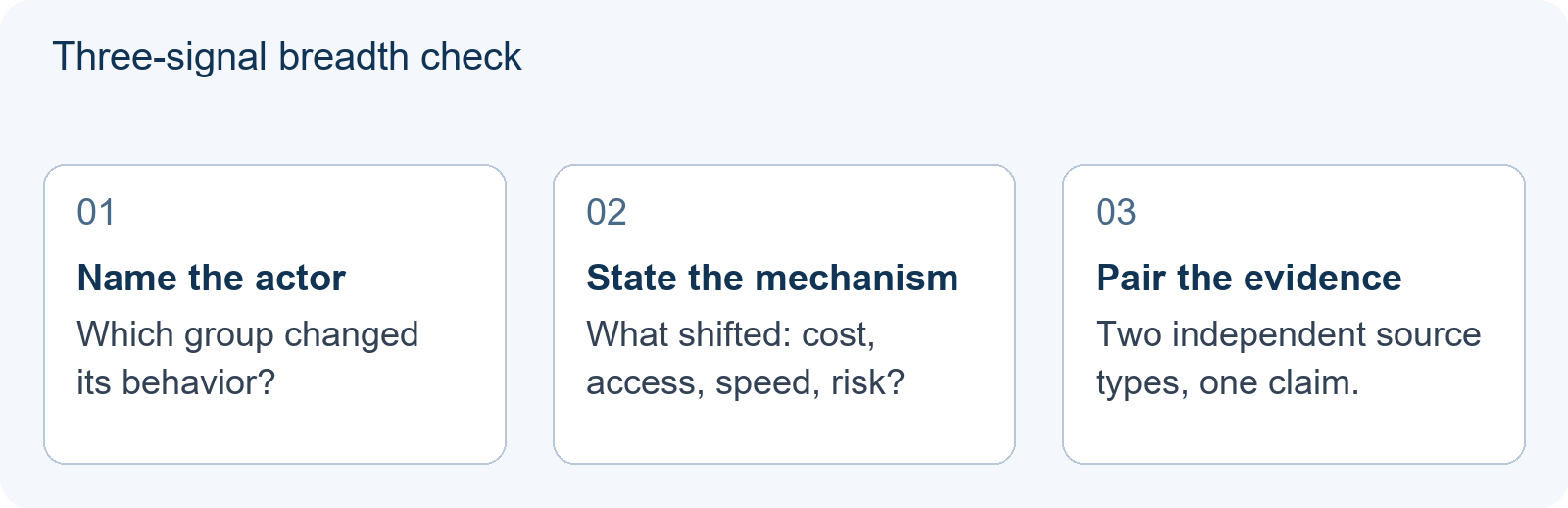
Run the check on your own working thesis before you open a new tab. Each signal is a fail condition, and one fail is enough to justify re-scoping rather than more research.
| Signal | Passes | Fails |
|---|---|---|
| Actor | One identifiable group whose behavior changed: a named port workforce, a category of households, a single regulator’s licensees | “Society”, “the world”, “people everywhere”, “humanity” |
| Mechanism | One link between the invention and the behavior: it lowered a price, removed a permit, shortened a wait, reduced a risk | A list of effects joined by “and also”; the mechanism is implied rather than stated |
| Evidence pair | Two independent source types for the same claim, for example an official statistical series plus an independent study or expert assessment | One press article, one blog post and one encyclopedia entry that all repeat the same sentence |
The evidence-pair test is easy to overlook. A claim supported by four sources that trace back to a single press release is a single source wearing four hats. If you cannot name two genuinely independent kinds of evidence before drafting, the topic is not yet researchable at this length, however compelling the story is.
Shrinking the topic without making it trivial
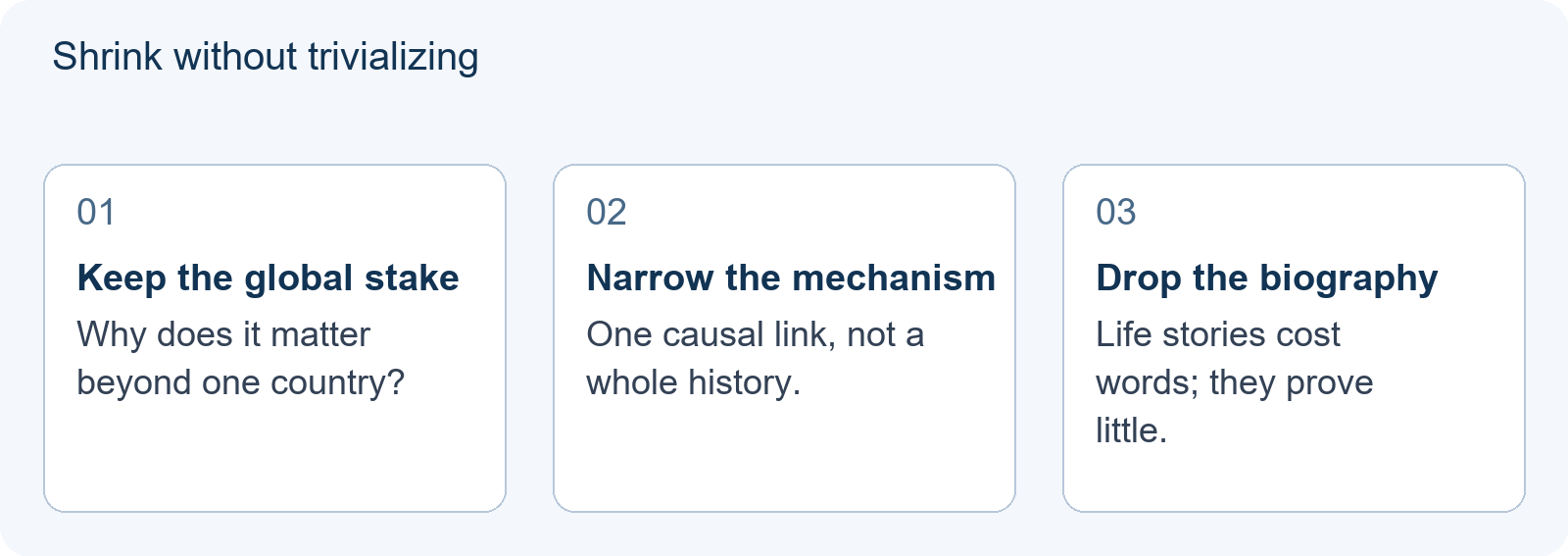
Narrowing can feel like losing ambition, and the temptation is to compensate with grand conclusions. Three moves let you shrink the object while keeping the essay consequential.
Keep the global stake, cut the global survey. A Junior invention essay still needs a reason the change matters beyond one neighborhood. The efficient way to get there is comparison or diffusion: how the same mechanism played out in two settings, or why adoption stopped at a border. The general move of turning a global topic into an answerable question applies here; the Junior version is simply to apply it to an object rather than a policy area.
Narrow the mechanism, not the significance. “The container changed trade” is unarguable and therefore uninteresting. “The container changed the cost of moving one category of goods, which changed where one kind of work was done” is arguable, evidenced and still international in scope.
Drop the biography and the timeline. Inventor life stories and chronological adoption narratives consume words without advancing an explanation. A single dated sentence in the introduction is usually enough chronology. Every additional date should be doing causal work, or it is scenery.
One test of whether you have narrowed enough: can a reader who disagrees with your conclusion still accept that your question was worth asking? If the only possible answer is “yes, the invention mattered,” the topic is still too soft.
Building the evidence budget consequence by consequence
Once the thesis has one mechanism and two or three consequences, budget evidence per consequence rather than per essay. A workable pattern for each consequence is: one quantitative or official source establishing that the change happened, and one independent source that either corroborates it from a different angle or complicates it. The second source is what turns description into analysis, because it gives you something to explain rather than something to repeat.
Watch for three failure modes. First, source monoculture: five citations that are all versions of the same report. Second, orphan statistics: a number with no stated population, year or unit, which cannot be checked and therefore cannot support a causal claim. Third, the missing hyperlink. The guidelines require reliable sources and hyperlinks for factual claims, so a claim whose source you cannot link is a liability at submission and again at Defense Day, when finalists may be invited to a 15-minute presentation and oral defense.
For source-type selection specific to the inventions essay, HIR Junior Division Evidence: Choosing Credible Sources for the Inventions Essay discusses the source problem. The point to carry forward here is structural: your evidence plan should have roughly the same number of rows as your consequence list. If it has three times as many, you are still writing a survey.
Allocating 900 words, then revising in four passes
The allocation below is a teaching suggestion, not a contest rule; the only word-count rule referenced here is the 800-1,200-word requirement excluding specified non-body elements. Its purpose is to make over-scoping visible early. Nine hundred words is used as the worked figure because it sits comfortably inside the range, and the figures sum to 900 as a planning target.
- Opening and thesis: about 90 words, including one dated sentence of context.
- Mechanism paragraph: about 150 words explaining what the invention actually changed.
- Consequence one with evidence: about 170 words.
- Consequence two with evidence: about 170 words.
- Complication or counter-case: about 160 words explaining where the mechanism failed or varied.
- International-affairs stake and conclusion: about 160 words, no new evidence.
If your outline cannot be squeezed into that shape, the topic is still broad. If it fits with room to spare, you have scope to add one more piece of evidence rather than one more consequence.
Then revise in four passes, each with a single job. Pass one: mark every sentence that is chronology or biography and delete it unless it carries a causal claim. Pass two: check that each consequence in the body matches a consequence in the thesis, and cut any that does not. Pass three: verify every factual claim has a working hyperlink to a reliable source and that no claim rests on one source wearing four hats. Pass four: read the thesis and the conclusion together and confirm they answer the same question. A word-count audit before you cut is worth running between passes two and three, because trimming is easier once you know which paragraphs are load-bearing.
Preparing one question for a teacher or consultant
A useful topic-scope conversation starts with a decision to test, not merely a subject. Bring four items on one page: the invention, the single mechanism, the two consequences you intend to evidence, and one source you have already found for the first consequence. That is enough for a teacher to say whether the mechanism is real, whether the two consequences are genuinely separate, and whether the evidence you have is the kind that can carry a causal claim.
Bring the fail case too. If you suspect your topic is broad, say which of the three signals fails and what you would give up by narrowing. A specific trade-off, such as dropping the emissions question to keep the household-cost argument, is easier to evaluate than a general “is this topic good?” question. Grade 7-8 writers who want a wider readiness view before that conversation can use Is Your Grade 7-8 Writer Ready for the HIR Junior Division? A Five-Signal Readiness Check as a companion.
One practical timing note for the current cycle: the Fall/Winter 2026 article submission deadline is 2 January 2027, with Defense Day on 5 February 2027, so a scoping decision made in November leaves real room for evidence gathering rather than a rushed rewrite.
General event background is available at Event background.
Frequently Asked Questions
How do I know if my Junior invention topic is too broad for 800-1,200 words?
Run three checks on your working thesis. Can you name one identifiable group whose behavior changed, rather than “society” or “the world”? Can you state a single mechanism, such as a fall in cost or a removal of a barrier, instead of a list of effects joined by “and also”? Can you name two independent kinds of evidence for that one mechanism before you start drafting? If any answer is no, the topic is still broad and should be narrowed before more research is added.
Can a Junior writer still choose a famous invention like the telephone or the container ship?
Yes, provided the essay isolates one component or one mechanism rather than surveying the invention’s whole history. Fame is not the problem; a multi-chain causal story is. Narrow to one feature, one changed behavior and two or three evidenced consequences, and the essay remains analyzable inside the 800-1,200-word limit. What has to go is the timeline, the inventor biography and the second and third mechanisms.
Does narrowing the topic make the essay less international in scope?
Not if you keep the stake rather than the survey. The contest describes its target as an analytical international-affairs article, and for a Junior invention essay that stake usually comes from cross-border diffusion or comparison: how the same mechanism played out in two settings, or why adoption stopped somewhere. A single well-evidenced mechanism with a comparative payoff can still satisfy the international-affairs framing; a list of global effects is not required.