The Junior division opens the HIR Academic Writing Contest to grades 7 and 8. The demands do not scale down: the published length requirement is 800 to 1,200 words, every factual claim needs a hyperlinked source, AP Style and traditional American spelling apply, and finalists face a 15-minute oral defense. Five tests will tell you whether your writer is ready, and what to build if not.
What the Junior division actually asks a 13-year-old to do
Adding a grades 7-8 entry point is a genuine change, and it is easy to read it as a gentler version of the high-school contest. It is not. What changes is the age band and the prompt; what does not change is the specification of the artefact.
Set out plainly, a Junior entrant is being asked to produce a piece of analytical writing in English within a published range of 800 to 1,200 words, excluding diagrams, tables of data and the authorship declaration. Every factual claim must be backed by a citation from a reliable source, delivered as a hyperlink, and anything that is not the student's own idea must be attributed. The prose must follow the newest edition of AP Style and use traditional American spelling. AI tools are prohibited outright, and the organiser states that submissions are run through multiple AI checkers, with articles scoring high across several of them disqualified. The Junior prompt published for the current cycle is “Inventions that Changed How We Live.” Confirm all of this, including whether any length or format requirement differs by division, on hir.harvard.edu before you plan around it.
Then there is the part parents rarely price in. Finalists are invited to a virtual Defense Day, where they deliver a 15-minute presentation and oral defense to Harvard International Review judges. A grade 7 student who cannot yet talk about their own argument for five minutes without reading from a page is not disqualified from entering, but they are entering something whose upper stage they are not equipped for. That is worth knowing in advance rather than in October.
The five-signal readiness check
Each of these is a test you can run this week, in under half an hour, using writing your child already has. Read the result honestly. “Not yet” is a useful answer at 12 and a costly one to discover at the deadline.
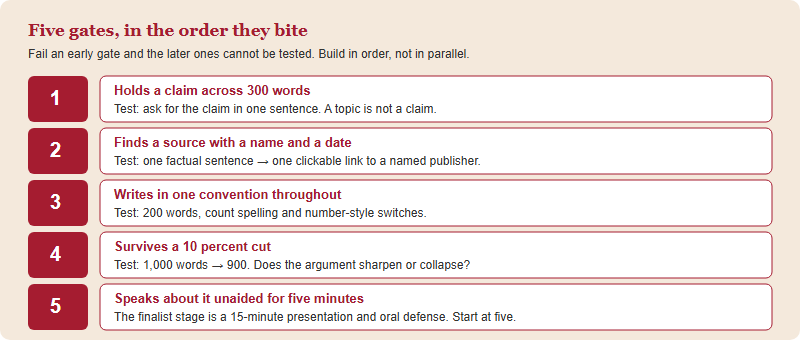
| Signal | How to test it this week | Ready looks like | Not yet looks like |
|---|---|---|---|
| 1. Can they hold a claim? | Hand back 300 words they wrote and ask for the claim in one sentence. | “Refrigeration mattered because it changed what could be sold far from where it was grown.” | “It is about refrigeration.” A topic, not a claim. This is the single most predictive signal. |
| 2. Can they cite? | Ask them to support one factual sentence with a link to a named organization and a date. | They reach for a statistical release, an institutional report or a dated news article, and can say who published it. | They paste a search-results page, a content farm, an undated aggregator, or an answer produced by a chatbot. |
| 3. Do they write in one convention? | Take 200 words and count spelling and number-style inconsistencies. | Consistently American spelling; numbers and dates handled the same way throughout. | British and American spellings alternate in the same paragraph; numerals and words used interchangeably. |
| 4. Can they take a cut? | Give them 1,000 of their own words and require 900 without losing the argument. | They delete background and keep reasoning. The piece gets sharper. | They delete reasoning and keep background, or they refuse, because every sentence feels load-bearing. |
| 5. Can they speak it? | Five minutes, no notes, on an argument they wrote a fortnight ago. | They restate the claim, give one piece of evidence and handle one “why not the other explanation?” question. | They narrate the essay from memory, or stall when asked anything the essay did not already answer. |
The gap that matters most: description is not analysis
Almost every grade 7-8 writer can describe an invention competently. Very few, unprompted, make a claim about one. That difference is where the Content marks live, and it is the difference the Junior prompt is built to expose, because a question about inventions that changed how we live invites description and rewards explanation.
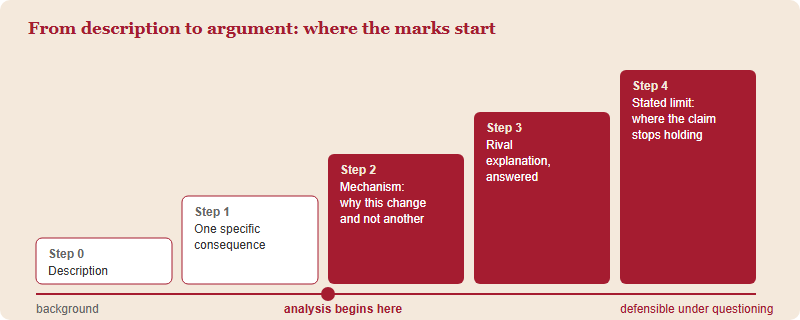
Use a staircase. Take any invention and ask which step the draft actually reaches.
- Step 0, description. What the invention is and roughly when it appeared. Necessary, but it is background, and background is the cheapest thing in the essay.
- Step 1, consequence. One specific thing that changed, stated narrowly enough to be checked. Not “it changed society.”
- Step 2, mechanism. Why the invention produced that change rather than a different one. This is the first step a judge can mark as analysis.
- Step 3, rival explanation. The strongest alternative account of the same change, and why it explains less. This is what the organiser's emphasis on argument rather than advocacy looks like in practice.
- Step 4, limit. Where the claim stops being true: which places, which decades, which conditions. A stated limit reads as confidence, not weakness.
A 900-word Junior essay that reaches step 2 with one well-sourced consequence beats a 1,200-word essay that stops at step 0 and covers four inventions. Breadth is the standard trap at this age, and the word ceiling punishes it mechanically: four inventions across 1,200 words leaves 300 words each, which is not enough room to establish a mechanism for any of them.
If the answer is not yet: a prerequisite path
“Not yet” does not mean waiting a year and hoping. It means three small repetitions, each of which takes 20 to 30 minutes and none of which requires a contest.
The one-sentence claim rep. Once a week, read something short together and write one sentence of the form “X mattered because Y, not because Z.” Nothing longer. The rep is difficult precisely because it forbids summary, and it builds the habit gate 1 tests. In our own coaching, grade 7 students tend to improve at this quickly once they understand it is the whole task (de-identified observation, per Hanlin; results vary).
The source-and-link rep. Take a factual sentence the student has already written and require a clickable source from a named organization with a visible date. Two rules make this valuable rather than mechanical: the link must open for someone who is not logged in, and the source must actually assert the specific thing claimed, not something nearby. Most middle-school writers discover on their second attempt that their favourite fact does not survive this.
The read-aloud rep. Have the student explain a paragraph they wrote two weeks ago, out loud, without the page. Any sentence they cannot paraphrase is a sentence they did not write in their own voice, and it should come out. This one rep does more for authenticity, for style marks and for eventual defense readiness than any amount of editing, and it also quietly protects against the borrowed-phrasing problem that the AI prohibition makes consequential.
Three patterns we see in first-time middle-school drafts
These are de-identified observations from our own coaching rather than official guidance, and results vary between students.
- The encyclopedia opening. Two hundred words of history before any claim appears. At a 1,200-word ceiling that is a sixth of the essay spent on material the judge already knows. A Junior essay can afford roughly two or three sentences of setup before it must commit.
- The uncited superlative. “The most important invention in human history” is a factual claim in the contest's terms, and the citation rule means it needs a source it cannot have. Replace superlatives with comparisons that can be evidenced: more of this, in this period, in this place.
- The borrowed adult voice. Phrasing lifted from a source or a template, retained because it sounds impressive. It costs twice: the student cannot defend it aloud, and the essay reads as though someone else wrote it, in a contest that prohibits AI assistance and checks for it. A 13-year-old writing plainly in their own register scores better than a 13-year-old imitating a policy journal.
One practical note on timing
Whichever way the readiness check comes out, the entry logistics deserve a diary entry rather than a scramble. The official page states that contestants register and pay before becoming eligible to submit an article, and describes admissions as rolling with limited capacity. For a family deciding whether a grade 8 student aims at the next open cycle or builds for a later one, that means the decision has a practical deadline earlier than the submission deadline. Check the current cycle table, the live Junior prompt and any fee on hir.harvard.edu, and read our overview of how the contest works alongside the 60-point rubric breakdown before you commit.
Frequently asked questions
Which grades can enter the HIR Junior division?
The official page lists the Junior division as grades 7-8 and the Senior division as grades 9-12. Confirm on hir.harvard.edu.
Is the word count lower for Junior entrants?
The published requirement is 800 to 1,200 words. Confirm on hir.harvard.edu whether any separate limit applies to your division.
Does a grade 7 finalist really do a 15-minute oral defense?
Finalists are invited to a virtual Defense Day with a 15-minute presentation and oral defense before HIR judges.
Can a parent or tutor edit the essay?
Treat the work as the student's own. AI tools are prohibited and checked for, and the oral defense exposes text the writer cannot explain.
This is an independent guide operated by Hanlin Education for China-based international-school students. We are not affiliated with, endorsed by, or sponsored by the Harvard International Review or Harvard University. Divisions, prompts, word limits, fees and rubrics are set by the organiser and change between cycles: confirm current details on hir.harvard.edu before acting on anything here. Errors reported to our editorial desk are corrected within seven working days.