HIR requires every factual claim to be backed by a citation from a reliable source, delivered as a hyperlink. That single rule decides what belongs in your evidence list: a link is a promise that a judge can click it, reach a named organization and find the exact claim. Here is how to tier sources, and how to build a clickable list from behind a paywall or a block.
The hyperlink rule is a verification test in disguise
The official requirements state that all factual claims must be backed by a citation from a reliable source, that ideas which are not your own must be properly attributed, and that citations should be made via hyperlinks. Read that third clause carefully, because it changes what “reliable” can mean in this contest.
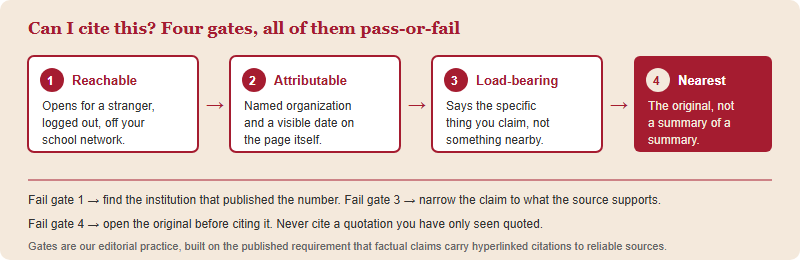
A footnote is a claim about a source. A hyperlink is an invitation to check it. When a judge can reach your evidence in one click, three properties stop being academic niceties and become pass-or-fail conditions:
- Reachability. If the page will not open for someone who is not you, not logged in and not on your school network, the citation does not function.
- Attribution. The destination has to show who published it and when. A page with no organization and no date cannot support a factual claim, however correct the claim happens to be.
- Load-bearing fit. The source has to assert the specific thing you said, not something adjacent to it. This is where drafts most often fail quietly in our own marking: the link opens, the organization is real, and the page does not actually contain the number.
This article is about choosing and reaching sources. The separate question of how to word attribution inside AP-Style prose, and where the marks for evidence sit within the mark scheme, is covered in our breakdown of the 60-point rubric.
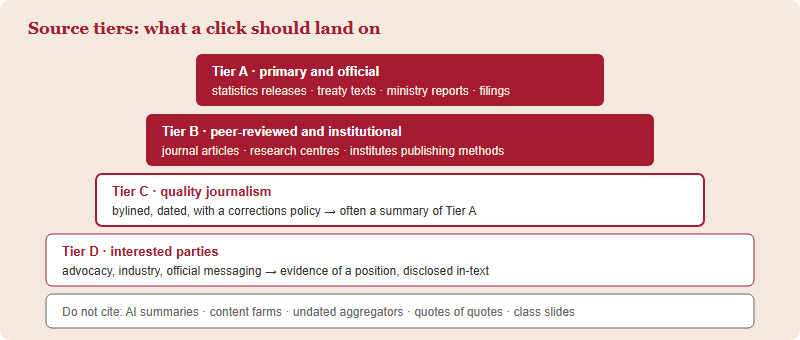
A working tier list
The organiser does not publish a hierarchy of acceptable sources, so treat what follows as our editorial judgment from marking our own students’ drafts rather than as official guidance. It has held up well as a rule of thumb: an essay whose three best citations sit in the top two tiers reads differently from one built on a stack of news summaries.
| Tier | What belongs here | Why it carries weight | The catch |
|---|---|---|---|
| A · Primary and official | Statistical releases, treaty and legal texts, court judgments, ministry and central-bank publications, intergovernmental databases, company filings. | The judge can verify the figure itself, not somebody's summary of it. One Tier A citation can carry a whole paragraph. | Slow to read, and easy to misread. A statistic has a definition, a base year and a coverage note, and quoting it without them is its own error. |
| B · Peer-reviewed and institutional research | Journal articles, university research centres, established research institutes and think tanks that publish their methods. | Provides the mechanism you need for analysis, not just the fact. This is where step-up arguments come from. | Check the date and whether the finding was contested. A 2009 finding presented as current is a substantive weakness. |
| C · Quality journalism | Named reporting with a byline and a date from outlets with a corrections policy. | Good for events, timelines, quotations and recency. Legitimate and often necessary. | Reporting frequently summarises a Tier A document. If it does, cite the document and use the article for context, not the reverse. |
| D · Interested parties | Advocacy groups, industry associations, corporate white papers, party or government messaging. | Excellent evidence of what an actor claims or wants, which is often exactly what an international-affairs argument needs. | Only usable if you disclose the interest in the sentence. Cite it as evidence of a position, never as a neutral finding. |
| Do not use | AI-generated summaries, content farms, undated aggregators, essay-mill samples, your own school slides, and quotes of quotes whose original you never opened. | — | Note separately that the contest prohibits AI tools outright and states that judges run articles through multiple AI checkers, with high scores across several checkers disqualified. |
Encyclopedias sit outside the table on purpose. A general encyclopedia is a superb finding aid and a poor citation: use it to locate the primary document in its reference list, then cite that document. If the only thing you can reach is the encyclopedia entry, you have found a gap in your evidence, not a source.
The access problem, and the legitimate ways around it
Writing from China adds a constraint that most guides ignore: some of the material you would naturally cite sits behind a paywall, and some domains are awkward or impossible to reach from where you are working. The rule that follows is uncomfortable but simple, and it comes straight from the hyperlink requirement.
If you cannot open it, you cannot cite it. Not because the source is bad, but because a hyperlink citation is a promise you cannot keep. Citing a page you reached only through a cached copy, a screenshot a teacher shared, or an abstract you never read past, produces a link that either fails for the judge or leads somewhere that does not contain your claim.
What you can do instead is substitute upward rather than downward. In practice there is almost always a reachable source that is stronger, not weaker, than the paywalled one:
- Go to the institution that produced the number. Journalism about a report is paywalled far more often than the report. National statistical offices, ministries, central banks and intergovernmental bodies publish freely and are Tier A anyway.
- Use your school's database access. Many international schools hold subscriptions students never use. Two cautions: cite the publisher landing page rather than a proxy URL that only resolves inside the school network, and check the link while logged out before you submit.
- Look for the open version. Working-paper series, author preprints, institutional repositories and open-access editions of journal articles frequently carry the same findings at a stable, public address.
- Prefer the document over the commentary. Treaty texts, resolutions, judgments and official communiqués are public, permanent and unusually good evidence, and they let you make claims about what an agreement says rather than about what a columnist thinks it means.
- If a source is genuinely unreachable, change the claim. A slightly narrower claim supported by a source you can link beats a bold claim supported by a broken one. Narrowing under evidence pressure is a skill judges can see.
Can you cite Chinese-language sources?
This is the question we are asked most often by students writing from mainland schools, and the honest answer has two halves.
What the published requirements say is that submissions must be in English with traditional American spelling and follow AP Style, and that factual claims must be backed by citations from reliable sources made via hyperlinks. The language of the essay is specified. We have not found a published restriction on the language of the sources, so treat that as unsettled and confirm it on hir.harvard.edu rather than assuming either way.
What editorial judgment says is that a Chinese-language primary source is often the strongest evidence available for a claim about China, and discarding it in favour of a weaker English summary makes an essay worse. If you use one, four practices keep it defensible:
- Prefer the official English edition when one exists. Many ministries, statistical offices and companies publish parallel English releases. Same authority, no verification friction.
- Attribute in English in the sentence. Name the issuing body in English on first reference and say what kind of document it is, so the claim stands on its own to a reader who cannot read the destination page.
- Translate the specific figure exactly, and only the figure. Quote the number and its unit, not a paraphrase of the surrounding argument. If a definition matters, state it.
- Carry the number visibly. A small data table puts the figure, the unit, the period and the publisher in front of the judge, and diagrams and tables of data sit outside the published word count.
What not to do: use a machine translation as your source, or cite a Chinese-language page for a claim about somewhere else when an English-language primary document exists. The first substitutes a tool for reading; the second looks like convenience rather than judgment.
How many sources, and where they sit
There is no published quota, and anyone who gives you one is inventing it. What we can offer is a shape that reads well at this length, drawn from marking student work rather than from the organiser.
Within a 1,000-word piece, roughly eight to fourteen distinct sources tends to sit right, with the two or three claims that carry the argument resting on Tier A or B material and the remainder doing dated, factual work. Two failure modes bracket that range. Twenty-five links to twenty-five news stories reads as a clippings file and signals that no source was read closely enough to argue with. Three links across 1,000 words leaves most of the essay uncited, which the requirement that every factual claim be sourced does not permit.
Distribution matters more than count. An essay with nine citations clustered in one paragraph and none in the analytical sections is telling a judge exactly where the writing stopped being evidenced. Every paragraph that makes a factual move needs at least one, and the paragraph containing your central claim should carry your best single source rather than your most convenient one.
A twenty-minute source audit
Do this once, on sources only, when the draft is otherwise finished. It is deliberately narrower than a full pre-submission review.
- Open every link in a private window, logged out. Anything that fails is not a citation yet.
- For each one, find the publisher name and the date on the destination page. If either is missing, replace the source.
- Read the sentence in your essay next to the sentence in the source. Confirm the source asserts that, not something adjacent.
- Ask of every Tier C citation whether it is summarising a document you could cite instead.
- Flag any Tier D source and check that the sentence discloses the interest.
- Count how many paragraphs make a factual move with no citation attached, and fix those before anything else.
One more reason to take the audit seriously: finalists face a 15-minute presentation and oral defense, and the fastest question a judge can ask is where a number came from. A source list that survives these four gates is also a source list you can talk about, which is the connection our Defense Day preparation guide works through in detail. If you are new to the contest structure, start with our overview of how it works.
Frequently asked questions
Does HIR require hyperlinked citations?
The published requirements state factual claims need a reliable source and citations should be made via hyperlinks. Confirm on hir.harvard.edu.
Can I cite a paywalled article?
Only if the link opens for a judge. Otherwise cite the institution that published the underlying document, which is usually stronger anyway.
Are Chinese-language sources allowed?
We found no published restriction on source language, but confirm on hir.harvard.edu. Prefer official English editions where they exist.
Can I cite an encyclopedia entry?
Use it to find the primary document, then cite that. An encyclopedia is a finding aid, not evidence for a factual claim.
This is an independent guide operated by Hanlin Education for China-based international-school students. We are not affiliated with, endorsed by, or sponsored by the Harvard International Review or Harvard University. Citation rules, style requirements, divisions and rubrics are set by the organiser and change between cycles: confirm current details on hir.harvard.edu before acting on anything here. Errors reported to our editorial desk are corrected within seven working days.