The summer cycle is closed, and the next HIR window is months out. That gap is not dead time: it is where Content points are made. Style errors can be cleaned up in a week, but evidence quality, analytical depth and coherence accumulate. Here is a four-block plan for the off-season, and the switch point where building stops and drafting starts.
The calendar arithmetic nobody does
The HIR Academic Writing Contest runs on cycles rather than a single annual deadline. As of writing, hir.harvard.edu lists three windows a year and gives the Fall/Winter cycle an article submission deadline of Jan. 2, 2027, with Defense Day on Feb. 5, 2027. Treat those as figures to verify rather than memorize, and confirm the current cycle table on hir.harvard.edu before you build a calendar on it.
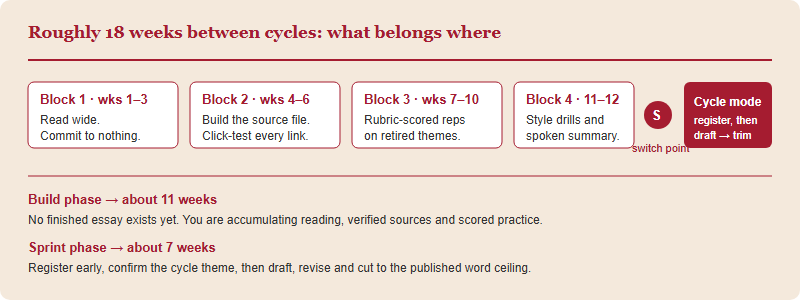
Run the arithmetic anyway, because it changes what you should be doing this week. From late August to a very early January deadline is roughly 18 weeks. We normally suggest allowing about seven weeks for drafting, revision and trimming (our own coaching guideline, per Hanlin; not an official figure). Subtract one from the other and you are left with something close to 11 weeks that belong to neither the last cycle nor the next drafting sprint.
Most entrants spend those 11 weeks doing nothing, then compress everything into the final three. That is the single most common shape of a weak entry, and it is not a motivation problem. It is a structural one: three weeks is enough time to fix mechanics and enough time to produce 1,200 words, but not enough time to acquire the reading, the sources or the argumentative habits that the Content half of the mark scheme rewards.
Why three weeks cannot buy Content marks
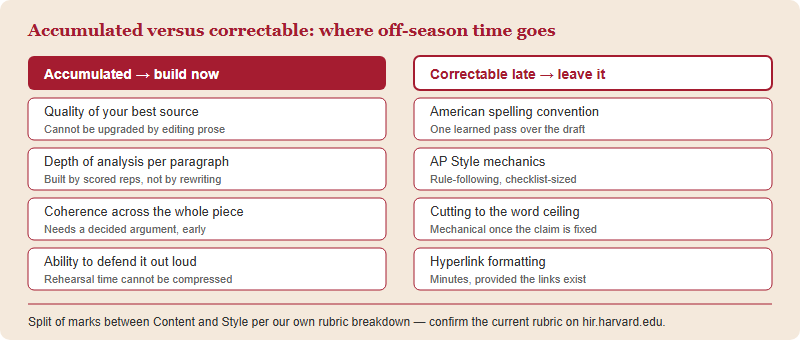
The contest is marked out of 60, split between Content and Style, with the Content half spread across six dimensions. Our full breakdown of that split is in the 60-point rubric, decoded; the point here is narrower and more useful. Some of those marks respond to late effort and some do not.
Consider what a late fix actually looks like. Traditional American spelling and the current edition of AP Style are rule-following tasks: you can learn the recurring cases, run a pass over your draft and stop losing those points inside a week. Cutting 1,350 words down to the published ceiling is a mechanical exercise once the argument exists. Formatting a hyperlinked citation takes seconds.
Now consider what a late fix cannot reach. If your strongest source is a news summary you found on the second day of drafting, no amount of polishing turns it into a primary statistic. If you have never written a paragraph that moves from evidence to analysis and had it marked, you will not produce six of them under deadline. If you have read three articles about your theme, your essay will read like it, and experienced judges recognise the shape immediately.
| Block | What you actually build | Concrete output | How you know it worked |
|---|---|---|---|
| 1. Read wide weeks 1–3 |
A base across the whole theme space, not one topic. Two substantial pieces a week, logged with a one-line summary of the claim each one makes. | A reading log of six to ten entries. No topic committed. | You can name three questions you could argue, and say what the strongest objection to each would be. |
| 2. Source file weeks 4–6 |
For two or three candidate questions, eight to twelve verified, clickable sources each. Primary and institutional material first, journalism second. | Two source files where every link opens for a stranger, logged out. | You have deleted more sources than you kept, because they failed the click test or did not say what you assumed. |
| 3. Scored reps weeks 7–10 |
Three 300-word paragraphs on retired or unrelated themes, each moving from one piece of evidence to a claim, each marked against the Content dimensions. | Three scored paragraphs plus a personal error list. | The same criticism stops appearing. That is the signal, not the score. |
| 4. Style and voice weeks 11–12 |
Drills on the AP Style categories that recur in international-affairs writing, plus rehearsing a five-minute spoken summary of an argument you did not write this month. | An error log that has stopped growing, and one clean spoken run. | You can explain an argument aloud without reading, and your mechanical errors reduce to a repeatable checklist. |
| Switch | Cycle mode begins. Registration comes first, then the live theme, then drafting. | A registered entry and a chosen question. | Nothing about the argument is still undecided when drafting starts. |
The three drills that pay in points
The 300-word rep. Take one piece of evidence: a single statistic, a single clause of a document, a single dated event. Write 300 words that get from that evidence to a claim, and stop. Do not write an introduction. Do not summarise the background. The rep trains the exact movement the mark scheme rewards, and it is short enough that you will actually do it three times rather than once. Score it yourself against the rubric first, then have someone else score it, and compare the two scores rather than the two opinions.
The objection rep. After each 300-word paragraph, write 80 words stating the strongest counter-explanation and why it explains less. This is where the contest's stated preference for argument over advocacy becomes mechanical rather than philosophical: an essay that has already survived its best objection reads differently from one that has never met it. It is also the single best preparation for the oral defense described in our Defense Day preparation guide, because judges' questions are objections.
The error log. Keep one document. Every time a reader marks something mechanical, add a line: the rule, the example, the fix. Do not paste in explanations copied from a style guide. Do record your own recurring failures, which in our own coaching tend to be a short, stable list that repeats indefinitely until written down. In our own teaching we find the log matters more than the drills, because a drill fixes an instance and the log fixes the habit (de-identified observation from our own coaching, per Hanlin; results vary).
The switch point, and why registration comes first
Build mode ends the moment you commit to a question. After that, everything you read is in service of an argument rather than in search of one, and that is a different activity with a different tempo.
Two logistical facts belong at that boundary rather than at the end. First, the official page states that contestants are asked to register and pay before becoming eligible to submit their articles, which makes registration a gate rather than a formality attached to submission. Second, it describes admissions as done on a rolling basis with limited capacity. Read together, those two lines say something plain: the entry decision is not safely deferred to the deadline month. Confirm both the process and any fee on hir.harvard.edu, since neither the amount nor the mechanics are ours to state.
The second thing to settle at the switch point is the theme. Senior entrants choose among broad themes published for the cycle, and the Junior division has its own prompt; the official page lists what is live for the cycle you are entering. Do not assume a theme carries across cycles. If you spent the off-season reading toward one, treat that reading as transferable background rather than as a committed topic, and check the current wording before you draft. For how entry, divisions and Defense Day fit together, start from our overview of the contest.
Four ways to waste the off-season
- Writing a finished essay in September. A draft that sits for three months hardens. You stop being able to see it, your evidence ages, and if the cycle theme is worded differently you will bend a finished argument to fit rather than build the right one. Write paragraphs in the off-season, not essays.
- Using AI to practise. The contest prohibits AI tools outright and states that judges run submissions through multiple AI checkers, with articles scoring high across several checkers disqualified. Beyond the rule, the practical damage is that generated prose trains the wrong reflex: you learn to recognise fluent text rather than to produce defensible text, and a 15-minute oral defense is precisely the format that exposes the difference.
- Collecting sources you never opened. A folder of 40 links is not a source file. A source file is eight to twelve items you have read, dated, attributed and checked against the specific claim you intend to make.
- Reading only inside your comfort discipline. If every entry in your log is economics, your objection paragraphs will be weak, because the strongest counter-explanation to an economic claim is usually not itself economic.
None of this requires more hours than a normal school term allows. Two pieces of reading a week, one 300-word rep a fortnight and a running error log is perhaps 90 minutes weekly. The advantage is not effort. It is that the work happens when there is still time for it to change how you write, rather than three weeks out, when there is only time for it to change how you feel.
Frequently asked questions
How long is the gap between HIR cycles?
The official page lists three cycles a year, so gaps run to several months. Confirm current dates on hir.harvard.edu before planning around them.
Should I write a full essay before the next cycle opens?
No. Write scored 300-word paragraphs instead. Full drafts harden, age, and get bent to fit a theme they were not built for.
Can I reuse off-season reading if the theme changes?
Yes. Reading transfers as background and as objection material. A committed topic does not. Check the live cycle wording before drafting.
When should I register for the next cycle?
Well before the deadline month. The official page says registration and payment precede submission eligibility, and describes capacity as limited.
This is an independent guide operated by Hanlin Education for China-based international-school students. We are not affiliated with, endorsed by, or sponsored by the Harvard International Review or Harvard University. Contest rules, dates, divisions, fees and rubrics are set by the organiser and change between cycles: confirm current details on hir.harvard.edu before acting on anything here. Errors reported to our editorial desk are corrected within seven working days.