Pick an invention whose effect you can trace through one daily routine and document with sources a Grade 7-8 writer can actually read. That is the practical answer for the 2026-27 HIR Junior Division. Fame is not evidence: a famous invention can still produce a thin essay if the writer can only list a launch date, an inventor biography and a vague claim that life changed.
The test below is deliberately pre-research. It helps a family reject a weak topic before weeks disappear into sources that never answer the question. It is a selection aid, not an official scoring sheet.
What the Junior Division actually requires
The Hanlin Courses WeChat report ‘2026 HIR Harvard International Review Writing Summer Competition Results Released! The Next Fall/Winter Cycle…’ (29 September 2026) reports that the Junior Division is for grades 7-8, uses the theme ‘Inventions that Changed How We Live’, and requires an 800-1,200-word English essay. The same report lists a Fall/Winter essay submission deadline of 2 January 2027 and HIR Defense Day on 5 February 2027, with successful finalists attending the online Defense Day.
This is an independent preparation guide, not affiliated with or endorsed by Harvard International Review or Harvard University. It does not reprint the complete official task brief; the task facts here come from the attributed report above, while the selection advice is editorial. Families should obtain and read the organizer’s current complete task file before drafting.
As of 9 November 2026, the China-region registration deadline of 25 October 2026 listed in that report has passed. Do not treat this article as a live registration notice. If you are already in the Fall/Winter cycle, the 2 January 2027 essay deadline and 5 February 2027 Defense Day are the dates to plan around. If you are not already registered, confirm current entry status with the organizer rather than assuming a late path.
Why a famous invention can fail the evidence test
A famous invention is easy to name and hard to prove. A writer can find a launch date, an inventor biography and a celebratory anniversary article. None of those sources automatically shows that daily life changed, or that the invention caused the change. A launch date establishes availability, not adoption. A biography explains design intent, not whether households, schools or workplaces used the object in the way the essay claims. An anniversary article may repeat a familiar story without giving the reader a checkable mechanism.
This matters in the Junior Division because the word limit is tight. In 800-1,200 words, the writer cannot cover the whole world, the whole century and every rival cause. A topic that demands a global survey risks collapsing into a timeline or making unsupported leaps. A narrower topic is not a smaller idea. It is a claim the writer can actually test.
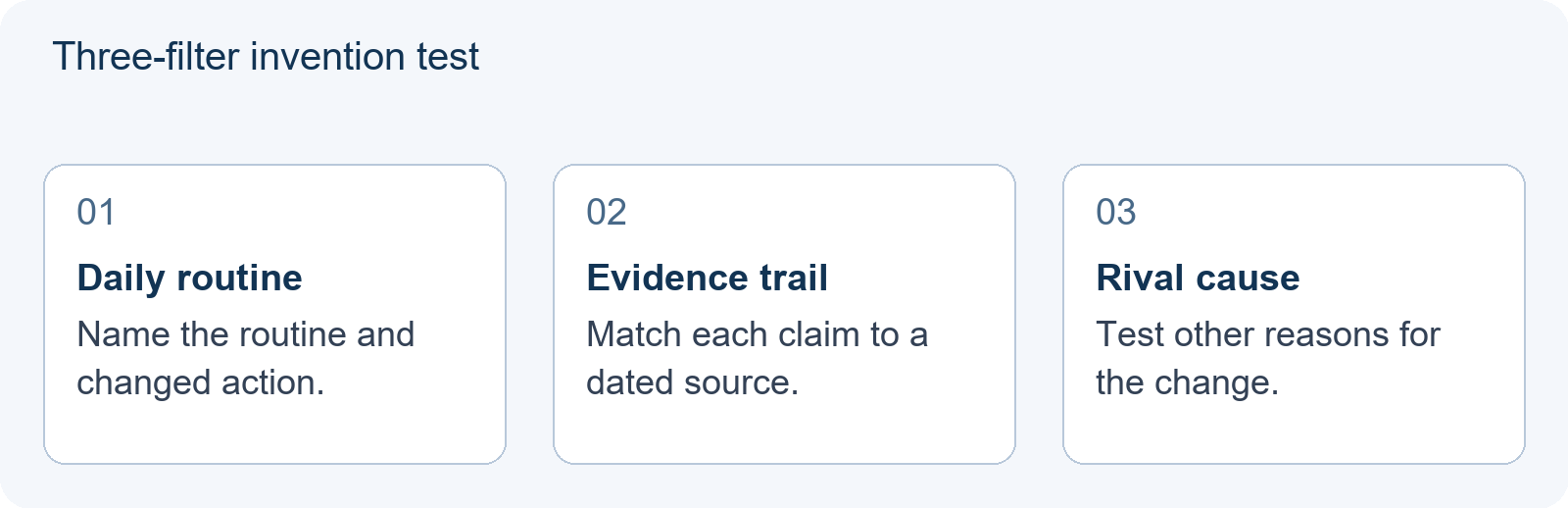
Filter 1: Can you name the daily-life mechanism?
A usable Junior topic is not ‘the internet’ or ‘the telephone.’ It is a named routine, a before-and-after action, and a group of people whose daily life plausibly changed. The writer should be able to say: ‘For this group, in this place and period, this invention changed this specific action, through this mechanism.’ If that sentence cannot be written without the word ‘everyone’, the topic is probably too broad.
Ask three questions. First, what routine does the invention touch—cooking, laundry, travel to school, keeping in touch with relatives, storing food, paying for a bus? Second, what action changed: time spent, who did the work, cost, safety, distance, or the information available? Third, who experienced the change, and who did not? A topic that cannot answer the third question will struggle to support a causal claim inside 800-1,200 words.
Reject topics whose only evidence is a launch date or an inventor biography. Both may appear in the essay, but neither can carry the central claim alone. The same rule applies to a product advertisement or a company history. They can show what a seller promised, not what a household did.
Filter 2: Can you build a traceable evidence trail?
Before committing, sketch the evidence you expect to find. A practical mix for a Junior essay is an official statistic or regulatory record, a contemporaneous report, and a scholarly or archival account. This guide does not assert an official minimum source count. The test is whether each part of your causal claim has a source that can be checked, dated and connected to the claim you are making.
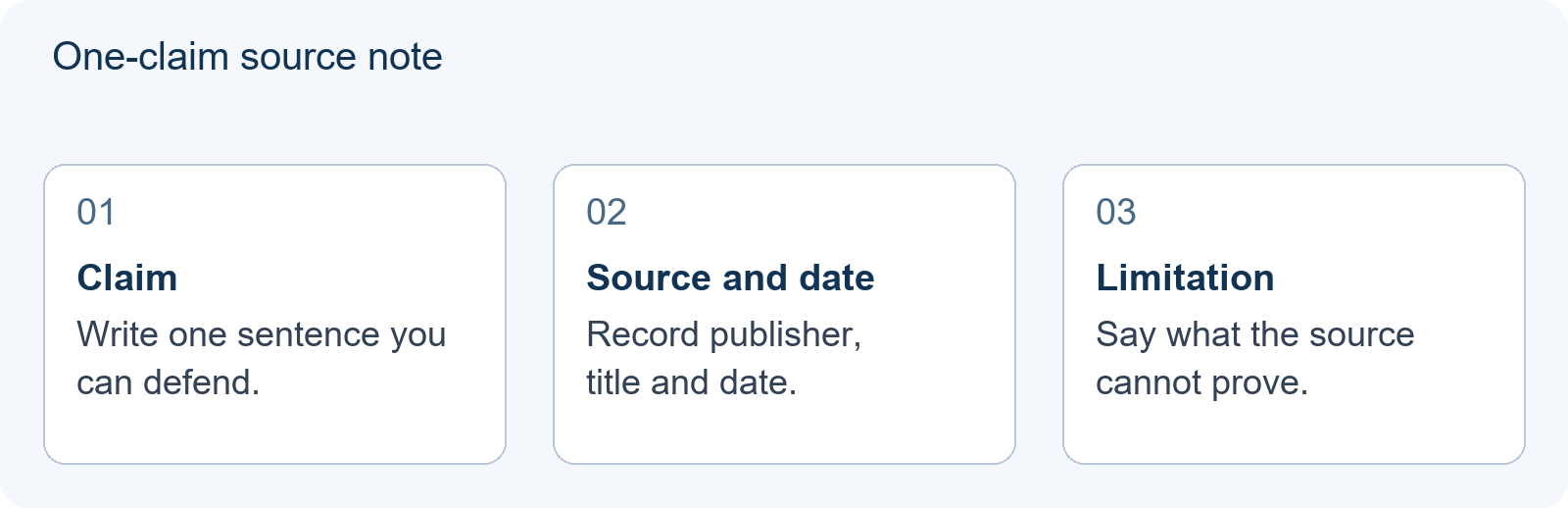
Use a one-claim note template before drafting. This is an editorial research recommendation, not an official form. The table below is a teaching illustration of how to record evidence without letting a source do more work than it can.
| Note line | What to write | Why it matters |
|---|---|---|
| Claim | One sentence you could defend aloud. | Keeps the source tied to your argument. |
| Source and date | Publisher, title, date and page if relevant. | Makes the evidence traceable later. |
| Limitation | What the source cannot prove. | Prevents overclaiming in the draft. |
For example, a source may show that an appliance was sold in a region, but not that households used it in the way you claim. A survey may show reported time use, but not prove that the invention alone caused the change. The note should state the limitation at the same time as the claim, while the source is still open. For a fuller source-credibility method, see HIR Junior Division Evidence: Choosing Credible Sources for the Inventions Essay and the site’s guide to Which Sources Actually Count: Building a Clickable Evidence List for an HIR Essay From China.
A simple two-source check can save a weak topic. If the claim is that a routine changed, look for one source that describes the routine before or during the change and one source that independently describes the change. The two sources should not simply repeat the same press release. If both come from the same company, the same campaign or the same single survey, the trail is thinner than it looks. The writer needs enough independence to show that the claim is not just a marketing narrative.
Filter 3: Can you handle rival explanations?
An invention is not the only factor that changes daily life. A washing machine needs electricity, water, detergent, housing space and someone who can afford it. A telephone needs a network, a billing system and people with a reason to call. If the draft says ‘X changed life’ without asking what else changed at the same time, the causal claim is vulnerable.
Use a rival-explanation test: name at least two other changes that could explain part of the outcome. Then decide whether your essay can acknowledge them without collapsing. A strong Junior topic does not need a perfect causal proof; it needs a claim narrow enough that the evidence can carry it.
The following is a labelled teaching illustration, not an actual contest prompt or official scoring example. Suppose two Grade 8 writers propose these candidates.
| Hypothetical candidate | Daily routine | Expected evidence | Rival explanations | Verdict |
|---|---|---|---|---|
| Household washing machine in one urban region, 1995-2005 | Weekly laundry; who did it; time and physical effort | Adoption data, appliance manuals, time-use surveys, oral histories | Piped water, detergent, housing, household size, gender norms | Workable if the claim is limited to one group and period. |
| Smartphone, global, 2007-present | Communication, information, shopping, photography and more | Adoption data, platform reports, surveys; causal evidence harder | Internet, landline pricing, platforms, social norms | Too broad unless sharply narrowed to one routine and group. |
Candidate 1 is not automatically better because it is older. It is more workable because the daily routine is narrow, the evidence types are identifiable, and the rival explanations can be named inside the word limit. Candidate 2 is not forbidden. A writer could narrow it to one routine, one group and one period—for example, how a specific group of students used mobile messaging to coordinate a daily commute—but the global claim in the table cannot be supported in 800-1,200 words.
Scope control: one claim, one group, one period
Turn the topic into a defensible sentence before research expands. A useful template is: ‘For [group] in [place] between [years], [invention] changed [routine] by [mechanism], although [rival factor] also shaped the outcome.’ Fill it with words you can define. If the group is ‘students’, say which students and where. If the period is ‘the 2000s’, say which years and why they matter. If the routine is ‘communication’, say which message, from whom, to whom and how often.
Write the claim at three sizes before drafting: a one-sentence claim, a one-paragraph outline, and a source checklist. If the one-sentence claim cannot survive the checklist, shrink the group, the place or the period. This is faster than discovering halfway through the draft that the evidence only covers a small subset of the people named in the introduction.
One risk is that a Junior draft promises a global history, but the body can only support one local example. A narrower claim is not a smaller idea. It is a claim the writer can actually test.
Plan backward from the January deadline
If you are already in the Fall/Winter cycle, work backward from 2 January 2027. Leave at least two weeks for source checking and citation repair after the main draft, because a late discovery that a key number has no denominator can force a rewrite. Leave separate time for a read-through against the task requirements; the essay is 800-1,200 words, so every paragraph must earn its place.
For each paragraph, mark its job in the margin: mechanism, evidence, limitation, rival explanation or conclusion. If a paragraph has no clear job, it may be a fact tour rather than an argument. That check is especially useful when the draft contains many dates but few causal links.
Defense Day on 5 February 2027 is an oral defense described in the source report, not a second essay. The writer should be able to explain the invention choice, the evidence trail and the rival explanations aloud. A topic chosen only because it sounded impressive will be harder to defend than one chosen because the writer can point to specific sources and limits.
If the essay is not yet started, do not let topic selection consume the whole calendar. Set a decision date: after a fixed number of research hours, choose the candidate whose evidence trail you can verify, not the name you recognize first.
Before you ask for help, prepare a topic-fit brief
A useful preparation conversation starts with a one-page brief, not ‘please choose a topic.’ Include: the candidate invention; the specific routine; the group, place and period; a draft causal sentence; two expected source types; one rival explanation; and the word budget. This lets a teacher or adviser test the logic before anyone writes a paragraph.
- Name the routine in ordinary language.
- State the claim with a group, place and period.
- List two source types you can actually access.
- Write one rival explanation you are willing to discuss.
- Mark any fact you cannot yet source as ‘to verify’, not as a placeholder number.
This brief also helps a family judge fit. If the student cannot explain the daily-life mechanism in two sentences, more drafting time may not fix the topic. If the student can explain it but lacks sources, the next step is evidence help, not a new topic. For a broader readiness check, see Is Your Grade 7-8 Writer Ready for the HIR Junior Division? A Five-Signal Readiness Check.
The goal is not to find an impressive-sounding invention. It is to find the invention whose effect on daily life can be shown, limited and defended with evidence the student understands.
General event background is available at Event background.
Frequently Asked Questions
Is a famous invention automatically a strong HIR Junior Division topic?
No. Fame can make a topic sound impressive, but it does not supply evidence. A strong Junior topic needs one traceable daily routine, a specific group and period, and sources that can support the causal claim without claiming that the invention alone changed everyone’s life.
How many sources should an 800-1,200-word Junior essay cite?
This guide does not set an official source quota. Use enough sources to support each part of your claim, mix source types where possible, and record the limitation of each source before drafting. Treat source count as a response to your claims, not as a target number.
Can a Grade 7-8 writer choose a very recent invention?
Yes, if accessible evidence exists and the claim is narrow. Recent inventions can be harder because adoption data, independent reporting and scholarly accounts may still be developing. Narrow the topic to one routine, group, place and period, and check that you can find sources beyond launch coverage.