Disclaimer: This is an independent preparation guide. It is not affiliated with or endorsed by Harvard International Review or Harvard University.
For many Grade 7 and 8 students, the Harvard International Review (HIR) Junior Division theme, “Inventions that Changed How We Live,” feels welcoming because the subject matter is familiar. Smartphones, vaccines, electricity, and the internet are easy to name. The difficulty is not finding an invention. It is finding credible evidence that supports an analytical claim about how that invention changed human life. A Junior entry that only lists dates, inventors, and famous firsts reads like a timeline. A stronger entry explains a mechanism of change: what changed, for whom, under what conditions, and with what consequences.
The challenge for young writers is moving from background reading to research-grade evidence. Many students default to general knowledge sites such as Wikipedia, Zhihu, or Xiaohongshu because they are accessible and fast. Those platforms can help you brainstorm. They can show you what terms people use, what debates exist, and what questions might be worth asking. They are not recommended as the main evidence for an academic contest. The reason is not that every user-generated page is false. The reason is that an essay needs sources with identifiable authorship, editorial accountability, and enough context for a reader to check the claim. This guide explains how to triage source types for the Junior Division, how to transform source material into analysis, and how to keep attribution clean within the 800–1,200 word limit.
Why a Junior inventions essay still needs research
The Junior Division theme invites writers to start from a specific invention and analyse its impact on human life. That wording is important. It does not ask for a celebration of inventors or a catalogue of technical features. It asks for an explanation of impact. For example, “The smartphone was released in 2007” is a fact. “The smartphone shifted social interaction from synchronous face-to-face contact toward asynchronous digital communication” is a claim. To support the second sentence, you need evidence that shows a change in behaviour, institutions, or economic activity.
Research gives you that evidence. It can provide a statistic, a case study, a policy document, or an expert analysis. It can also help you avoid overgeneralising. A Grade 8 writer might observe that mobile phones are everywhere and conclude that they transformed life for everyone in the same way. Research complicates that claim. It shows differences between urban and rural areas, age groups, income levels, and countries. Those differences do not weaken the essay. They give the writer something precise to explain.
Good research also helps you narrow your scope. The theme is broad, but the word limit is short. You cannot cover the entire history of the internet in 1,000 words. You need one invention, one pathway of impact, and a small number of claims that can be supported. Research is how you find that pathway. It is also how you discover whether your first idea is too obvious. If every source says the same general thing, you probably need a sharper question.
Source triage for Grades 7–8
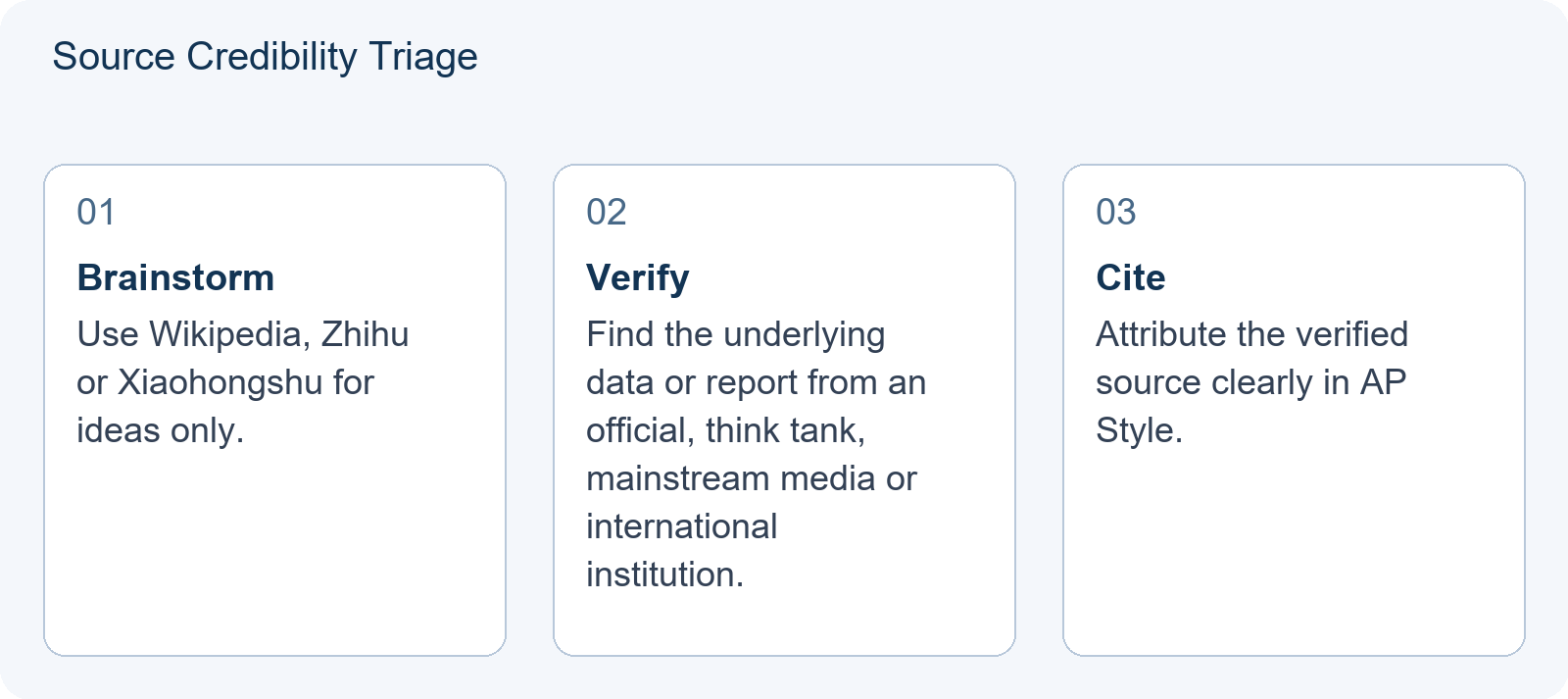
Not all sources are equal, and not every source needs to be equally strong. For an HIR Junior essay, source selection should prioritise official sites, think tanks, mainstream media, and institutions such as the World Bank, IMF, and UN. These organisations may publish data, reports, or analysis that can be named and checked. When you evaluate a source, ask three questions: Who published it? What expertise or responsibility does the publisher have? Is the information current enough for the claim?
Primary and official sources. These include government reports, international organisation databases, official statistics, and corporate white papers. They are useful when you need definitions, policy details, or measurable data. For example, if you write about mobile payments, a World Bank report on financial inclusion can provide a credible frame. A government statistical office may provide national adoption figures. These sources are strong because they are authoritative and often explain their methodology.
Reputable secondary sources. Mainstream media outlets, such as BBC, Reuters, or The Economist, and academic journals can provide context and analysis. They are useful for understanding public debate, policy controversy, or expert interpretation. When you use a secondary source, look for one that cites its own evidence. If a news article says “studies show,” try to find the study or at least name the institution behind it. A secondary source is most valuable when it helps you interpret primary data, not when it replaces data altogether.
Background-only sources. Wikipedia, Zhihu, and Xiaohongshu are best used for early brainstorming. They can help you identify key terms, possible case studies, and related questions. They should not be cited as main evidence. A user-generated post may be useful for a quick orientation, but it usually lacks the editorial accountability and methodological detail that a contest essay needs. Use it to find leads, then verify those leads through official or reputable secondary sources.
A practical triage system looks like this: if a source is written by an institution with a clear public record, it can support a factual claim; if it is a news analysis with named journalists and cited evidence, it can support interpretation; if it is a user-edited page, it can suggest a direction but should not carry the argument. This distinction matters because Junior writers often cite the first search result. A better habit is to ask what kind of work the source is doing in your essay.
Teaching illustration: from claim to source
To show how this works, consider a clearly labelled teaching illustration. It is not an official contest prompt sample, and the details are hypothetical. Imagine a student wants to write about mobile payment systems. The first idea is vague: “Mobile phones changed how people pay for things.” That sentence is true in a general way, but it does not give the essay an argument.
A refined claim might be: “QR-code mobile payments reduced the cost of accepting digital payments for small vendors, which made it easier for some informal sellers to record sales and reach customers beyond their immediate neighbourhood.” This claim is still manageable, but it now has a mechanism. The mechanism is lower cost and easier acceptance. The consequence is greater market participation for small vendors.
To support the claim, the student should not cite a random blog post. The student might look for a World Bank report, a national financial inclusion survey, or a peer-reviewed development study. Suppose the chosen source reports that after a mobile-payment system was introduced, a group of small merchants reported lower payment-processing costs or higher sales. The student should not write “everyone uses mobile money” or “mobile payments ended poverty.” Instead, the student could write: “According to [institution and year], small merchants in [setting] reported [specific finding]. This finding supports the claim that mobile payments can lower a barrier to market participation, because a vendor who can accept digital payment may serve customers who carry little cash.”
That paragraph does three things. It names the source, states a specific finding, and explains why the finding matters for the thesis. The student does not need to invent a statistic. If the source provides a number, the student cites the number and explains it. If the source provides a qualitative case study, the student describes the case and explains the mechanism. The teaching point is that evidence becomes useful only when it is connected to a claim.
Turning source material into analysis
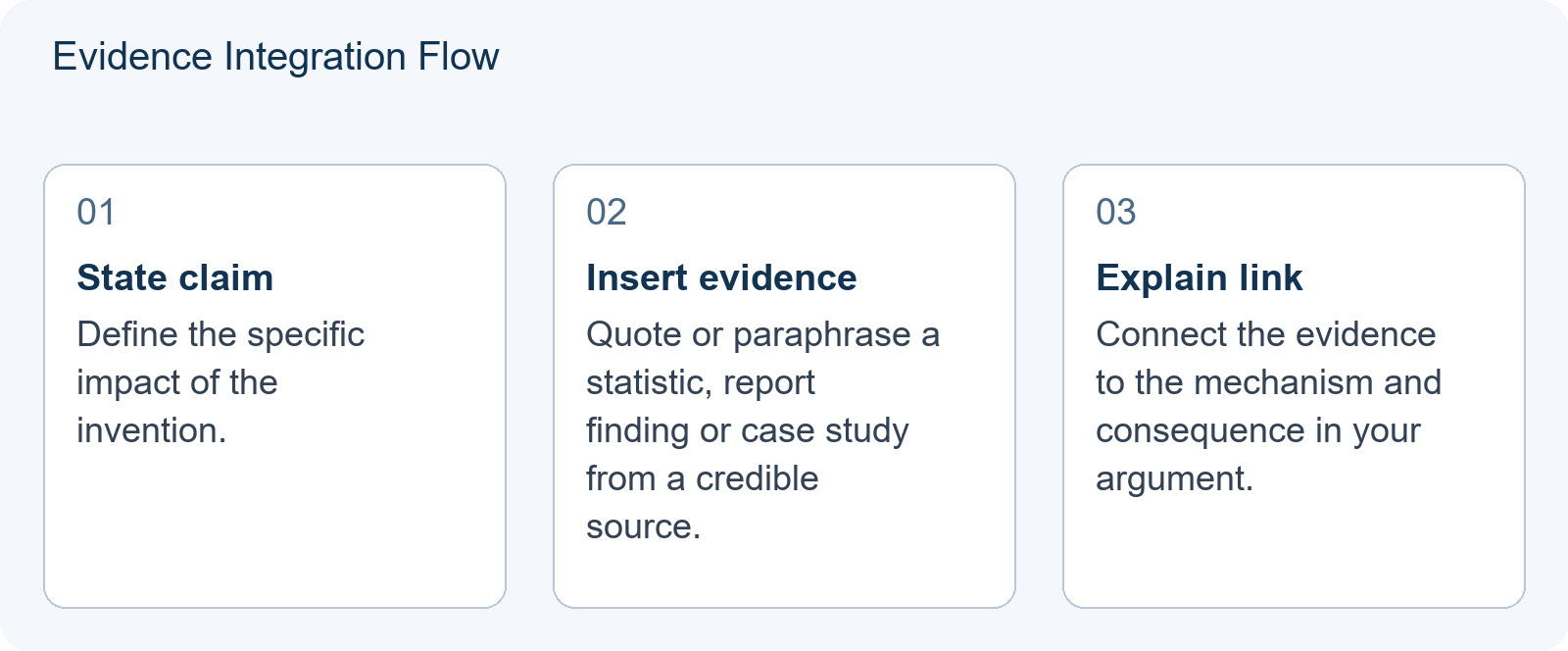
Finding good sources is only half of the work. You must integrate them. Avoid quote dumping, where a long passage sits in the essay without explanation. A simple method for Junior writers is Claim–Evidence–Reasoning.
Claim: State your point clearly. Example: “Digital maps changed how people navigate unfamiliar cities.” This is not yet proven. It is the direction of the paragraph.
Evidence: Provide a fact, quotation, or data point from a credible source. For a teaching illustration, a writer might use a transport authority report that measures how travellers plan routes; the writer must cite the actual report and figure from their own research. The exact figure should come from the source you actually found. If you do not have a source, do not invent a number.
Reasoning: Explain why the evidence supports the claim. Example: “This shift matters because route-planning tools can reduce the time cost of navigating an unfamiliar system, which may change which routes, neighbourhoods, or jobs people consider accessible.” This final step is where analysis happens. Without it, the source is just a fact sitting in the paragraph.
In the Junior Division, space is limited. Each paragraph should serve a purpose. If a source does not directly support your thesis or help explain a mechanism, cut it. Two well-analysed pieces of evidence are often more powerful than five loosely connected facts. This is especially true when the word limit is 800–1,200 words. HIR’s word-count guidance treats charts, data tables, and the author declaration as excluded from that count, but you should still make sure any visual or table has a clear source note.
Attribution and AP Style basics
HIR uses AP Style, so do not simply carry over MLA or APA habits from school. Practical checks include names of people, institutions, and countries. In general AP Style, numbers under ten are spelled out, while larger numbers use Arabic numerals. Titles should follow AP Title Case rules. Spelling should be consistent, and the contest notes indicate that HIR generally expects American English rather than a mix of British and American forms.
More important than memorising every rule is making your evidence traceable. Key facts, data, policies, and quotations need reliable source support. Charts and data tables also need source notes. Do not write “studies show” without naming the institution or publication. Do not write “many people think” unless you can show which people and where that claim comes from. A sentence such as “According to a World Bank report on financial inclusion” is stronger because the reader knows who produced the information.
When you attribute a source, give enough detail for a reader to find it. For a report, name the institution and year. For a news article, name the publication and, if useful, the journalist. For a dataset, name the database and the year of the data. You do not need to overload a short essay with long citations, but you do need to avoid vague references. A clean source note builds credibility even when the sentence is short.
Consistency also matters. If you use American spelling, use it throughout. If you use figures, keep the style consistent. If you include a chart or table, label it clearly and state where the data came from. These are not decorative details. They signal that the writer has control over the material.
Red flags to avoid
Certain patterns weaken Junior Division essays. Recognising them helps you self-edit before submission.
- Encyclopedia summaries. Paragraphs that read like dictionary entries define the invention but do not analyse its impact. Always ask: so what changed?
- One-user anecdotes. A personal story or a single social media testimonial is rarely representative. It can illustrate a broader trend, but it should not be the main proof of a global claim.
- Invention lists without argument. Listing the wheel, the printing press, and the internet without connecting them to one thesis produces a disjointed essay. Choose one invention or a tightly related cluster and explore it deeply.
- Unverified claims. Statements such as “everyone knows” or “it is obvious that” replace evidence with assumption. Replace them with sourced facts or reasoned explanation.
- Source dumping. A paragraph that strings together three quotes without explaining their relationship to your claim is not analysis. Connect each source to the paragraph’s claim.
Pre-submission evidence check
Before finalising your draft, conduct a dedicated evidence audit. Read your essay with a pen or highlighter. Mark every factual claim, statistic, quotation, and policy reference. Next to each mark, write the source name and source type, such as “World Bank report,” “BBC article,” or “government database.” If you cannot name the source, the claim is not ready.
Then check balance. Are you relying too heavily on one type of source? Do you have enough specific evidence for your central claim? Have you explained why each piece of evidence matters? If a paragraph contains evidence but no reasoning, add a sentence that connects it to the thesis. If a paragraph contains reasoning but no evidence, find a source or narrow the claim.
Finally, check the small details that affect credibility. Confirm that numbers follow AP Style. Check that names of institutions and countries are accurate. Make sure charts and tables have source notes. Ensure the essay stays within the 800–1,200 word limit, remembering that HIR’s word-count guidance treats charts, data tables, and the author declaration as excluded. A clean, well-sourced essay demonstrates the research discipline expected of a competitive Junior writer.
For further guidance on readiness and scope, see the related Hanlin reading on Is Your Grade 7-8 Writer Ready for the HIR Junior Division? A Five-Signal Readiness Check. For a practical method of organising evidence, see Which Sources Actually Count: Building a Clickable Evidence List for an HIR Essay From China. For how diagrams and data tables interact with the word limit, see The Words That Do Not Count: Using Diagrams and Data Tables Inside the 800-1,200 Word HIR Limit.
Frequently Asked Questions
Can I cite a personal interview with a relative about an invention?
A personal interview can add colour, but it is weak as primary evidence for a global impact claim. Use it only to illustrate a trend that is supported by broader evidence.
Do I need to cite every fact?
Cite specific data, quotations, policies and non-common-knowledge claims. General statements do not need citations, but any claim about scale, change or impact should be sourced.
Can I use a Chinese-language source if I translate it?
Yes, if it is credible. Translate accurately, identify the original institution or author, and give enough citation detail for an English reader. The same source-quality test applies.