Disclaimer: This is an independent preparation guide for students participating in academic writing competitions. It is not affiliated with, endorsed by, or officially connected to Harvard International Review or Harvard University.
The 2026 HIR Fall/Winter Cycle lists Senior Division Theme B as “Security in a Multipolar World.” The supplied source notes also state that contemporary security concepts extend beyond traditional military alliances to include cybersecurity, energy security, and supply-chain security. That expansion is an opportunity and a trap. It invites students to write about technology, energy, and trade, but it does not make every technology, energy, or trade issue a security argument.
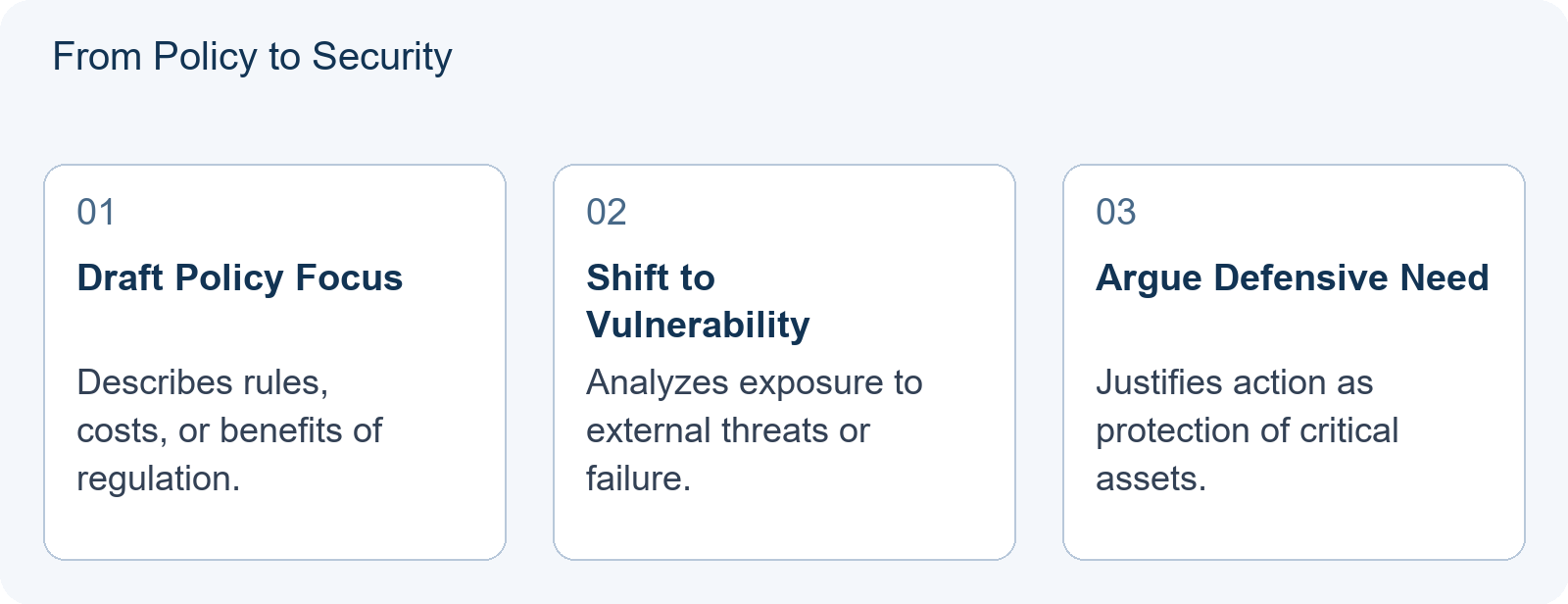
Drafts often fail by describing a policy field instead of analyzing a security problem. You might accurately explain data-protection rules, renewable-energy targets, or semiconductor subsidies, but the essay still misses the core question: what is threatened, how does the harm occur, and who or what poses the danger? This guide provides a four-part method to transform those descriptions into rigorous security arguments. Note that this is an independent preparation tool, not official scoring guidance, and all examples are hypothetical teaching illustrations.
Why Non-Military Security Arguments Collapse into Policy Description
A recurring failure mode is treating a policy issue as automatically a security issue. Government action, international cooperation, or technical risk does not by itself create a security argument. Security requires a threatened value and a causal pathway to harm. Without those elements, the essay becomes a policy brief: useful for a government report, but weak as an analytical HIR article.
Consider the difference between “Country X should subsidize solar manufacturing” and “Country X’s dependence on imported solar components creates a coercive vulnerability because a supplier can restrict exports during a diplomatic crisis.” The first sentence recommends an economic policy. The second identifies a referent object (industrial capacity), a mechanism (export restriction), an actor (a supplier with leverage), and a consequence (coercion). The second sentence is a security claim. The first is not.
A second failure mode is threat listing. A draft may move from cyberattacks to energy shortages to trade barriers without explaining how those threats connect. The reader sees many risks but no argument. In a multipolar setting, the analytical value comes from showing how distributed power creates specific dependencies and vulnerabilities. Listing problems does not show that. Tracing a causal chain does.
If the topic is still too broad, use the method in HIR Essay Scope: Turning a Global Topic Into an Answerable Question before applying the diagnostic. Scoping first prevents a security argument from becoming a survey of an entire policy area.
The Four-Part Diagnostic for Theme B Essays
Use this four-part test on every major paragraph. A paragraph does not need all four parts in every sentence, but the essay as a whole must make each part explicit. The test is a teaching tool, not an official rubric.
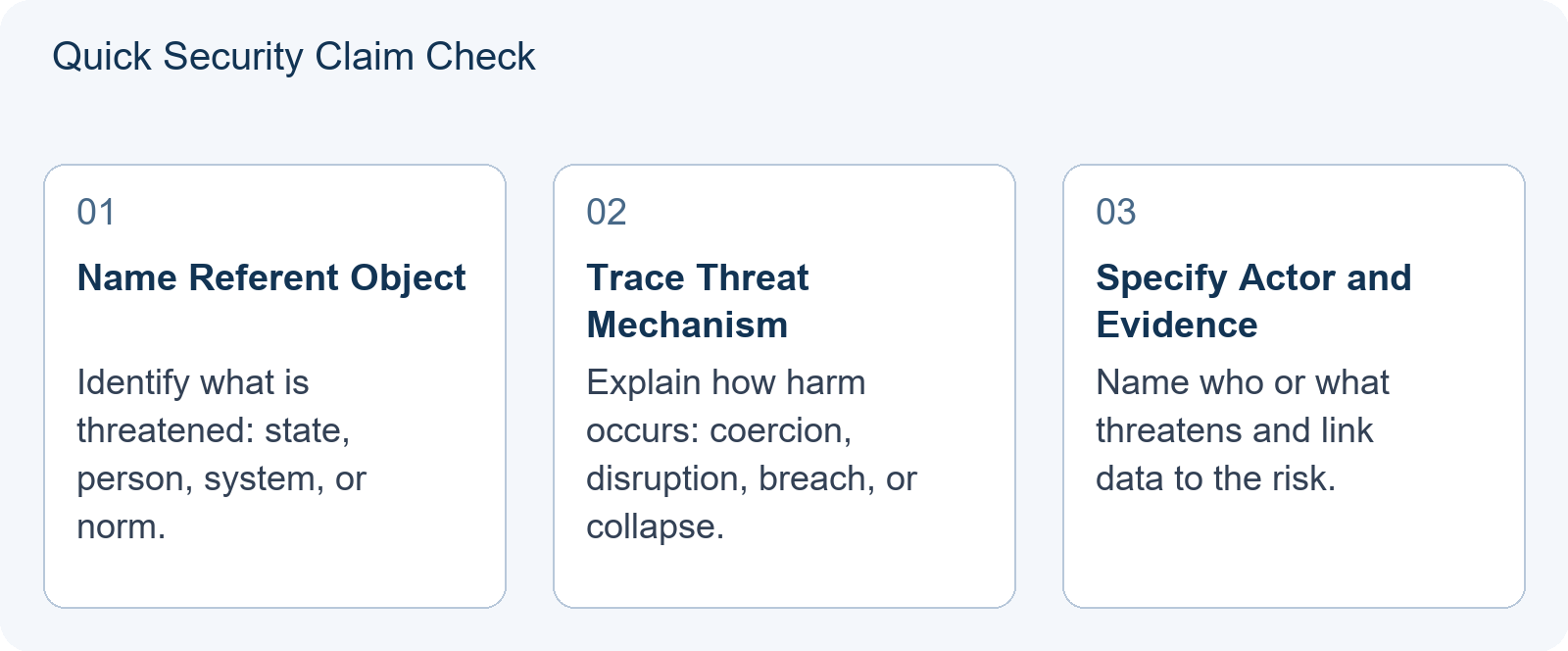
1. Referent Object: What Is Being Threatened?
Traditional security studies often focus on the state. Non-military security can expand the referent object to include individuals, communities, ecosystems, or critical systems. In a Theme B essay, you must name what you are protecting. Are you arguing about the security of a national grid? The privacy of citizens? The continuity of global supply chains? Ambiguity here weakens the argument. If you write about “data breaches,” specify whether the threat is to corporate intellectual property, individual identity, or election integrity. These choices require different evidence and lead to different conclusions.
2. Threat Mechanism: How Does the Harm Occur?
Identifying the object is insufficient. You must explain the causal pathway. How does the threat materialize? In cybersecurity, the mechanism might be ransomware disrupting hospital operations. In energy security, it might be pipeline sabotage causing winter blackouts. In supply-chain security, it might be export controls halting semiconductor production. Vague statements such as “technology causes risks” are inadequate. Precise language is better: “Dependence on foreign cloud providers creates a single point of failure that adversaries can exploit through regulatory pressure.” That sentence shows the operational logic behind the threat.
3. Actor and Level: Who Poses the Threat?
Multipolarity means there is no single hegemon. Therefore, identifying the actor is crucial. Is the threat posed by a rival state, a non-state hacker group, a multinational corporation, or a systemic condition such as climate stress? The level of analysis also matters. Is the threat local, national, regional, or global? A student writing about “cyber warfare” must clarify whether they are discussing state-sponsored attacks on critical infrastructure or criminal syndicates targeting small businesses. Mixing these levels confuses the reader and dilutes precision.
4. Evidence Linkage: Connecting Data to Risk
Every piece of evidence must support the claim of insecurity. Statistics on internet usage are irrelevant unless linked to vulnerability rates. Trade volume data is useless unless connected to dependency ratios. The diagnostic question is: “Does this fact prove that the referent object is under threat via the specified mechanism?” If not, remove it or reframe it. This keeps the essay focused on analyzing risk rather than describing context.
If the draft reads like a sequence of examples, use the When Your HIR Essay Is a Fact Tour: A Three-Layer Test for Answering the Prompt to check whether each paragraph advances an argument. A security essay can cite many facts, but each fact should do analytical work.
Teaching Illustration: Climate Migration as Security
Note: This is a hypothetical teaching illustration, not an official HIR prompt or scored example.
Suppose a student is interested in climate change. A weak draft might argue: “Climate change causes droughts, which force people to move. Governments need better migration policies.” This is a humanitarian or policy description. It lacks a clear security referent object.
A revised, security-focused argument would apply the diagnostic:
- Referent Object: National political stability in border states.
- Threat Mechanism: A rapid influx of climate migrants overwhelms social services, fuels xenophobic unrest, and weakens institutional legitimacy.
- Actor/Level: Systemic environmental degradation interacting with domestic governance failures.
- Evidence: Case studies of regions where resource scarcity preceded civil conflict, linking displacement volumes to instability metrics.
This version turns a general observation into a specific security claim. It argues that climate change threatens state security through social destabilization. It also connects to multipolarity by showing how environmental stress can alter the internal stability of multiple states at once.
Cyber Sovereignty: Regulation vs. Security Claim
Cybersecurity is a possible Theme B choice, but it can become a debate about internet governance. A student might write about data-localization rules or platform regulation. Those are governance topics. To make them security arguments, the writer must frame regulation as a response to coercion, espionage, or fragility.
Teaching illustration: suppose a draft describes China’s cyber sovereignty by listing data-flow rules. That is a policy summary. A security argument would analyze how those rules are intended to protect national critical infrastructure from foreign espionage or influence operations. The referent object is state sovereignty and data integrity. The mechanism is preventing unauthorized access or manipulation. The actor is a foreign intelligence service, a technology firm, or a criminal network. By focusing on the defensive purpose of the regulation, the essay becomes a security analysis.
Conversely, if the essay focuses on user privacy rights, it shifts toward human security or civil liberties. That can still be a valid Theme B argument, but it requires a different threat framing: the referent object is individual autonomy, the mechanism might be surveillance or data misuse, and the actor might be a state or platform. The key is to choose one framing and follow it consistently.
Supply-Chain Weaponization: Efficiency vs. Coercion
Supply-chain security has gained prominence because of global disruptions. A draft might focus on the benefits of reshoring manufacturing. That is an economic efficiency argument. To qualify as security, the essay must address coercion or systemic failure.
Teaching illustration: a strong argument might posit that dependence on a single source for critical minerals creates a vulnerability that rival powers can exploit during geopolitical tensions. The referent object is industrial capacity and defense readiness. The mechanism is embargo, export restriction, or price manipulation. The actor is a strategic competitor. The evidence should show how supply cutoffs or threats of cutoffs have affected production capabilities or military planning. This distinguishes the essay from a discussion of logistics optimization. It frames supply chains as potential vectors of power projection in a multipolar world.
Repair Moves: Narrowing the Thesis and Adding Counterarguments
If a draft fails the diagnostic, it needs repair, not just editing. First, narrow the thesis. Instead of “Cybersecurity is important,” try “State control of cloud infrastructure reduces vulnerability to foreign ransomware attacks.” The second claim is arguable because it identifies an object, a mechanism, and a proposed relationship between policy and risk. It can be supported or challenged with evidence.
Second, add a counterargument. Acknowledge that excessive regulation might stifle innovation or create new bottlenecks. Then respond by showing why the security benefit still matters or under what conditions it does not. This demonstrates analytical balance. For a structured way to add the objection, see Steelman the Objection: How to Write the Counterargument Paragraph in an HIR Essay.
Third, connect evidence directly to the threat mechanism. Do not just cite a report on cyberattacks; explain how the attack vector exploited a specific weakness in the system you are analyzing. This tightens the logical chain and prevents the essay from becoming a collection of unrelated facts.
Revision Check: Keeping Analysis Distinct from Recommendation
Finally, ensure the conclusion does not turn into a policy prescription list. If you include recommendations, they should flow logically from the security analysis. If the essay identifies a vulnerability, the recommendation should mitigate that specific vulnerability. Avoid generic calls for “international cooperation” unless you have explained how cooperation addresses the identified threat mechanism. The goal is to leave the reader convinced that you have diagnosed a security problem, not just suggested solutions to a general challenge.
Common Invalid Move: Listing Many Threats Without a Causal Chain
An invalid move is the “threat catalogue” paragraph: cyberattacks, energy shortages, trade barriers, and climate stress all appear as separate bullets. This can look comprehensive, but it does not analyze multipolar security. The reader cannot tell which threat matters most, how the threats interact, or what evidence would count against the argument. A better approach is to select one primary threat mechanism and show how other factors either intensify or constrain it. Depth beats breadth when the word limit is 800–1,200 words.
By applying this four-part diagnostic, students can transform broad interests in technology, environment, or economics into rigorous HIR Theme B security arguments. The method does not replace research. It organizes research around a defensible claim about what is threatened, how harm occurs, who or what poses the threat, and why the evidence proves risk. This is the difference between describing a policy world and analyzing security within it.
Frequently Asked Questions
Can I write about environmental issues for Theme B?
Yes, but you must frame them as security threats. Define the referent object, such as national stability, and the mechanism, such as resource scarcity leading to conflict.
Is describing a law enough for a Theme B security argument?
No. A description alone is policy analysis. You must analyze the security rationale behind the law: what threat it mitigates and how the mechanism works.
How do I handle multiple threats in one essay?
Avoid listing unrelated threats. Choose one primary security concern and explore its causal chain deeply. Interconnectivity is better than breadth.