Handing your reader the strongest objection to your own argument, then answering it, is not a risk in the HIR contest — it is one of the cheapest ways to earn analysis and coherence marks. This guide gives the difference between a strawman and a steelman, a four-move paragraph you can write in about 150 words, where to place it inside 800–1,200 words, and why the same move pays twice at the oral defense.
Why conceding raises your score instead of lowering it
Students resist the counterargument paragraph because they think of an essay as a case for the prosecution: any admission is a point given away. That intuition is right in debate and wrong here, because of how the marks are split. Content carries 30 of the 60 marks across six five-point dimensions, and two of the six — analysis of evidence, and overall coherence of argument — are the ones a concession directly feeds. Our breakdown of the 60-point rubric works through all eleven dimensions; the short version is that nothing in the rubric rewards the appearance of certainty, and two lines reward demonstrable thinking.
Think about what a judge sees. If an obvious objection to your thesis exists and your essay never mentions it, there are only two explanations available: you did not think of it, or you thought of it and hid it. The first reads as thin research, the second as advocacy. Both cost you on the same two lines. Raise the objection yourself and you eliminate both readings at once — and you get to choose the framing, which is a real strategic advantage. The objection appears in the version you can answer rather than the version a judge invents.
This is also the mechanical expression of the contest’s own governing principle: an argument, not an agenda. An agenda cannot afford to admit anything, because admitting anything undermines the campaign. An argument can, because an argument is a claim about what is true under stated conditions. That is why the concession paragraph is the clearest single signal in the essay of which of the two you have written. If you are new to the contest and its framing, start with our overview of what the HIR Academic Writing Contest is.
One clarification, because students routinely overcorrect. Conceding is not balance, and it is not neutrality. You are not writing “on the one hand, on the other hand, it is complicated.” You are conceding a specific sub-point in order to hold a specific main point more firmly. If your concession leaves the reader unsure what you think, you have written a hedge, not a concession, and hedges cost coherence marks rather than earning them.
Strawman or steelman: the same objection, two ways
Weak counterargument paragraphs tend to fail in the same place — not in whether the objection appears, but in which objection the writer chose to answer. Picking a weak version of the other side is the classic strawman, and judges see through it instantly, because they know the field well enough to know what the real objection is.
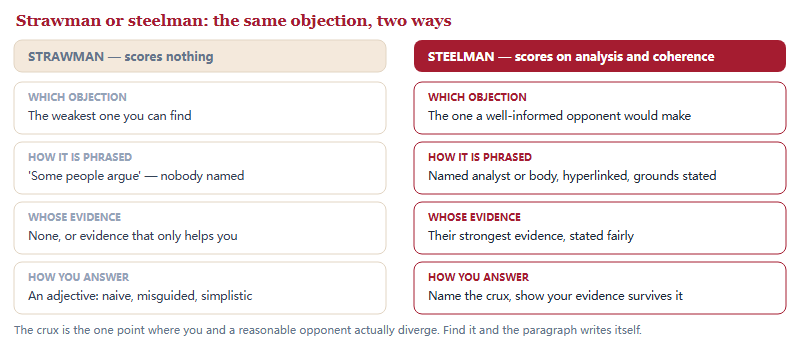
The far-right row is the one that separates the top band. A strawman is answered with an adjective — the objection is called naive, short-sighted or simplistic, and the essay moves on. A steelman is answered by locating the crux: the specific point at which a reasonable, informed person who has read the same evidence still ends up somewhere different from you. Almost always that crux is one of three things: a mechanism (they think A causes B through a different route), a scope condition (they are right about their case, not yours), or a time horizon (they are describing the short run, you the long run, or the reverse).
The four-move concession paragraph
Once you have the crux, the paragraph has a fixed shape. Four moves, in this order, and it will fit comfortably in 120 to 180 words.
- Move 1 — Name the objection precisely, and attribute it. Not “critics say,” but who, and on what grounds. The contest requires factual claims to carry a citation from a reliable source via hyperlink (hir.harvard.edu), and an objection you attribute to a real analyst or institution is more credible than one you attribute to the air.
- Move 2 — Grant what is true, without hedging. Say the part you accept, plainly and in your own voice. “This is correct, and it matters.” Any wriggling here (“while it may perhaps be somewhat true that…”) tells the reader you are not really conceding, and costs you the credibility that the whole move was designed to buy.
- Move 3 — Locate the crux. One sentence naming the exact point of divergence. “The disagreement is not about whether X happened, but about whether X explains Y.” This sentence is the analytical core of the paragraph, and it is the one students omit.
- Move 4 — Show why your evidence survives at that crux, and say what would change your mind. Return to your own evidence, apply it at the point of divergence, and finish with the falsifiability sentence: the observation that would defeat your reading.
That last clause is worth its word count. “If the pattern held in the two countries without the policy, my explanation would fail” is one line, and it tells a judge that your claim is a claim rather than a preference. It is also the single sentence most likely to produce a good moment at the oral defense, because you have already told the panel where you are vulnerable and shown that you were not frightened of it.
Here is the shape in outline. The bracketed slots are where your own hyperlinked evidence goes — this is a skeleton, not a template to copy, and it deliberately contains no invented facts. “[Named institution] argues the opposite: that [their claim], on the grounds that [their strongest evidence, hyperlinked]. That evidence is real, and any account of this problem has to deal with it. The disagreement is narrower than it looks: it is not about whether [the shared fact] occurred, but about whether it explains [the outcome]. Here the [comparison, dataset or case, hyperlinked] is decisive, because [what it shows at exactly that point]. If [the observation that would refute you], this reading would not hold — but [what the evidence shows instead].”
Where it goes, and what it costs in words
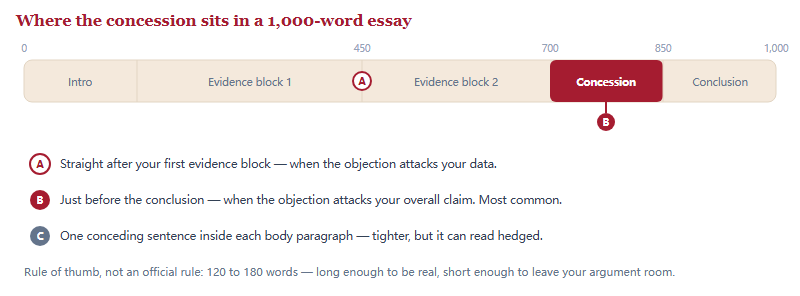
Placement is not arbitrary: it follows from what the objection attacks. There are three sensible options in an essay of this length, and one common mistake.
| Placement | Roughly where | Use it when | The risk |
|---|---|---|---|
| A — after the first evidence block | Around words 450–600 | The objection attacks your evidence: your data are contested, dated, or measure something adjacent | Interrupts momentum if the objection is really about the whole thesis |
| B — before the conclusion | Around words 700–850 | The objection attacks your claim: a reader could accept all your evidence and still disagree | Arrives late; if it is the strongest thing in the essay, the reader wonders why they waited |
| C — distributed | One sentence per body paragraph | Tightly comparative essays where each case has its own counter-reading | Reads as hedging; no single passage demonstrates sustained analysis |
| The mistake | Inside the conclusion | Never | Raising a serious objection you then have no room to answer leaves the essay ending on your opponent’s point |
Four objections that are always available — and the Defense Day payoff
If you cannot find an objection, you are not looking in the right places. For any argument in international affairs, four families are available, and running through them takes about ten minutes.
- The evidence objection. Your data do not show what you say they show — wrong measure, wrong period, wrong sample, contested source. Ask yourself: who collected this, and what would a specialist say about it?
- The mechanism objection. The pattern is real but your causal story is wrong; there is another route from A to B. Ask yourself: if my mechanism were switched off, would the outcome still appear?
- The scope objection. True in your case, not generalisable — one country, one decade, unusual conditions. Ask yourself: what is special about my case, and does the argument depend on it?
- The alternative-cause objection. A third factor drives both things you have linked, or it would have happened anyway. Ask yourself: what is the most plausible rival explanation, and can I rule it out or only bound it?
Pick the one that would most damage you if a judge raised it, and answer that one. Answering the least damaging is a strawman with extra steps.
Which brings us to the reason this paragraph is worth more than its 150 words. HIR describes Defense Day as a 15-minute presentation and oral defense before its judges, and its materials describe judges “conducting even more careful review and assessment during the interview stage to ensure authenticity of work” (hir.harvard.edu). One hard question to expect in that room is some version of “why should we believe your explanation rather than the obvious alternative?” A student who wrote a real steelman has already scripted that answer, and can go further: they can name the objection before the judge finishes asking it, grant the true part, and go straight to the crux. That is a very difficult thing to fake and an easy thing to earn — you earn it at the drafting stage, months earlier. Our Defense Day preparation guide covers the rest of the session.
Between cycles is the right time to build this habit, because it is a thinking skill rather than a formatting one. Take an essay you have already written — for the summer round that has now closed, or for school — and write the objection paragraph you left out. You will usually find that doing so forces one change in the thesis itself, and that change is the improvement. At the time of writing, the contest page lists a Fall–Winter round with an article deadline of January 2, 2027 and Defense Day on February 5, 2027, with registration described as rolling and capacity limited; confirm current dates on hir.harvard.edu before planning around them.
Frequently asked questions
Does a counterargument paragraph make my essay look weaker?
No. It is where analysis and coherence marks live. An essay that never meets an objection reads as though nobody looked for one.
How long should the counterargument be?
There is no official length. In a 1,000-word essay, roughly 120 to 180 words is enough to be real without crowding your own argument.
Do I need a source for the objection itself?
Attribute and hyperlink it where you can. hir.harvard.edu requires factual claims to carry a citation from a reliable source.
Can I concede a point and still take a side?
Yes. Conceding a sub-point is not neutrality. The contest asks for an argument, not an agenda, so you are still expected to take a position.
This is an independent guide operated by Hanlin Education for China-based international-school students. We are not affiliated with, endorsed by, or sponsored by the Harvard International Review or Harvard University. The HIR Academic Writing Contest is run by the Harvard International Review, a student-run journal founded in 1979. Contest rules, dates, word limits and evaluation criteria change between cycles — confirm current details on hir.harvard.edu before you enter. Paragraph structures and word budgets above are our editorial guidance, not official contest requirements. Factual corrections are made within 7 working days.