If you are searching for HIR essay definitions, the short answer is this: in an HIR academic writing essay, your key contested term — security, power, culture, innovation, sovereignty — should normally be defined in one clause or sentence in your introduction by fixing what is inside the term, who is acting, what observable indicator would show the term is present, and what would count as a counterexample. Then every paragraph must use that same version of the term. This is coaching guidance for the HIR writing process, not an official rubric or scoring rule, and it applies to whichever HIR cycle you are entering.
The failure it prevents is specific. A contestant writes a thesis like “Digital sovereignty is reshaping global culture,” then in paragraph two discusses data-localization statutes, in paragraph three discusses platform content moderation, and in paragraph four discusses undersea cable ownership. Each paragraph may contain accurate scholarship, but the essay is not defending one claim, because “digital sovereignty” quietly changed meaning three times. The conclusion then feels bigger than the evidence, and a reader cannot say what would falsify the thesis at all. A tighter definition does not make the essay simpler; it makes the argument falsifiable, which is what allows analysis to accumulate instead of scatter.
Why an Undefined Term Makes Your Thesis Unfalsifiable
A term is unfalsifiable when no realistic evidence could contradict it. “Globalization harms culture,” “technology increases inequality,” “security is deteriorating” — each of these can absorb any evidence, because the reader can never tell what is being measured. In an 800–1,200 word HIR essay, that absorbency is fatal: you have roughly three or four body paragraphs of evidence, and if the term is elastic, each paragraph is testing a different thesis. The examiner-facing problem is not that the topic is broad; it is that the units of analysis shift between paragraphs without being announced.
A first move is to separate two questions that students often merge: theme choice and term definition. Choosing “Theme B: Security” or “Theme A: Global Culture in the Digital Era” puts you inside a subject area; it does not tell you what kind of security or culture you are arguing about. Our guide on HIR Theme B Security: Building Non-Military Threat Arguments deals with the first question of theme. This article deals with the second: once the theme is fixed, how do you define the term inside your thesis so the whole essay is testing one claim?
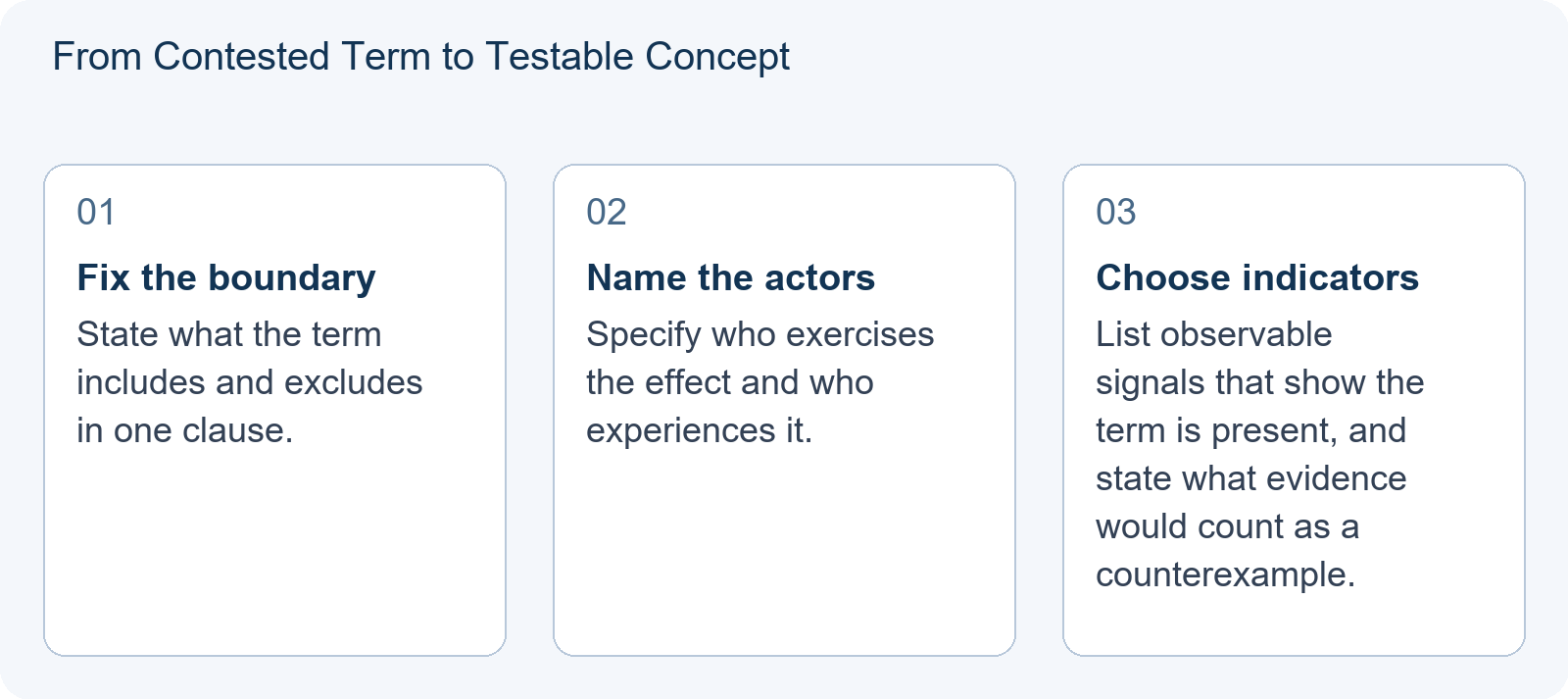
The Four-Part Operationalization Test
Apply the following test to your key term during drafting. It is a teaching heuristic, not an authoritative rule set, and its purpose is to make your thesis testable within the word limit.
1. Boundary: What is inside and outside the term?
A boundary is a sentence, not a dictionary entry. If your term is “innovation,” say whether it includes incremental product improvements or only disruptive breakthroughs. If it is “culture,” say whether you mean language practice, media consumption, or normative values. The boundary does two jobs: it stops readers from importing their own colloquial meaning, and it tells you which evidence you may credibly cite. A boundary that excludes too much will starve your evidence; a boundary that includes everything will fail the counterexample step below.
2. Actors: Who exercises the effect, and who experiences it?
Terms like power, agency or resilience are placeholders until an actor is named. Are you analysing state regulators, platform companies, multilateral institutions, civil-society organisations or individuals? In a “soft power” essay, state-sponsored cultural diplomacy and corporate brand influence are different objects of study with different indicators, different counterarguments and different policy implications. This is the same specificity that our guide on HIR Essay Scope: Turning a Global Topic Into an Answerable Question applies at the topic level; here you apply it at the term level inside a single sentence.
3. Observable indicators: How would a reader know the term is present?
This step converts an abstract definition into evidence selection. If you define “democratic backsliding,” name the observable indicators: changes to electoral law, documented incidents of press restriction, shifts in judicial-independence scoring, or the removal of term limits. Indicators do not need to be numbers, but they must be the kind of thing a source could confirm or deny. If no indicator exists, no paragraph can actually test the definition.
4. Counterexample: What would disprove the definition?
Ask what a case would have to look like for your term to be absent. If you cannot imagine it, the definition is too wide or tautological. Define “stability” as the mere absence of armed conflict and almost any quiet authoritarian period qualifies, which erases economic collapse or political repression from view. Add institutional-trust or continuity-of-governance indicators and a counterexample becomes imaginable, which means the definition can support real analysis rather than just labelling.
Worked Teaching Illustration: Defining “Digital Sovereignty” Three Ways
The following is a teaching illustration, not a contest problem or an official scoring example. It shows how one term can be operationalised three different ways, and how each choice changes the argument, the evidence and the counterargument.
| Definition choice | Boundary and actors | Observable indicators | Argument the definition supports |
|---|---|---|---|
| Data localization | State regulators requiring citizens’ data to be stored within national borders; tech firms as regulated entities. | Domestic-storage mandates, cross-border transfer penalties, compliance audits. | Argues about legal-compliance cost, trade friction, and the effect on small firms’ entry. |
| Algorithmic governance | National regulators overseeing recommendation and ranking algorithms; platforms as implementers. | Mandated transparency reports, local-content quotas in feeds, audit findings. | Argues about information flow, cultural preservation, and the limits of platform self-regulation. |
| Infrastructure autonomy | States and state-linked firms building independent cloud, cable and hardware capacity. | Domestic fibre and cable investment, exclusion of foreign vendors, sovereign-cloud procurement. | Argues about geopolitical risk, supply-chain resilience, and the cost of strategic redundancy. |
If you commit to the first definition, your evidence base should be data-protection legislation, compliance-cost studies and trade analyses; China’s Data Security Law and the EU’s GDPR are natural anchors because they belong to that definitional boundary. If you commit to the second, your evidence shifts to platform transparency regimes, local-language recommendation patterns and content-moderation research. If you commit to the third, you are arguing about industrial policy and supply chains, and data law is largely off-topic for your thesis even though it is still “digital sovereignty” in a loose sense. Choosing one definition is not a loss of scope; it is the condition under which the three or four available paragraphs actually add up to a single claim.
How the Definition Changes Evidence and Counterargument
A working definition functions as a filter on your research, not just a phrase in your introduction. Once “security” is defined as the cyber-resilience of financial institutions, evidence about border patrols or treaty alliances is no longer relevant; you look for breach reporting from banks, supervisory standards for cybersecurity audits, insurance arrangements for digital losses, and the documented costs of major ransomware incidents. The paragraph count stays the same, but every paragraph now tests one claim rather than three.
The definition also resolves a problem our guide on HIR Essay Source Disagreement: Writing When Credible Accounts Conflict addresses directly: two reliable sources can disagree about whether a country is “secure” because they are using different definitions — one measuring military capability, the other cyber-defence. Naming your definition lets you say which source counts as evidence for which claim, instead of treating the disagreement as noise. Counterarguments are sharpened in the same move. If your reviewer objects that a policy did not increase sovereignty, they must either accept your indicators and argue about the evidence, or reject the definition and offer a competing one — both of which are productive disagreements rather than definitional drift.
Diagnostic Checklist: Five Warning Signs Your Key Term Is Doing Too Much Work
- The shifted goalpost. Your introduction defines power as economic leverage, but a body paragraph discusses military alliances with no bridge sentence explaining the connection.
- The unmeasurable claim. You argue a policy increased well-being but never name an indicator a source could confirm or deny.
- The dictionary-only definition. The only definition you give is a generic dictionary entry; it is not anchored to the specific actors or context of your argument.
- The assumed reader. You use a term like globalization without saying whether you mean trade flows, migration, cultural exchange or digital information movement.
- The overstuffed thesis. Your thesis statement contains two or more undefined contested terms, so no single paragraph can test all of them.
Revision Drill: Making One Thesis Sentence Testable
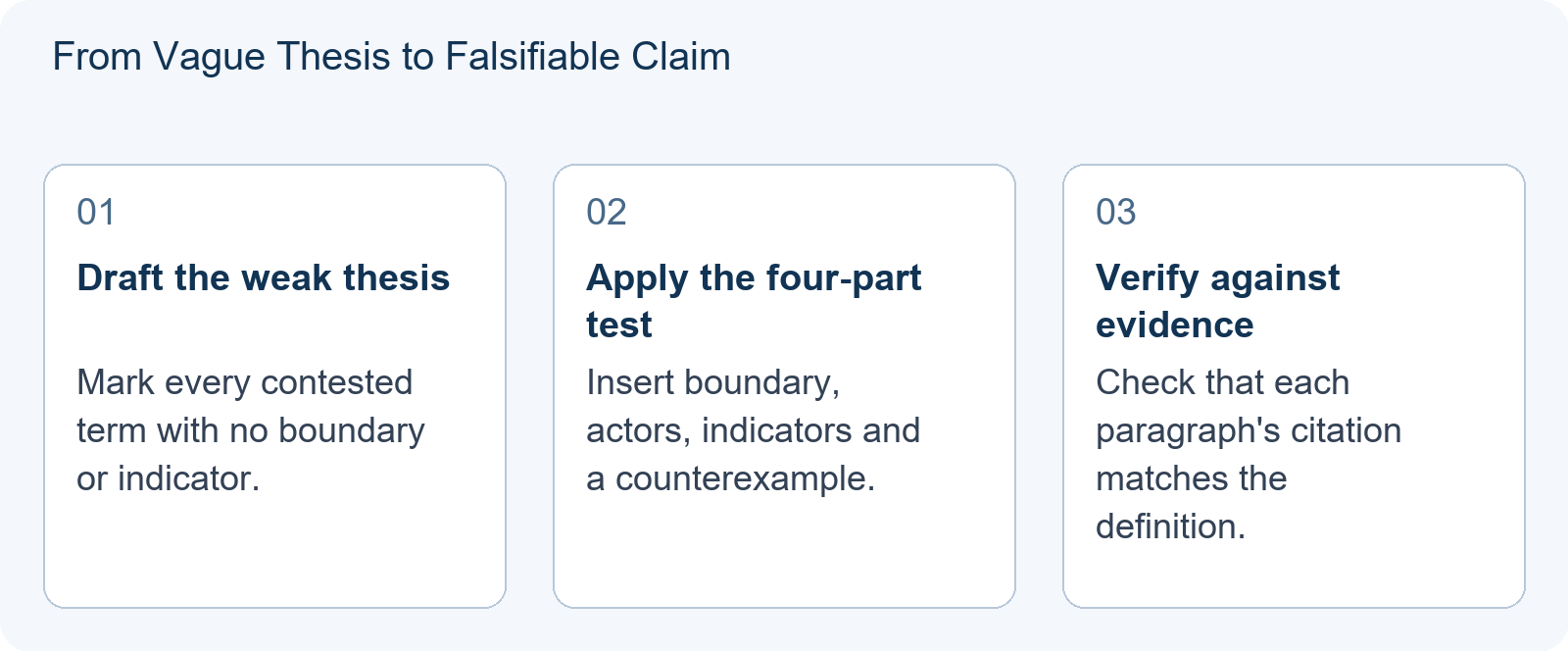
Take a weak thesis and rewrite it using the four-part test. Weak: “Social media threatens democracy.” Diagnosis: neither “social media” nor “threatens” nor “democracy” has a boundary, an actor, an indicator or a counterexample. Revised: “Algorithmic amplification of polarising content (indicator) weakens cross-party voter consensus (boundary) in established electoral democracies (actors), a pattern that would be disconfirmed if platform exposure data showed no measurable shift in cross-party attitude surveys (counterexample).” The revised sentence is longer, but every clause is anchored, and it tells you exactly what evidence to look for and what evidence would refute it.
The same discipline applies to counterargument paragraphs, which is why our guide on Steelman the Objection: How to Write the Counterargument Paragraph in an HIR Essay depends on precise definitions — you cannot sincerely strengthen an objection to a claim you have not actually stated.
When to Keep a Term Broad and When to Narrow It
Within an 800–1,200 word HIR essay, narrowing is the default. A narrow term lets you concentrate limited words on fewer, deeper pieces of analysis. The exception is a prompt that explicitly asks for comparison across contexts: if you are comparing resistance movements across two regions, you may define the term broadly as “organised opposition to external rule,” then narrow the indicators separately for each case. The test is not whether the definition is short, but whether it survives the counterexample question. If it does not, you have not defined a term; you have named a mood.
In the final read-through, underline every use of your key term and check that each underlined instance points to the same boundary, actor set and indicators as your introduction. If any instance has drifted, either bring it back to the definition or revise the definition to accommodate it. Both moves are legitimate; leaving the drift unmarked is not. That single check is the fastest way to make an HIR essay read as one argument instead of four adjacent summaries.
General event background is available at Event background.
This is an independent preparation guide, not affiliated with, endorsed by, or sponsored by the Harvard International Review.
Frequently Asked Questions
Do I need to quote a dictionary definition in my HIR essay?
No. A generic dictionary definition is usually insufficient for an analytical essay because it is not anchored to your actors, context or indicators. Instead, give an operational definition in one clause or sentence that names what the term includes, who is acting, and what observable indicator would show the term is present.
Can I use different definitions of the same term in different paragraphs?
Avoid it unless you explicitly signal that you are comparing two competing definitions. Silent shifts make the thesis unfalsifiable and make each paragraph test a different claim. If the discussion genuinely needs a second definition, announce the switch, explain why, and show how the new definition changes the evidence.
How long should the definition section of my HIR essay be?
Within an 800–1,200 word essay, one sentence or a short clause in the introduction is usually enough, with the rest of the essay demonstrating the definition through evidence and counterargument. Repeatedly restating the definition consumes words you need for analysis. If the definition needs a full paragraph, the term is probably too broad for the word limit and should be narrowed.