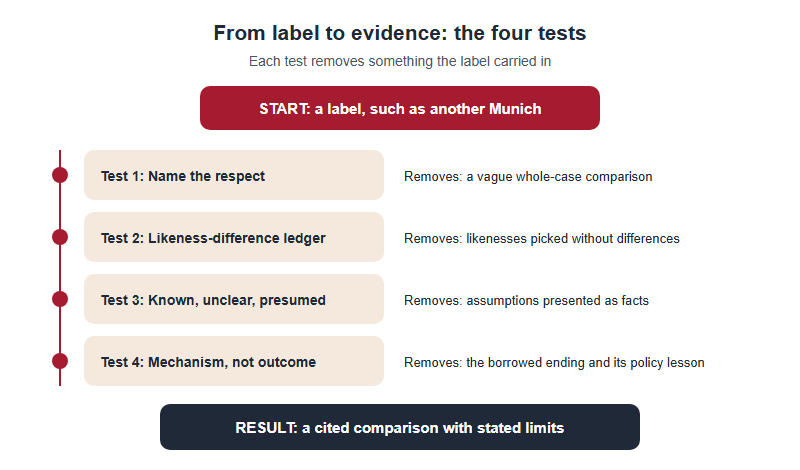
A historical analogy can be real evidence in an HIR essay, but only when you show which features of the past case match the present, which do not, and whether the differences break the comparison. Used as a label, as in “a new Cold War” or “another Munich,” an analogy asserts a conclusion instead of analyzing evidence. The four tests below turn one into the other, and they are worth learning early in a long Fall-Winter runway.
Why analogies tempt HIR writers, and what they carry in
The Senior prompts invite comparison with the past. In HIR’s submission guide, Theme B, “Security in a Multipolar World,” points students toward how “military technology, shifting alliances, and emerging powers” are transforming international security, and Theme C asks how technological breakthroughs alter global relationships. Every one of those subjects has a famous precedent, and every famous precedent comes with a name that sounds like analysis.
The trouble is what the name carries. An analogy compresses four things: a set of actors, a mechanism, an outcome and, very often, a lesson. “Munich” refers to the September 1938 agreement that let Nazi Germany annex the Sudetenland, followed in March 1939 by Germany’s occupation of the remaining Czech lands; in policy debates it is invoked to argue that concessions to an expansionist state invite further demands. “1914” is used to argue that alliance commitments and fast escalation can turn a local crisis into a general war. “The Cold War” implies two blocs and a long, managed rivalry. Borrow the word and you borrow the lesson, which is frequently a policy position. That is how an analogy slips an agenda into an essay that HIR says should have “a thesis but should not have an agenda.”
Scholars have studied this effect for decades. Yuen Foong Khong’s Analogies at War (1992) examined how analogies such as Korea, Munich and Dien Bien Phu shaped U.S. decisions on Vietnam in 1965, including how officials defined the problem in the first place. Richard Neustadt and Ernest May’s Thinking in Time (1986) proposed a discipline for decision makers who reach for history: set out the likenesses and the differences, and separate what is known from what is merely presumed. The four tests below adapt that discipline to an 800-1,200 word essay.
The four tests
Test 1: Name the respect
“Like 1914” is not yet a claim. “Like 1914, in that a crisis involving one ally could pull in partners bound by commitments” is. Before an analogy appears in your draft, write one sentence stating exactly which mechanism you are borrowing. If you cannot, you are borrowing a mood.
Test 2: Build the likeness-difference ledger
List the likenesses, then list at least as many differences, and for each difference ask whether it breaks the mechanism you named. Some differences are cosmetic. Others go to the heart of the comparison, and those are the ones your essay must address in the text rather than hope nobody raises.
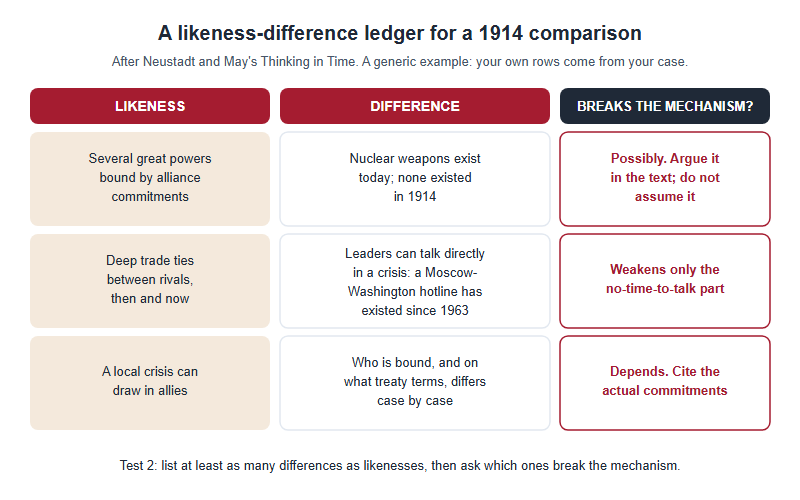
Notice the second row. Before 1914, rival powers were closely tied by trade, and Norman Angell’s prewar bestseller The Great Illusion argued that war between such economies had become self-defeating. War came anyway. That is why “interdependence prevents conflict” is itself a claim built on historical reasoning, and it needs the same ledger as any other analogy.
Test 3: Sort known, unclear and presumed
This is the other Neustadt and May tool mentioned above. For the present-day side of the comparison, mark which features are documented and cited, which are unclear and which you are presuming. Leaders’ intentions almost always belong in the last group. The characteristic failure of an analogy is to move a presumption into the known column: “their aims are unlimited, as in 1938” treats the conclusion of a debate as its starting fact.
Test 4: Borrow the mechanism, not the outcome
The 1914 mechanism, alliance commitments turning a local crisis into a wider one, does not carry the 1914 outcome with it. If your essay uses the mechanism, say plainly that the outcome is not assumed, and identify what in the present case could interrupt the chain. That sentence is where an analogy stops being a prophecy and becomes analysis.
How much weight history can carry in 1,200 words
Different uses of history support different kinds of claim, and a short essay cannot afford the most expensive ones.
| Use of history | What it can support | What it cannot support | Rough word cost |
|---|---|---|---|
| Label (“a new Cold War”) | Nothing beyond naming your conclusion | Any claim at all | A few words, which is why it tempts |
| Illustration: one past case showing a mechanism | That the mechanism is plausible and has operated before | That it is operating now, or how likely it is | 80 to 150 words, plus present-day evidence |
| Tested analogy: the ledger visible in the text | A reasoned claim that the mechanism applies, with stated limits | A prediction of the outcome | 150 to 250 words |
| Pattern: many cases, cited from a study | A base rate you can cite and qualify | That your case will follow the base rate | A sentence or two citing the study |
The last row needs care. Graham Allison’s Thucydides’s Trap argument, set out in his 2017 book Destined for War, counted 16 cases over the past 500 years in which a rising power challenged a ruling one, 12 of which ended in war. That is a pattern claim, and citing it is legitimate. But a base rate is not a forecast for any single case, and the way the cases were selected and coded has itself been debated, so a careful essay cites the study, says what it counted and then argues from the evidence of its own case.
In practice, one tested analogy is usually the ceiling for an essay of this length. Two unexamined comparisons cost more than they add, because each opens a set of differences you have no room to address.
Three rewrites: from label to evidence
Each pair below keeps the writer’s instinct, since the comparison may well be relevant, and replaces the label with a claim a reader can check. The bracketed parts mark where your own cited evidence goes.
- Label: “The rivalry has become a new Cold War.”
Evidence: “The rivalry resembles the Cold War in the respect this essay relies on: [the mechanism, with cited evidence]. It differs in one that matters more for sanctions: unlike the United States and the Soviet Union, today’s rivals trade heavily with each other [cited figures], which changes what economic pressure costs both sides.” - Label: “Negotiating now would be another Munich.”
Evidence: “The Munich comparison rests on a premise: that the other side’s aims were unlimited, which is why concessions in 1938 failed. Whether that premise holds here is a question about present evidence [stated goals, past conduct and capabilities, cited], and the 1938 outcome cannot answer it.” - Label: “Like the railway, AI will change everything.”
Evidence: “Railways reshaped power partly by moving troops and goods faster than rivals could adapt. The comparison holds for AI only where a similar speed advantage exists, and this essay argues that it exists in [one domain, with evidence] but not in [another].”
The Munich rewrite also shows a point of tone. HIR’s contest page asks that submissions be “culturally sensitive, fact-checked, and respectful,” and comparisons with Nazi Germany are among the most inflammatory moves available in international-affairs writing. Use them only where the specific mechanism fits, never as shorthand for disapproval.
Citing history, and defending it on Defense Day
History is not exempt from the evidence rules. The contest page on hir.harvard.edu says all factual claims must be backed by a citation from a reliable source, made via hyperlinks, and that non-digital sources must be cited properly as per AP Style. The submission guide adds that sources should be credible, that academic publications from prominent institutions can generally be trusted more than the average dot-com, and that a questionable source you still need should have its bias or criticism acknowledged. For historical claims, that points toward scholarly histories and reputable reference works.
Two details from the guide come up constantly in historical writing: decades take no apostrophe (the 1930s), and the HIR does not use footnotes, so a history-book footnote has to become a hyperlink or an in-sentence attribution. The guide’s top descriptor for Analysis of Evidence describes analysis that brings the evidence “to life” and mirrors “that of a journalist, analyst, or academic.” A tested analogy is one of the clearest ways to show that, and our rubric walkthrough covers the neighboring rows.
If you become a finalist, expect the comparison to be questioned. “Why that analogy and not another?” is a natural challenge to any historical argument, and the best preparation is the ledger itself plus one counter-analogy: the precedent that points the other way, and your reason for thinking it fits less well. Our Defense Day preparation guide covers the rest of that conversation, and our complete guide to the contest explains the cycles if you are still choosing one.
Frequently asked questions
Can I use historical examples in an HIR essay?
Yes. Cite each factual claim with a hyperlink and explain why the past case fits your question. HIR asks for evidence and nuance, not labels.
Is calling a rivalry a new Cold War an agenda?
Not automatically, but the label imports an outcome and often a policy lesson. Test the likenesses and differences before you rely on it.
How many analogies fit in 800 to 1,200 words?
Usually one, tested properly. Several unexamined comparisons read as decoration and crowd out the present-day evidence your argument needs.
Do I need to cite well-known history?
HIR says all factual claims need a citation from a reliable source, so cite the dates, events and outcomes your comparison depends on.
This is an independent guide operated by Hanlin Education for China-based international-school students. We are not affiliated with, endorsed by, or sponsored by the Harvard International Review or Harvard University; the HIR is a student-run journal, not an official Harvard University publication. Themes, citation rules and cycle dates are set by the organiser and can change — confirm current details on hir.harvard.edu. Historical examples here illustrate method and take no position on current disputes. Errors are corrected within 7 working days of being reported.