Senior Theme C of the HIR Academic Writing Contest is “Technology, Innovation, and Power.” The hinge word is power, not technology. A defensible entry names one technology, one arena and one mechanism through which advantage shifts, then argues that case in 800 to 1,200 words. This guide shows how to scope it, how to tell Theme C apart from Themes A and B, and what survives questioning.
The hinge word is power, not technology
Most Theme C drafts we read from China-based students are technology explainers wearing an essay costume. They open with what the technology is, spend 600 words on how impressive it has become, and close with a paragraph about promise and peril. That is a well-informed explainer. It is not an argument, and the contest rubric rewards argument.
Power, in international affairs writing, is the capacity to make others act, or to set the terms inside which others must act. It shows up in concrete, checkable forms: who sets the technical standard, who controls a chokepoint in the supply chain, who holds the data other parties need, who can deny access, and who gets to write the rule that everyone else complies with.
There is a fast diagnostic you can run on your own draft before you write another paragraph:
If the technology in my essay worked exactly as well, but a different actor owned or controlled it, would my argument change?
If the answer is yes, you are writing about power and Theme C is the right home. If the answer is no, you have written a product review with footnotes, and no amount of polish at the sentence level will fix the score. The contest guidance repeatedly frames the goal as analysis rather than advocacy; our own reading of the rubric criteria is covered in our breakdown of the 60-point rubric, where analysis of evidence is scored separately from the use of evidence. Those are two different columns, and technology explainers routinely score in the first and collapse in the second.
Filing your topic correctly: Theme C versus Themes A and B
The three Senior themes for 2026 are Global Culture in the Digital Era (A), Security in a Multipolar World (B) and Technology, Innovation, and Power (C). Many strong topics could physically sit under two or three of them. Semiconductors, undersea cables, generative AI and satellite internet are all live under more than one heading.
The theme you choose is not a label you attach at the end. It is a promise about what you will prove and what will count as evidence. Choose A and the reader expects you to argue about meaning, identity and cultural production. Choose B and the reader expects threat, deterrence, alliance behaviour or vulnerability. Choose C and the reader expects capability, control and the distribution of advantage.
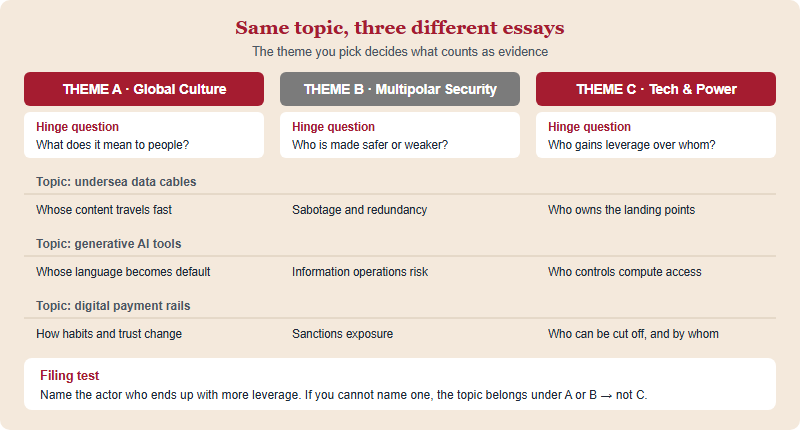
The practical consequence is that a misfiled essay reads as unfocused even when every sentence is competent. A judge assessing a Theme C entry is asking “who gained leverage, and how do you know?” If your evidence is all about audiences, meaning and identity, you have written an excellent Theme A essay and submitted it in the wrong lane.
Four power mechanisms that fit inside 1,200 words
The contest allows 800 to 1,200 words, and the official guidance notes that diagrams, tables and authorship declarations sit outside that count. Twelve hundred words is roughly three pages. That is enough for one mechanism argued properly, and not enough for two argued shallowly. Pick one of these four and commit.
| Mechanism | The claim looks like | Evidence you must be able to name | The trap |
|---|---|---|---|
| Standard-setting | Whoever fixes the technical standard shapes the market and the rules that follow it | The standards body, the competing specifications, at least one adoption decision and its date | Assuming the biggest market automatically wins the standard |
| Chokepoint control | A single upstream node converts a commercial position into political leverage | Where the chokepoint sits in the chain, its concentration, and one instance of leverage being used or threatened | Describing concentration without showing leverage actually exercised |
| Data and information asymmetry | The party that sees more can act faster or price better than the party that sees less | What data is collected, who holds it, and one decision it demonstrably changed | Treating “they have lots of data” as an argument rather than a premise |
| Diffusion and leapfrogging | Cheap adoption lets a late entrant skip a generation and reset the hierarchy | Adoption figures over time, the skipped generation, and what the incumbent lost | Confusing fast adoption with durable advantage |
Notice what every row in the right-hand column has in common. The trap is always the same shape: stating a condition and calling it a conclusion. Concentration is a condition. Leverage is a conclusion. Data volume is a condition. Changed behaviour is a conclusion. The gap between the two is exactly where the analysis marks live, and it is the gap most 1,200-word drafts jump over.
The scoping ladder: from theme to claim in four moves
Students who start writing from the theme itself produce sprawl, because the theme is the size of a university course. Descend the ladder first, on paper, before you draft. Each rung narrows the field, and the last rung should be a single sentence you could say aloud without notes.
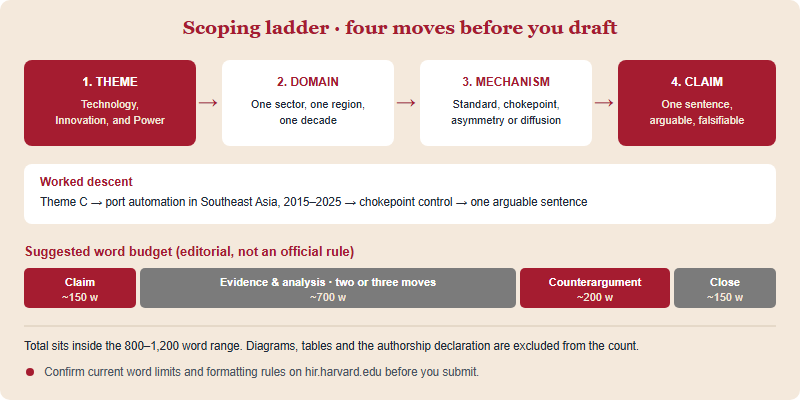
The fourth rung deserves a hard test. Write your claim as one sentence, then ask whether a well-informed adult could disagree with it while still accepting all your facts. If nobody could disagree, it is a description, not a claim. “Semiconductor supply chains are concentrated” fails. “Concentration in advanced packaging gave a small number of firms more practical veto power over deployment schedules than export controls did” is arguable, and therefore worth 1,200 words.
Choose a topic that survives being questioned out loud
Theme C topics carry a specific risk that Theme A topics do not. They lean on numbers: market shares, capacity figures, adoption rates, export values. Numbers are excellent evidence and terrible security. If your entire argument rests on one contested figure from one source, an examiner only has to ask where the figure comes from and whether anyone disputes it.
Finalists are invited to a virtual HIR Defense Day, where they give a 15-minute presentation and oral defense. That format should shape your topic selection weeks earlier, not the week before. Before you commit, run three checks:
- The 60-second test. Can you explain your mechanism to a smart person outside your subject in one minute, with no jargon? If the mechanism only makes sense in technical vocabulary, it will not survive live questioning.
- The source-aloud test. Can you say, from memory, where each of your three or four key figures came from and what year it refers to? If not, either learn them or replace them.
- The strongest-objection test. Can you state the best case against your own claim in two sentences, fairly, without sneering? If you cannot, you have not finished thinking, and the counterargument paragraph will read as a straw man.
Our fuller treatment of the format, including how to structure the presentation itself, sits in our Defense Day preparation guide. The point for scoping purposes is narrower: pick the topic you would be happy to be interrogated about, not the topic that sounds most impressive in a title.
Dates, second entries and the rules that constrain your choice
Two logistics points change how Theme C should be approached this season. Both come from the official contest page and both should be re-confirmed there before you act on them.
First, the calendar. The Summer cycle submission date is listed as Aug. 24, 2026, with Defense Day on Oct. 5, 2026; the Fall/Winter cycle is listed as Jan. 2, 2027, with Defense Day on Feb. 5, 2027. If you have seen a later August date in an older guide or an internal school handout, treat the official page as authoritative and plan to the earlier date. Beijing time runs 12 hours ahead of U.S. Eastern Daylight Time, so an Eastern-time cut-off lands in the middle of the following day in China. Do not discover that on the last afternoon.
Second, the resubmission rule. The official page states that contestants may resubmit, but a further submission must explore a different theme from the one originally submitted within the same contest year. That has a direct strategic implication: if you already entered under Theme A or Theme B this year, Theme C is a live second lane rather than a repeat of the same essay. It also means you cannot treat a second entry as a revision of the first. Note too that entry is gated before the essay is: the contest page states that contestants are requested to register and pay before becoming eligible to submit their articles, and to do so prior to the submission deadline. The page does not publish a fee figure, so confirm the current amount and the payment route on hir.harvard.edu. If you are new to the contest structure, start with our overview of how the HIR contest works.
One rule is worth restating plainly because the penalty is severe. Use of ChatGPT and comparable AI tools is prohibited, submissions are screened, and a high AI score can result in disqualification. Theme C is the theme most likely to tempt a student into generating a plausible-sounding paragraph about supply chains they have not actually researched. That paragraph is both the easiest to detect and the easiest to dismantle at Defense Day.
Frequently asked questions
Is Theme C only about artificial intelligence?
No. Theme C is about how innovation redistributes leverage. Energy technology, logistics, biotech, payments and standards bodies all qualify if you argue a power mechanism.
Can I write about a Chinese company or Chinese policy?
Yes, provided you argue rather than advocate. Local knowledge is an asset when it produces specific evidence, and a liability when it produces a position statement.
How many case studies should a 1,200-word Theme C essay use?
Usually one, occasionally two. Two shallow cases score worse than one case examined properly, because analysis marks reward depth over coverage.
Where do I confirm the deadline and format rules?
On hir.harvard.edu. Cycle dates, word limits, style requirements and the AI policy are published there and take precedence over any secondary guide, including ours.
This is an independent guide operated by Hanlin Education for China-based international-school students. We are not affiliated with, endorsed by, or sponsored by the Harvard International Review or Harvard University. Theme wording, cycle dates, word limits and contest rules cited here reflect the official contest page at the time of writing; always confirm current details on hir.harvard.edu before you act on them. Factual errors reported to our editorial desk are corrected within 7 working days.