For the live Fall-Winter HIR cycle, useful pre-submission feedback starts with a narrower question than “Is this good?” Ask instead: “Which parts of the 60-point structure are weak, and what evidence in my draft shows it?” The verified cycle facts used for this article (2 November 2026) record a 60-point rubric made of twelve rows scored from 1 to 5, split into 30 points for Content and 30 for Style. The same facts list the essay deadline as 2 January 2027 and Defense Day as 5 February 2027. That timeline matters because feedback received late is harder to use well. A writer who wants rubric-specific comments should send a short reviewer brief with the draft, not the draft alone. The brief tells the reader what to diagnose, which part of the rubric to address, and what kind of help is wanted. This guide is independent editorial analysis, not official scoring guidance.
Send a reviewer brief, not just a draft
The common failure is easy to picture. A student sends a PDF with the message “Could you read this and tell me what to improve?” The reader returns comments such as “make it stronger,” “add more analysis,” or “tighten the prose.” None of those comments is necessarily wrong, but each one makes the writer do the translation. Which paragraph is weak? Is the problem the claim, the evidence, the link between them, or the sentence? Does the comment concern the Content half or the Style half of the rubric? Without that information, the writer may polish sentences while the central argument remains underdeveloped.
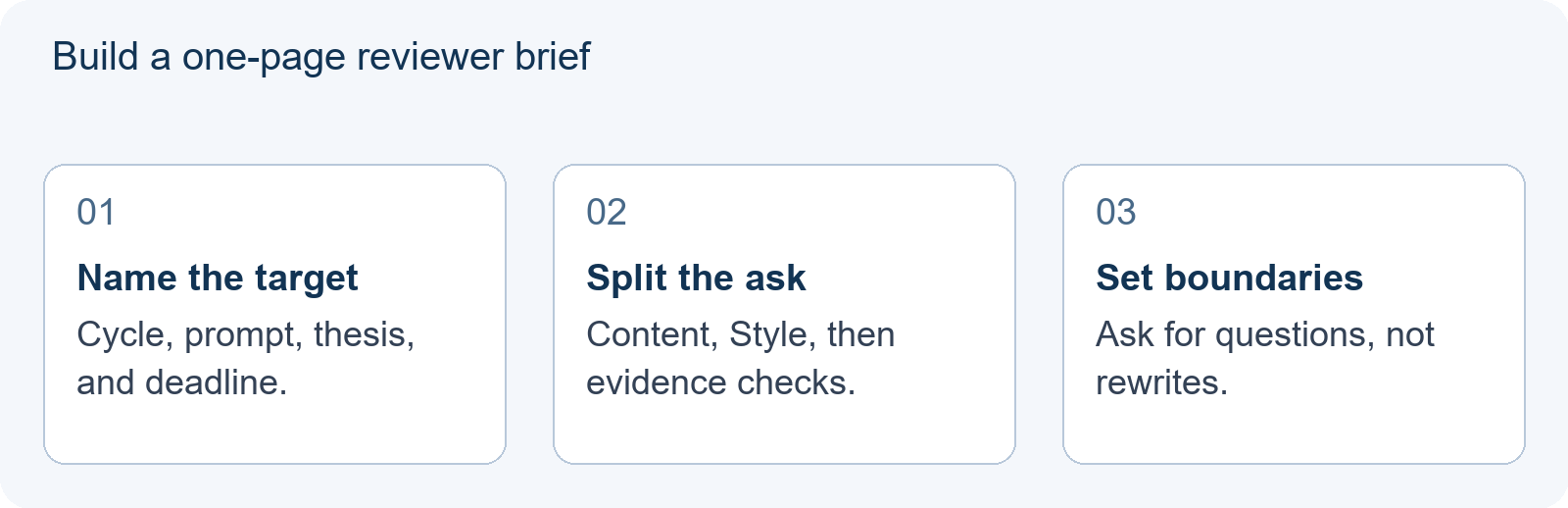
A reviewer brief reduces that translation work. It is usually one page, sent with the draft and the current rubric text if the writer has it. It should identify the contest and cycle, state the working thesis in one sentence, name the writer’s own suspected weakness, and ask three focused questions. The brief should also state the boundary: the reviewer is asked to diagnose and question, not to rewrite the entry. That boundary protects authorship and makes the comments more useful. A reader who knows that the writer wants diagnostic feedback will usually give sharper reasons than a reader asked for a general impression.
Use plain language in the brief. “Please mark any paragraph where my evidence does not clearly support the claim” is easier to act on than “Please evaluate my argumentation.” “Please flag style-rule problems separately from content problems” is more useful than “Please check the writing.” The brief does not need to be formal. It needs to be specific enough that the reviewer can reply with examples from the draft.
What the one-page brief should contain
A strong brief gives the reviewer enough context to read diagnostically. It should not summarize the whole essay, because the reviewer will read the essay. It should identify the decision the writer is trying to make. The table below is a preparation aid, not a claim that any particular review service includes these steps.
| Brief field | Why it helps | Example wording |
|---|---|---|
| Contest target and cycle | Anchors comments to the live rules and deadline. | “HIR Fall-Winter cycle; essay due 2 January 2027.” |
| Working thesis in one sentence | Lets the reviewer test whether each paragraph serves the argument. | “My claim is that X caused Y through Z, not merely that X and Y appeared together.” |
| Writer’s suspected weakness | Invites confirmation or correction instead of a generic tour. | “I think paragraph four summarizes evidence without explaining it.” |
| Three focused questions | Produces comments that can become revision actions. | “Which claim lacks evidence? Where does the Style half slip? What should I cut first?” |
| Authorship boundary | Keeps the reviewer in a diagnostic role. | “Please ask questions and mark examples; do not rewrite sentences for me.” |
The three questions should not all be about the same level. One can ask about the whole argument, one about a paragraph or evidence choice, and one about style. That spread prevents the reviewer from spending the entire session on comma placement while the thesis remains unclear. It also gives the writer a way to compare comments later: if two reviewers both flag the same global issue, that issue probably deserves priority.
Map comments to Content thirty and Style thirty
The verified cycle facts describe the rubric as twelve rows scored from 1 to 5, with thirty points in Content and thirty in Style. The facts do not supply the individual row titles in a form this article can reproduce, so a reviewer should use the current rubric text available to the writer rather than invent row names. The writer can still ask for a useful first split: “Is this comment about Content, Style, or both?” That single question turns a vague note into a more actionable one.
Content comments concern the essay’s answer: whether the thesis is clear, whether claims are supported, whether evidence is used rather than merely listed, whether counterarguments are handled, and whether the conclusion follows. Style comments concern the presentation: sentence clarity, paragraph coherence, transitions, citation form, and the specific style rules recorded in the verified cycle facts. Those rules include spelling out percent, using the Oxford comma, avoiding footnotes, using hyperlinked citations, and keeping the essay between 800 and 1,200 words excluding figures. A reviewer does not need to give a score. The writer needs to know which half of the rubric a comment belongs to, and preferably which row number if the current rubric is available.
Ask for at least one concrete example for each major comment. “The evidence is thin” is less useful than “In paragraph three, the sentence beginning ‘Recent data show’ makes a causal claim but links to a report that only describes a correlation.” “The style is uneven” is less useful than “The second paragraph uses a semicolon where two sentences would be clearer, and the citation is not hyperlinked.” Concrete examples let the writer verify the comment against the draft instead of guessing what the reviewer meant.
Teaching illustration: from vague comment to rubric action
The following is a hypothetical teaching illustration, not an actual contest problem, official scoring example, or claim about how any named reviewer would mark a real entry. Suppose a reviewer writes: “The middle paragraph is doing too much.” That comment is directionally useful but not yet actionable. The writer can ask three follow-up questions: Which sentence carries the paragraph’s main claim? Which piece of evidence is left unexplained? Does the problem sit in Content, Style, or both?
After rereading, the writer might turn the comment into three possible actions. First, a Content action: “Paragraph three introduces two claims, but only the first is tied back to the thesis. Split the paragraph or drop the second claim.” Second, an evidence action: “The sentence about local funding has no linked source; add a citation or qualify the claim as an inference.” Third, a Style action: “The second sentence has three subordinate clauses; read it aloud and split it.” Each action points to a different part of the draft. The writer can now decide which action matters most before the deadline.
This mapping also protects against false precision. A reviewer who says “this feels like a 3” has not given the writer much to revise. A reviewer who says “this paragraph lists three examples but never explains how any of them supports the causal claim” has given a diagnostic comment that can be checked against the text. The writer should prefer the second kind of comment, even if it is less flattering. The goal is not to collect praise or predicted scores. The goal is to find the next revision that improves the essay’s fit with the rubric.
Keep global, paragraph, and sentence comments separate
Feedback becomes confusing when one level hides another. A sentence-level comment such as “this sentence is awkward” may be correct, but it can distract from a global problem: the paragraph may not need that sentence at all. A paragraph-level comment such as “this evidence is weak” may be correct, but it can distract from a thesis problem: the paragraph may be answering a question the essay never asked. A global comment such as “the argument is unclear” may be correct, but it can feel impossible to act on unless the reviewer points to the first place where the argument loses focus.
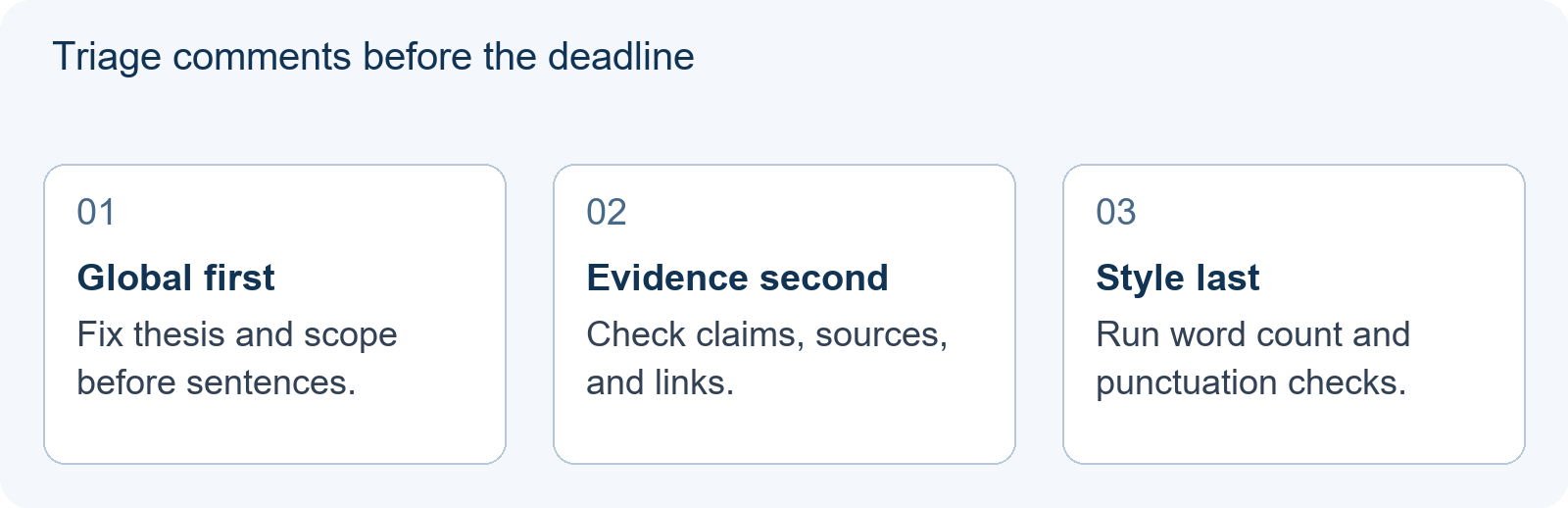
Ask the reviewer to order comments by level. Global comments should come first: thesis, scope, sequence of argument, and handling of the strongest objection. Paragraph comments should come second: claim, evidence, explanation, and transition. Sentence and style comments should come last. This order is practical because early revisions can delete sentences that a reviewer would otherwise spend time polishing. It is also fair to the reviewer, who can see where the essay’s main risk lies before editing commas.
If the reviewer only has time for a short pass, ask for three global comments and three paragraph-level examples. That combination is usually more useful than a full sentence-level edit. If the draft is already strong at the global level, then ask for a style-focused pass. A reviewer’s note that the essay “lists too much” often points to a global or paragraph-level problem rather than a sentence problem, so ask for the first place where the listing replaces explanation.
Protect authorship while collecting feedback
The most useful feedback request asks for questions, not replacement sentences. A reviewer can ask, “What warrant connects this evidence to your claim?” or “Why does this paragraph come before the next one?” Those questions push the writer back into the draft. A reviewer who writes new sentences may produce smoother prose, but the writer may not be able to defend the changes at Defense Day or explain them in a revision log. The boundary is not anti-help. It is a way to keep the feedback usable.
Keep a revision log in the writer’s own words. For each major comment, record the reviewer’s point, the writer’s diagnosis, the change made, and the reason. That log does two things. It prevents the writer from making random edits just to show activity, and it creates a record of the writer’s own reasoning. If a teacher, tutor, or parent is involved, the log also makes the division of labor visible. For a fuller discussion of that boundary, see Who Actually Wrote This? Using a Teacher, Tutor or Parent on an HIR Entry Without Losing the Draft.
Writers should also avoid asking a reviewer to “make it sound more academic.” That request often produces inflated language without improving the argument. Ask instead: “Where does the sentence become hard to follow?” or “Which technical term needs a definition?” The reviewer can point to the problem; the writer supplies the solution. This is slower than accepting replacement prose, but it produces a draft the writer can actually defend.
Triage comments when the deadline is close
When feedback arrives close to 2 January 2027, the writer needs a triage rule. Start with comments that affect the whole essay: a mismatch between thesis and prompt, an unsupported central claim, a missing counterargument, or a conclusion that introduces a new idea. Those changes can force other edits, so they should come before sentence polishing. Next, handle paragraph-level evidence problems: claims without sources, sources that do not support the sentence, and paragraphs that list examples without explaining them. Last, run the style pass: word count, hyperlinked citations, no footnotes, percent spelled out, Oxford comma, and sentence clarity.
Style should come last because cutting for the 800 to 1,200 word limit can change transitions and emphasis. A sentence that looks polished before a cut may become orphaned afterward. The style pass should therefore be a final audit, not the first revision. For the specific punctuation and citation rules that can cost points, see AP Style for International Affairs: The Rules That Actually Cost HIR Points. That is an adjacent technical check, not a substitute for a reviewer’s comments on the actual draft.
A simple triage table can help. Mark each comment as Global, Paragraph, or Sentence; then mark it as Content or Style. Do the Global Content items first, then Paragraph Content, then Global Style, then Paragraph Style, then Sentence Style. This order is not an official scoring formula. It is a practical way to spend limited revision time on the changes most likely to affect the reader’s understanding of the argument.
Preparing a consultation or resource request
If the writer later asks a teacher, tutor, or coach for a consultation, the same brief is useful. Send the current draft, the current rubric text if available, the reviewer brief, the revision log, and the live deadline. State what kind of help is wanted: a Content-focused diagnostic, a Style audit, a Defense Day evidence check, or a final read for coherence. Ask whether the reviewer can comment on Content and Style separately and whether they will provide written comments the writer can act on. Do not ask for a promised score or a guaranteed outcome. A responsible consultation should produce clearer next actions, not a prediction.
This preparation also helps the writer compare advice. If one reader says “shorten the introduction” and another says “the thesis arrives too late,” the writer can test both against the draft and the rubric. If a comment cannot be tied to a sentence, a paragraph, or a rubric half, it may be interesting but not yet actionable. The writer should leave the consultation with a short list: what to change first, what evidence to add, what style rule to check, and what question remains unresolved. That list is more valuable than a page of general impressions. If the writer is instead diagnosing a past result, the adjacent article HIR Essay Feedback: What to Improve After a Bronze or Silver Result addresses that different question.
General event background is available at Event background.
This is an independent preparation guide, not affiliated with, endorsed by, or sponsored by the Harvard International Review.
Frequently Asked Questions
Should I ask a reviewer to predict my HIR score?
A predicted score is less useful than a diagnostic comment. Ask the reviewer to identify whether a problem sits in the Content thirty or the Style thirty, to point to a specific paragraph or sentence, and to give one concrete example. A score prediction can create false precision; a rubric-linked comment gives you something to revise.
How many comments should I request before submission?
A practical request is three to five priority comments plus selected marginal notes. Ask for at least one global comment, one paragraph-level evidence comment, and one style-rule comment. That spread is more useful than a full sentence-level edit because it helps you decide what to change first when time is short.
Can a reviewer rewrite my sentences for me?
It is better to ask for questions and examples rather than replacement sentences. A reviewer can show where a sentence is unclear or where a claim lacks support, but the writer should produce the revision and record the reasoning. This protects authorship and makes the draft easier to defend at Defense Day.