Style carries 30 of the HIR contest's 60 points — and the contest asks for AP Style's newest edition, a house style almost no Chinese international-school student writes in by default. That gap is not a knowledge problem. It is a mechanical one, and it is the cheapest 30 points in the competition to protect. This is the working reference for the rules that actually bite in an international-affairs essay.
One framing note before the rules. AP Style is a newsroom manual, not an academic one. Your school essays were probably marked in MLA, Chicago or a house style your teacher invented; all three are wrong here, and the habits transfer badly. Timing matters too: the Summer cycle closes in late August, so confirm the exact date and time on hir.harvard.edu before you plan your final week, and run the style pass as the last thing you do once the argument has stopped moving.
Why style is worth arguing about at all
Students discount style because it feels like decoration. The rubric does not agree. Content is 30 points across six dimensions; Style is another 30 across six more — tone; spelling, punctuation and grammar; adherence to the HIR Style Guide; citations; source quality; and overall ease of reading — check the organiser's own rubric on hir.harvard.edu for exactly what that block rewards. Our line-by-line reading of the 60-point rubric sets out the full split. The practical consequence is blunt: an essay with a brilliant argument and a scattering of MLA habits can finish behind a merely competent essay written cleanly.
Three things make this a solvable problem rather than a vague one:
- The rules are finite. A 1,200-word essay on global affairs touches maybe fifteen AP conventions. You are not learning a manual; you are learning a short list.
- The errors are systematic. Students do not misformat one number. They misformat every number the same way, which means one find-and-replace habit fixes a dozen instances.
- They are checkable. Unlike “is my analysis deep enough,” every rule below is a yes or no you can verify in the final pass.
One caveat that is itself a rule: AP updates annually, and it has changed things students still get taught the old way. The percent sign and hyphenation guidance both moved in recent editions, and on percent the HIR Style Guide overrides AP outright: spell the word percent, never use the % sign. The contest specifies the newest edition, so treat any handout older than a couple of years — including this article — as a prompt to check rather than as the authority. The Stylebook is the authority.
Numbers: the rule that breaks first
Global-affairs writing is dense with figures, so number style is where most style marks leak. AP's baseline is simple — spell out one through nine, use figures for 10 and above — and then a set of categories overrides it and always takes figures.
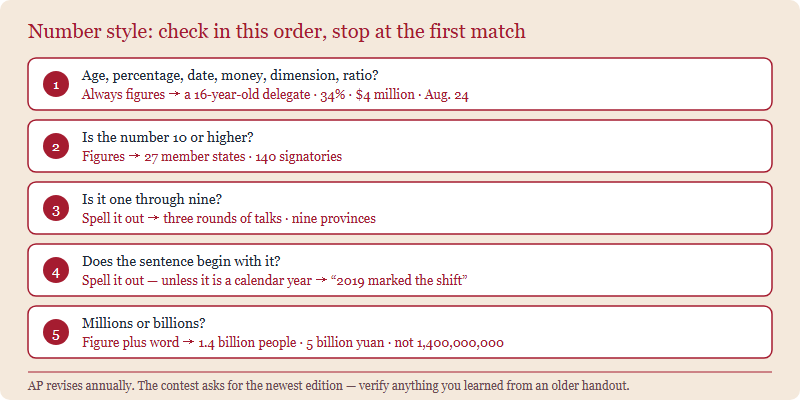
Two refinements worth knowing. AP moved to the % sign paired with a numeral rather than the spelled-out word, so “exports fell 12%” is current and “exports fell 12 percent” is the older habit — a good illustration of why the newest edition matters. And ordinals follow the same one-through-nine logic: third round, 11th summit.
Dates, months and time
This one has a satisfying irony: students misformat the very deadline they are racing. AP abbreviates only some months, and only when a specific date follows.
| Situation | AP form | What students write instead |
|---|---|---|
| Month with a specific date | Feb. 9, Sept. 12, Nov. 3, Dec. 1 | February 9th, Nov 3, 3 November |
| Months never abbreviated | March, April, May, June, July — always in full | Mar. 12, Jul. 4 |
| Month and year only | August 2026 (no comma, not abbreviated) | Aug. 2026 · August, 2026 |
| Full date inside a sentence | The vote on Nov. 3, 2025, changed the balance. | Missing the comma after the year |
| Clock time | 3 p.m. · 11:30 a.m. · noon · midnight | 3:00 PM · 12 p.m. · 15:00 |
| Decades | the 1990s · the ’90s | the 1990’s · the 90s |
| Number ranges in text | rose from 3% to 5% | rose 3-5% |
The ordinal suffix is the single most common error in this group. AP writes Nov. 3, never Nov. 3rd, and never 3 November. If your draft was typed in a British-curriculum school, expect day-first dates throughout and fix them as a set.
Names, titles and second reference
International-affairs essays are full of officials, ministries and multilateral bodies, which is exactly where AP diverges hardest from academic habit. Two principles carry most of the work: a formal title is capitalised only immediately before a name, and second reference strips down.
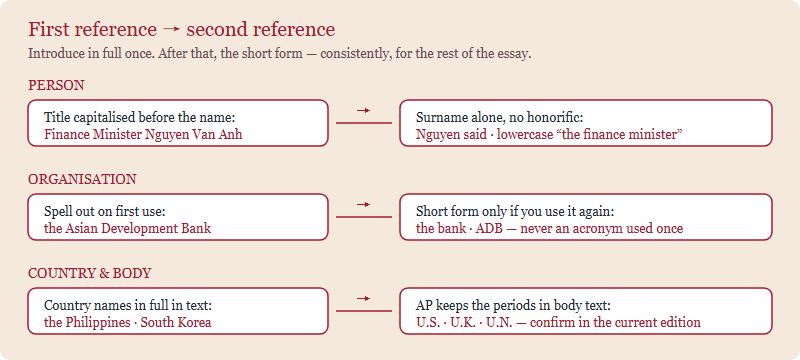
Three corollaries students get wrong:
- No honorifics on second reference. Not Mr. Nguyen, not Dr. Chen in most news style — the surname alone. Check the current edition for the exceptions.
- Standing-alone titles are lowercase. “President Marcos” but “the president said.” A capitalised “the President” mid-sentence is the tell of an academic habit.
- Do not introduce an acronym you never reuse. Writing “the Regional Comprehensive Economic Partnership (RCEP)” and then never saying RCEP again costs you words and adds clutter. AP's instinct is to avoid alphabet soup entirely: name it in full, then call it “the pact.”
Punctuation, hyphens and the words themselves
The remaining rules are small, frequent and easy to sweep in one pass.
| Rule | Do this | Not this | Why it matters here |
|---|---|---|---|
| Serial comma | trade, security and migration | trade, security, and migration | AP omits it in a simple series; keep it only where a list item contains its own “and” or the meaning blurs |
| Compound modifiers | a state-owned enterprise | a state owned enterprise | Hyphenate before the noun; AP relaxed this in a recent edition, so check the current guidance |
| -ly adverbs | a rapidly growing sector | a rapidly-growing sector | Never hyphenate after an adverb ending in -ly |
| Attribution verb | the report said · the minister said | stated · claimed · opined | “Said” is neutral; “claimed” signals doubt and reads as editorialising |
| No italics | Use quotation marks or plain roman type | Italicised titles and foreign terms | AP is a wire style and does not rely on italics; a Chicago-trained draft is full of them |
| Foreign terms | Explain in English on first use | Untranslated terms left to the reader | A judge outside your region should not have to look anything up |
| Quotation punctuation | Commas and periods inside the quotation marks | Outside, in the British habit | The single most visible marker of a non-AP draft |
On report and document titles, do not spend your final evening agonising. In a 1,200-word essay the clean solution is to name the publishing body and hyperlink the title — “a 2024 World Bank assessment found…” — which satisfies attribution, saves words, and sidesteps the quotation-mark question entirely. The mechanics of hyperlinked attribution are set out in our guide to citations in an AP-Style HIR essay.
The 25-minute style pass
Run this once, after the argument is frozen, in this order. Each step is a search rather than a read, which is why it is fast and why it catches things rereading never does.
- Minutes 1–5 — numbers. Search for every digit in the document. Check each against the ladder above. Then search for “percent” and decide once, for the whole essay, which form the current edition wants.
- Minutes 6–10 — dates and times. Search for each month name. Fix abbreviations, ordinal suffixes and day-first ordering as a group.
- Minutes 11–16 — names. List every person and organisation you mention. For each, confirm one full first reference and a consistent short form after it. Delete any acronym used only once.
- Minutes 17–20 — punctuation. Search for “ , and ” to catch serial commas. Scan for italics. Check that closing punctuation sits inside quotation marks.
- Minutes 21–25 — voice. Search for “stated,” “claimed,” “very,” “really” and “in order to.” Replace or delete. Then read the first and last paragraphs aloud.
Do this pass on a printed copy or a phone screen if you can. The change of medium is not superstition; it interrupts the pattern-completion that makes you read what you meant rather than what you typed. And leave it until the writing has genuinely stopped changing — polishing sentences you are about to delete is the most common way students spend a final evening badly.
Two last points of scope. Style marks are only half the mechanical picture: word count, the authorship declaration and the prohibition on AI-generated text are compliance requirements, not style ones, and the organiser sets how they are enforced. Confirm all of those on hir.harvard.edu rather than from a friend's account of last year. And if you are new to the contest structure — divisions, cycles, Defense Day — start from our foundation guide before you worry about commas.
Questions students actually ask
Which edition of AP Style should I use?
The contest asks for the newest edition, and AP revises annually. Confirm the current requirement on hir.harvard.edu and check any rule you learned from an old handout.
Do I really lose marks for a serial comma?
One comma, no. A draft that is consistently in MLA or British habits reads as unedited, and Style is judged as a 30-point block on exactly that.
Can I use italics for emphasis or foreign words?
Avoid it. AP is a wire style that does not lean on italics; rewrite for emphasis and explain foreign terms in English instead.
When should I do the style pass?
Last, after the argument is frozen. Roughly 25 minutes of targeted searches beats an hour of rereading, and polishing text you may still cut wastes both.
This is an independent guide operated by Hanlin Education for China-based international-school students. We are not affiliated with, endorsed by, or sponsored by the Harvard International Review or Harvard University. AP Style is published and revised by The Associated Press and the current edition is the authority; contest requirements, cycle dates and style expectations are set by the organiser and can change — confirm current details on hir.harvard.edu before you rely on anything here. Errors reported to our editorial desk are corrected within 7 working days.