A non-selection tells you an entry did not clear a bar. It does not tell you which bar. Assume you will receive no score breakdown unless the organiser provides one, and diagnose the entry yourself. In the drafts we review, almost every miss sits in one of four places — compliance, topic, argument architecture, or evidence handling — and each demands a different fix.
This matters in August specifically. The Spring cycle's Defense Day has already passed, the Summer submission window closes this month, and a Fall–Winter cycle follows with rolling registration; the organiser publishes each submission date and Defense Day on hir.harvard.edu. Confirm every one of those dates on hir.harvard.edu before you plan around them. The practical point is that you have a real runway to the next window — long enough to fix the right thing, and long enough to waste on fixing the wrong one.
First, read the result correctly
Three things are true about a non-selection, and students routinely believe none of them.
- Selection is comparative. Judges read a stack against a 60-point rubric — 30 points of Content, 30 of Style. A competent essay can miss because the essays around it were sharper, not because it was bad.
- The rubric is public; your score is not. You can reconstruct roughly where you lost ground by reading your own article against the published criteria. That is a far more useful exercise than speculating about the judges. Our line-by-line reading of the 60-point rubric is the reference for this.
- The failure is usually singular. Students assume everything was wrong and rewrite everything. In practice one class of problem dominates, and the other three were fine. Diagnosing before rewriting is the entire value of the next four weeks.
The 45-minute self-diagnostic
Print your entry. Do this with a pen, in one sitting, before you look at any new topic ideas. Five tests, in this order, because an earlier failure makes later tests meaningless.
- Test 1 — The 25-word claim. Without looking at the article, write your thesis in 25 words using a verb that could be wrong. Then find that sentence in the article. If you cannot write it, or it is not on the page, stop: this is an architecture failure and nothing below matters yet.
- Test 2 — The counterargument. Highlight where you state the strongest objection to your own claim. Not a straw man you dismantle in a clause — the real one, given its best form. Missing entirely? Architecture again.
- Test 3 — The ratio. Mark every sentence P (presents evidence) or A (interprets it). Count. If P outnumbers A by a wide margin, you wrote a report. The rubric's Content block rewards analysis of evidence, not the quantity of it.
- Test 4 — The compliance sweep. Word count inside 800–1,200. AP Style throughout. Citations by hyperlink where digital, AP Style for non-digital. Authorship declaration present. No AI-generated text — entries are run through multiple AI checkers, and high scores across them can disqualify. Confirm each requirement on the official site, because compliance failures are the cheapest points anyone ever loses.
- Test 5 — The stranger. Give it to someone outside your subject and ask them to restate your claim in one sentence. If they restate the topic instead of the claim, your introduction is doing the wrong job.
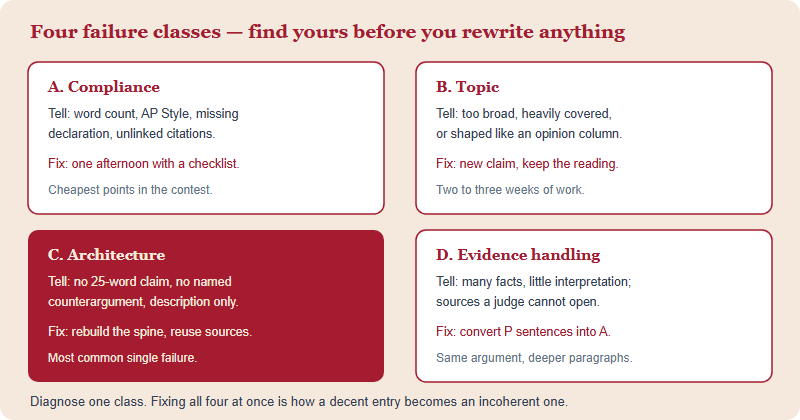
Symptom to prescription
| What you noticed | Class | What it actually means | Rewrite or start fresh? |
|---|---|---|---|
| You trimmed to 1,190 words at 1 a.m. and cut the last section | A | The word ceiling was managed at the end, not designed in from the start | Keep the claim; rebuild the outline to a word budget |
| Your title could describe fifty other articles | B | Scope never narrowed to a mechanism | New claim, same subject area; the reading is not wasted |
| You cannot state your thesis without reading the essay | C | The article describes rather than argues | Rewrite the spine, keep the sources |
| Readers said “interesting” but not “I disagree” | C | Nothing at stake — no falsifiable claim | Rewrite around a claim someone could refute |
| Half your sentences begin with a statistic | D | Evidence presented, not analysed | Same article; convert presentation into interpretation |
| Several citations were paywalled or dead | A / D | The judge could not verify your support | Same article; re-source to openly accessible references |
| You wrote passionately about what should change | B | Op-ed shape; the contest wants analysis, not advocacy | New claim — convert the “should” into a “because” |
One row deserves emphasis, because it is where the most talented writers lose. “Interesting but not disputable” is not a compliment; it means the article had no argument to defend. That is also the connection to Defense Day: an essay nobody could argue with produces fifteen minutes with nothing to say. If you were selected but the defence went badly, the diagnosis is different again — see how to prepare for Defense Day.
Revise or start over: the decision rule
Students waste more time on this decision than on any other. The rule is simple: the claim decides, not the prose. If the claim survives Tests 1–3, everything else is a revision job, however rough the draft feels. If the claim fails, no amount of polishing rescues it, and beginning again is faster than repairing it.
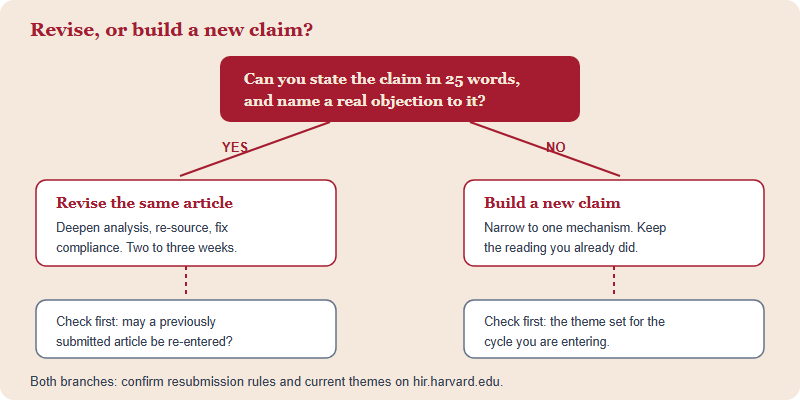
Two checks belong in this decision and are easy to skip. First, do not assume a previously submitted article may be entered again — contests differ, and this one's rules on resubmission are the organiser's to state. Ask, or confirm on the official site, before you build a plan on it. Second, themes are set per cycle and per division (Junior for grades 7–8, Senior for grades 9–12), so a revised article must still answer the theme of the window you are entering. If either check goes against you, the “revise” branch quietly becomes the “new claim” branch — better to discover that now than in December.
A runway, not a rewrite marathon
If you are targeting the Fall–Winter window the site lists with a Jan. 2, 2027 submission date, you have roughly four and a half months from mid-August. That is generous, and generous timelines fail in a specific way: nothing happens until December. Fix that with four checkpoints instead of a daily plan.
| Checkpoint | The one deliverable | Test it must pass |
|---|---|---|
| 1. Diagnosis | One page naming your failure class and the evidence for it | You can say which of A/B/C/D, and why, in two sentences |
| 2. Claim locked | 25-word claim plus the strongest objection, both written out | A reader outside your subject can disagree with it |
| 3. Sources assembled | Six to ten references a judge can open, with what each proves | Every claim in your outline maps to a source |
| 4. Full draft, then rest | Complete 800–1,200 word draft, then a week untouched | You can still defend it aloud after the gap |
Leave the compliance sweep for last, once the article has stopped changing shape. Word count, AP Style, hyperlink citations and the authorship declaration are the final pass, and re-checking them against the official requirements at that point is a single evening. Registration is separate from submission and must be completed first, and the organiser lists a payment as part of it — confirm the current process, fee and closing date on hir.harvard.edu, and do not leave registration to the week of the deadline. If you want the whole structure of divisions, cycles and judging in one place, start from our foundation guide to the contest.
The reframe worth keeping
An entry that was not selected still did the thing that matters: you produced a researched, rubric-tested piece of writing on a global-affairs question, in a house style you did not previously know, under a real deadline. That article remains usable as a writing sample and as material for an application supplement, whatever the result. The contest is one of the few places where students get an external read on that skill at all — and the second attempt, made with a diagnosis instead of a feeling, is a genuinely different attempt.
Questions students actually ask
Will I be told my score or given feedback?
Assume not, unless the organiser provides it. Diagnose against the published 60-point rubric instead, and confirm what feedback exists on hir.harvard.edu.
Can I resubmit the same article in the next cycle?
Do not assume so. Resubmission rules are the organiser's to set — confirm on the official site before planning a revision around it.
Should I change topic completely?
Only if the claim failed the 25-word and counterargument tests. Execution problems are much cheaper to fix than a claim that cannot be argued.
When is the next window?
A Fall–Winter cycle with rolling registration follows the Summer one; confirm its submission date and Defense Day on hir.harvard.edu.
This is an independent guide operated by Hanlin Education for China-based international-school students. We are not affiliated with, endorsed by, or sponsored by the Harvard International Review or Harvard University. Cycle dates, registration steps, fees, themes and resubmission rules are set by the organiser and can change — confirm current details on hir.harvard.edu before you rely on anything here. Errors reported to our editorial desk are corrected within 7 working days.