Living in the region you write about is an evidence advantage, and most entries throw it away. The contest wants research-backed analysis of international affairs rather than personal opinion, and it does not accept op-eds. Proximity earns points when it produces sources, granularity and a checkable claim. It loses points the moment it becomes a story about your family.
Two opposite mistakes are common among students at international schools in China. The first is avoidance: everyone writes about China, I should pick somewhere exotic — so a Shanghai student produces a thin 1,000 words on a conflict they have read three news articles about. The second is over-identification: the essay becomes a personal testimony, moving and unusable, because the rubric has nowhere to put it. Both waste the one structural advantage a locally based writer has.
Judges are not tired of your region — they are tired of the survey
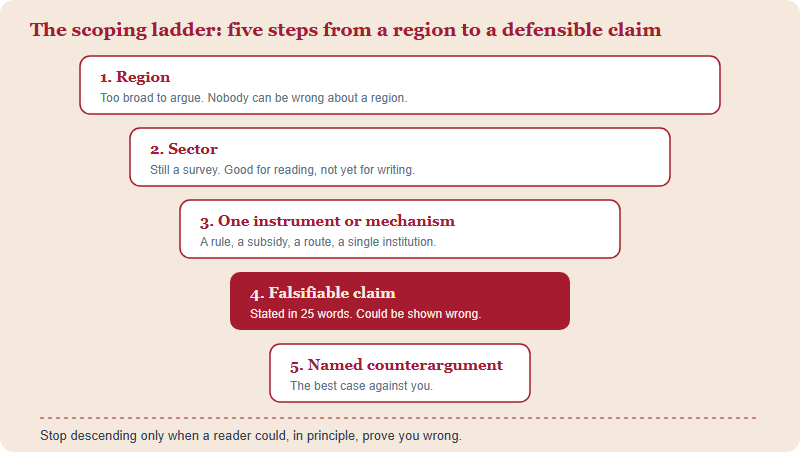
When students tell us a topic is “overdone,” they are almost always describing a scope problem wearing a subject-matter costume. “China's economy” is overdone. “How one municipal procurement rule changed the incentives for a specific class of supplier” is not overdone; it is barely done at all, because most people writing about the region are two thousand miles away and cannot read the rule.
The contest asks for analytical writing on the theme set for your cycle and division, in 800–1,200 words. That word ceiling is the real constraint. It is enough for one claim and its objection, and not enough for a country overview. The moment you accept that, your location stops being a cliché risk and becomes a sourcing advantage. If you have not yet internalised how the 60-point rubric splits Content and Style, our breakdown of the 60-point rubric is the fastest way to see where evidence handling actually scores.
The three traps
Nearly every proximity-based draft we read falls into one of three shapes. Each has a distinct tell and a distinct repair.
| Trap | What it looks like on the page | Why it costs you | The repair |
|---|---|---|---|
| 1. The native informant | “Growing up in my city, I watched the neighbourhood change …” | Reads as memoir. The claim rests on one unverifiable observer — you. | Keep the observation as a hypothesis generator. Then find the document, dataset or filing that shows it happened at scale. |
| 2. The brochure | Fluent recitation of an official narrative, or of the standard foreign critique of it, with no friction. | Nothing is at stake. A judge cannot tell what you concluded, only what you have read. | Find the tension: where does the stated aim of a policy diverge from a measurable outcome? Argue the gap, in either direction. |
| 3. The survey | “This article examines the political, economic and social dimensions of …” | Three shallow sections instead of one deep one. Analysis has no room left. | Delete two of the three dimensions. Spend the recovered 600 words on mechanism and counterargument. |
Trap 1 deserves a word of defence, because the advice “cut the anecdote” is usually given badly. Your observation is not worthless — it is often the reason you noticed a question nobody else noticed. The rule is about load-bearing: an anecdote may open a paragraph, but it may not be the thing holding the argument up. If deleting your personal observation collapses the essay, the essay was an op-ed.
The proximity dividend: four things a distant writer cannot do
Once the scope is narrow, being here starts paying. Four concrete advantages, in rough order of how much they raise a score:
- You can read primary-language sources. Ministry notices, provincial or municipal implementation rules, statistical yearbooks, industry association reports, court filings, listed-company disclosures. Most English-language commentary on your region is written from secondary summaries of exactly these documents. Going one layer up the source chain is the single strongest move available to you.
- You can check a repeated claim. A number gets copied between outlets until it looks like fact. If you can trace it to the original release and find that it measured something narrower than the claim implies, you have an article — and a genuinely under-appreciated one.
- You can see the implementation gap. The distance between what a rule says and what actually happens is the most reliable source of real arguments. But it must be documented: an inspection report, a compliance filing, a survey, a local news investigation. Not “in my experience.”
- You can pick a granular unit. One city, one corridor, one regulation, one supply-chain node, one campus system. Granularity is what makes 1,000 words feel deep instead of rushed.
Notice that three of these four are sourcing advantages, not opinion advantages. That is the whole point of this article: proximity should show up in your bibliography, not in your adjectives.
Using non-English sources responsibly
Students often assume a Chinese-language source is inadmissible. There is no reason to assume that — but there are handling rules that protect your score, and one formatting question you should settle before you submit.
- Make it locatable. Contest guidance directs writers to cite via hyperlink where the source is digital, using AP Style for non-digital sources. A judge who cannot reach the source cannot credit it. Confirm the current citation instructions on hir.harvard.edu.
- Say the translation is yours. If you translate a quoted passage, mark it plainly — “author's translation” — and keep the quotation short. Never present a paraphrase as a quotation.
- Pair local with verifiable. The strongest structure is a local primary source doing the specific work, anchored to an internationally accessible dataset doing the general work. The pairing signals that you did not simply trust one document.
- Quote sparingly. At 1,200 words, a long block quotation is an expensive way to say something you could summarise and cite. Reproducing extended passages from copyrighted material is a risk you have no reason to take.
- Do not run source text through a generative model and paste the output. The contest forbids AI-generated text and judges run entries through AI checkers. Translate carefully yourself, or use a source you can read directly.
Converting an anecdote into an evidence sentence
This is a mechanical operation, and it is worth practising on your own draft tonight. Take the sentence that carries your personal observation and ask three questions: What is the general claim hiding inside it? Who counted it? Where can a reader see the count? The answers become the replacement sentence.
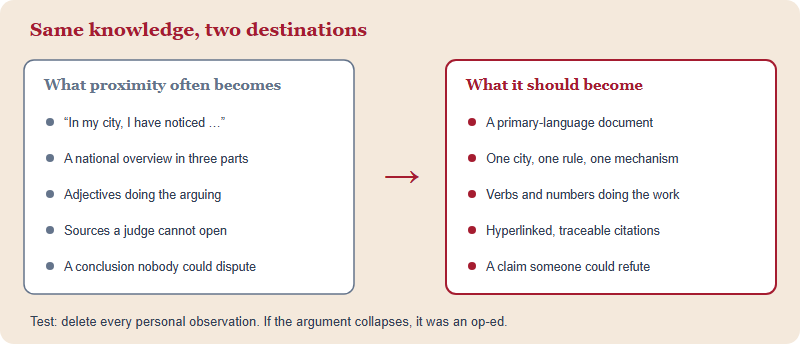
A worked shape, deliberately generic so you supply the facts: instead of “the shops near my school kept closing,” you write that a named local registry recorded a change in the number of active licences in a specified district over a specified period, cite it, and then argue about the mechanism — which is where the analysis marks live. The observation still generated the question. It just stopped being the evidence.
Defense Day rewards proximity — if you prepared for the obvious question
Finalists give a 15-minute presentation and oral defence to HIR judges. If your article is built on regional access, expect a version of three questions, and rehearse all three aloud rather than in your head:
- “How do you know that?” Answer with the source and its limitation in one breath: what it measures, what it does not, why you still trust it for this claim.
- “Isn't your closeness a bias?” The honest answer is yes, and that is why the argument rests on documents rather than on impressions. Say so directly. Defensiveness reads worse than the bias.
- “What would change your mind?” Have a real answer ready — a specific finding that would break your claim. Students who can name one are visibly more credible than students who cannot.
Our walkthrough of how to prepare for Defense Day covers the format itself; the point here is narrower. Regional expertise invites a specific line of questioning, and it is entirely predictable, which means there is no excuse for being surprised by it. For the wider picture of divisions, cycles and what the contest is, start with our foundation guide.
A 30-minute test before you commit
Run this before you invest a fortnight in a topic. If you are targeting the Summer deadline, run it tonight; if you are aiming at the Fall–Winter window, you have time to fail it twice and still win. Confirm both dates on the official site.
- Minutes 1–10: Write your claim in 25 words with a verb that could be wrong. If it contains “explores,” “examines” or “highlights,” it is not yet a claim.
- Minutes 11–20: Find two sources a judge can open in one click that bear directly on it. Not on the topic — on the claim. If you cannot in ten minutes, the scope is still too wide or too obscure.
- Minutes 21–25: Write the strongest counterargument in two sentences. If it is easy to demolish, you picked a straw man; find the real objection.
- Minutes 26–30: Delete every sentence containing “I.” Does the claim still stand? If yes, write the article. If no, keep the observation and go back to step 3 of the ladder.
Questions students actually ask
Is writing about my own country too common to score well?
Subject is not the problem; scope is. A narrow mechanism in a familiar country beats a broad survey of an unfamiliar one.
Can I cite Chinese-language sources?
Cite what a judge can locate: hyperlink digital sources, use AP Style for non-digital ones, and mark your own translations. Confirm citation rules on hir.harvard.edu.
Can I include something I personally witnessed?
Only as a way in, never as the proof. The contest wants research-backed analysis and does not accept op-eds, so the argument must rest on documents.
Does a table of local data eat into my word count?
Guidance excludes diagrams and tables of data from the 800–1,200 count, but confirm the current wording on the official site before you rely on it.
This is an independent guide operated by Hanlin Education for China-based international-school students. We are not affiliated with, endorsed by, or sponsored by the Harvard International Review or Harvard University. Contest rules, themes, dates, citation requirements and word-count exclusions are set by the organiser and can change — confirm current details on hir.harvard.edu before you rely on anything here. Errors reported to our editorial desk are corrected within 7 working days.