Disclaimer: This is an independent preparation guide. It is not affiliated with, endorsed by, or sponsored by Harvard International Review or Harvard University.
Short answer: The most efficient preparation for HIR Defense Day Q&A is not a list of guessed judge questions. It is a one-page evidence backup sheet built from your own submitted essay. For every factual and causal claim in the entry, you record four fields — source, scope, limitation, and backup evidence — then convert each limitation into the follow-up question a careful reader would ask, and rehearse a short honest answer. Hanlin’s current HIR source pack, checked 2026-10-26, does not list official judge question patterns or defence-day scoring rules. Every questioning pattern and mock exchange below is therefore a labelled coaching illustration, not confirmed event content.
Why a polished deck is not enough
Finalists tend to spend most of their preparation budget on the slide deck and the opening presentation. That is a sensible use of time: a clear fifteen-minute talk communicates your thesis efficiently. But a deck is a one-directional artefact. It speaks. It does not answer. When the conversation moves to a specific number, a contested source, or a causal leap between two sentences, the slides give you nothing to say. You have to reason live about your own evidence.
The gap between a rehearsed presentation and an unrehearsed defence is not usually caused by a weak argument. It is caused by evidence that was never explicitly mapped to the sentence it supports. In the essay, a footnote or in-text attribution quietly carries the burden. In the Q&A, the same burden shifts to you. A backup sheet moves the evidence back into the room before the questions start.
Step 1 — Extract every factual and causal claim
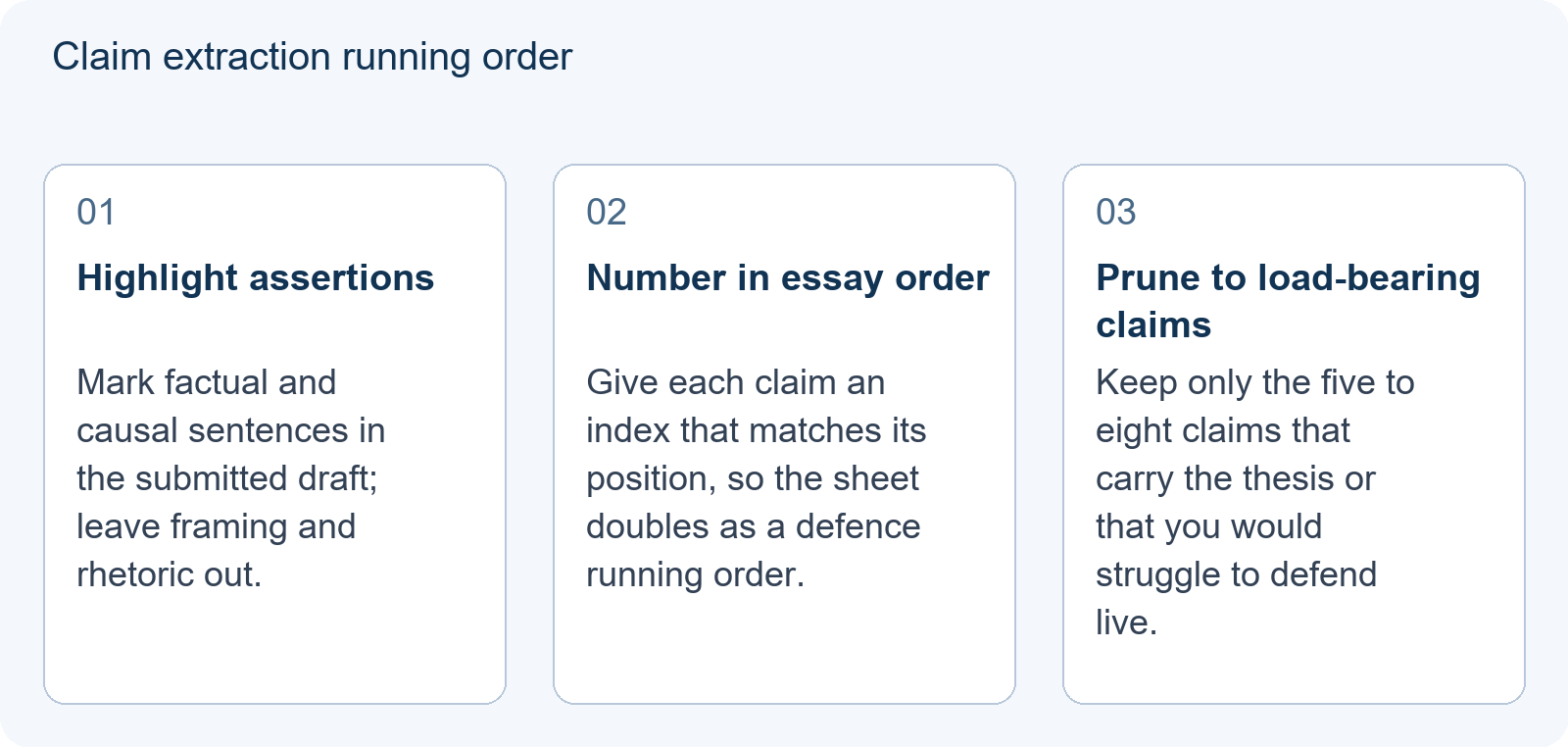
Read your final submitted draft with a highlighter in hand. Mark two kinds of sentence:
- Factual claims that assert what is the case: a measured value, a trend, a policy, a date, a comparison between two countries.
- Causal claims that assert one thing produces, drives, or explains another: “X increased Y,” “regulation reduced Z,” “the reform weakened W.”
Leave out opinions, rhetorical flourishes, and framing sentences. They are part of your argumentative voice, not claims that require external validation. A useful test: if the sentence would be false under a plausible alternative measure, it belongs on the list.
A worked teaching example: suppose your essay contains the sentence, “The shift to remote work has increased urban expansion in mid-sized Chinese cities.” That is a causal claim, and it assumes two further factual claims — that remote work has increased, and that urban expansion has increased in the population you name. Your claim list should include all three, because each one is a separate door a follow-up question can open.
Number the claims in the order they appear in the essay. You will keep this numbering through the rest of the process, because it becomes your defence running order.
Step 2 — Fill four fields per claim
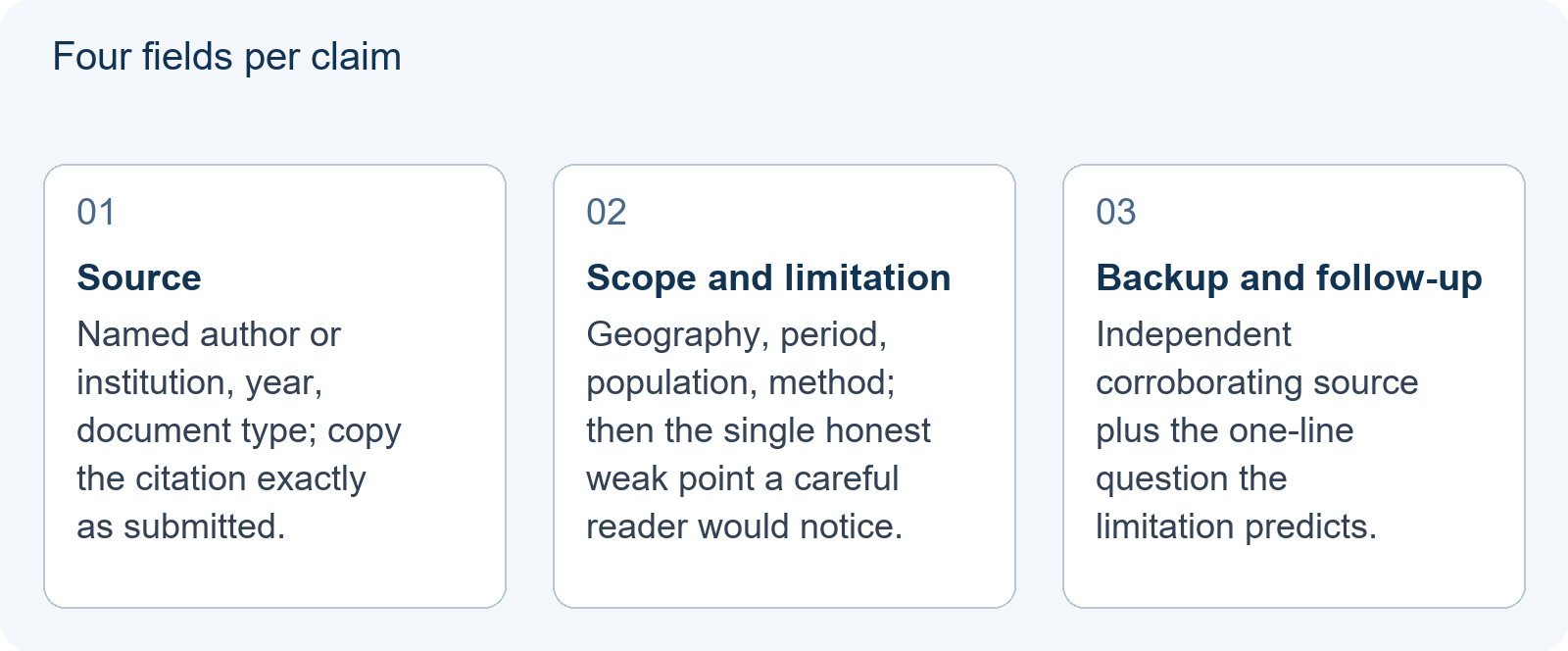
Build a table with one row per numbered claim and four columns. This is the sheet.
- Source. The specific reference that carries the claim. Name the author or institution, the year, and the document type — not “a report” but “a 2024 World Bank country brief on urbanisation.” If the essay already cites it, copy the citation exactly, including the URL if it was in your evidence list.
- Scope. What the source actually covers. Geography, period, population, sector, and method. A survey of twenty firms in one province is a different scope from a national administrative dataset. Writing the scope in one line is the fastest way to catch an unintended generalisation.
- Limitation. The honest weak point. Outdated data, narrow sample, self-reported measures, a single case study, a definition that differs from the one you used elsewhere, an interest that could bias the publisher. Judges are not the only readers who notice these; you should notice them first.
- Backup evidence. One independent source that corroborates the same claim or that partially substitutes for it if the primary source is challenged. It does not have to match the primary source exactly in scope. It has to survive the specific limitation you already named.
The four-field format is deliberately narrow. If you cannot fill a field, that is a signal that the claim is softer than the essay made it look, and it should be framed that way during the defence rather than defended as if it were settled.
Step 3 — Turn each limitation into a question
Once the sheet is populated, walk down the Limitation column and rewrite each entry as a question. The rule is: the more obvious the limitation is to you, the more likely it is to be the first question asked. Three limitations produce three shapes of question.
- Scope limitation → “Your evidence covers [population X]. Does your conclusion hold for [population Y]?”
- Vintage limitation → “Has this trend continued since your source was published?”
- Method limitation → “Self-reported data tends to overstate participation. How does that affect your estimate?”
Write a two- to three-sentence answer under each question. The answer must do three things: concede what is true in the question, locate your original claim precisely within its scope, and point to the backup evidence. Do not draft a rebuttal to the question. Draft a calibrated confirmation of what your evidence can and cannot support. This is the same discipline recommended for writing when credible accounts of an event conflict, applied live; see the related Hanlin article HIR Essay Source Disagreement: Writing When Credible Accounts Conflict.
You will not use every drafted answer. That is fine. The drafts exist so that when a question lands, you recognise its shape and respond from the same evaluative posture you brought to the essay.
The evidence backup sheet at a glance
The table below is a teaching illustration. The source names are placeholders, not claims about any specific report. The point is the structure, not the content.
| # | Claim (from my essay) | Source & why it matters | Scope & limitation | Backup evidence | Likely follow-up |
|---|---|---|---|---|---|
| 1 | Remote work increased urban expansion in mid-sized Chinese cities. | [Source A] — a 2024 city-level housing report; the only dataset disaggregated by municipality size. | Covers three coastal provinces, 2020–2023; omits inland cities. | [Source B] — an independent provincial statistics bulletin for a fourth city. | “Does the trend extend inland?” |
| 2 | Carbon pricing reduced industrial emissions in the sampled markets. | [Source C] — an academic study on the Nordic experience. | Sample is high-income, high-enforcement systems. | [Source D] — a pilot-programme evaluation in a middle-income economy. | “Do the mechanisms transfer to weaker enforcement?” |
Three labelled teaching mock exchanges
Note: these are coaching illustrations written by Hanlin for teaching purposes. They are not official judge questions, and they do not describe any specific HIR event.
Illustration 1 — Credibility probe.
Question (teaching): “Your main source is not peer-reviewed. Why should this carry the weight it does in your argument?”
Illustrative response: “That is a fair framing. The source supplies real-time aggregation that formal studies typically publish with a lag, so I used it for the pattern rather than the precise magnitude. The magnitudes come from [Source B], and where the two disagree by more than ten per cent, I rely on [Source B] and treat the other as directional.”
Illustration 2 — Relevance probe.
Question (teaching): “You cite a European regulatory example, but your essay is about an Asian market. How is the comparison earned?”
Illustrative response: “The comparison is a mechanism check, not a transfer of outcomes. The European case shows that compliance costs land unevenly on small producers. My essay claims the same pressure would appear in the Asian market for a different institutional reason, and the parallel case study in my backup sheet shows that pressure already in one sub-sector.”
Illustration 3 — Counter-evidence probe.
Question (teaching): “Your data ends in 2023. Recent reporting suggests the opposite direction. Does that not undercut the argument?”
Illustrative response: “It narrows the period over which the claim holds. My argument is about a structural shift in how firms choose locations, not about a straight line in one indicator. A reversal in the headline indicator is consistent with the mechanism if it appears alongside continued dispersion of firm location, which is what the newest [Source D] data shows.”
Script pattern: acknowledge, locate, connect
When you cannot recall the exact answer, the structure still holds. Three moves in order:
- Acknowledge the specific part of the question that is true. Do not concede more than the question warrants, and do not defend more than your evidence warrants.
- Locate your original claim inside its scope. Say what population, period, or method it applied to. “Within the 2020–2023 sample of coastal municipalities” is a complete sentence on its own.
- Connect back to the thesis. Show that the additional nuance refines your argument rather than dissolving it, or name the condition under which your claim would fail. Naming the failure condition is stronger than pretending none exists.
This pattern has a practical benefit under time pressure: it is short enough to remember, and it prevents the two classic failure modes — over-apologising and over-claiming.
When you do not know, or a source is imperfect
Two separate situations require two separate responses.
You do not know the answer. Do not improvise a figure or an attribution. Convert the question into the next step you would take: “I do not have that number in front of me. The measure I used is [measure], and to extend it I would go to [type of source]. Based on the pattern I have, I would expect [direction, with a clear qualifier].” This is honest and it demonstrates method.
A source is genuinely weak. Say so before the question is asked. Position the weak source where it actually belongs — as corroboration, as illustration, or as the source that lets you name an alternative you ruled out. A weak source defended as strong is worse than a weak source labelled as such. The Hanlin article Which Sources Actually Count: Building a Clickable Evidence List for an HIR Essay From China covers the pre-submission version of this discipline, and it is the page to revisit if your evidence list itself needs repair before rehearsal.
Rehearsal checklist for non-native English speakers
For China-based finalists, the risk is rarely the argument. It is load management: translating a question in your head, retrieving the evidence, and speaking all at once. Four rehearsals that behave better than reading your notes aloud:
- Read each drafted answer aloud twice, then close the sheet and say it from memory. The second pass, not the first, is where fluency begins.
- Record yourself answering your top five likely questions. Listen for two things: filler sounds, and any place where you gave a number without saying where it came from.
- Practise saying every proper noun you used — authors, institutions, programme names — at a slow, steady pace. Pronunciation errors on the evidence are the easiest points to lose early.
- Prepare two ways of saying “I would like to check that” and “that is a fair point,” so you have a natural bridge when a question catches you off guard.
Pacing and tone interact with clarity more than accent accuracy does. The related Hanlin guide HIR Defense Day in Your Second Language: A Spoken-English Playbook for China-Based Finalists (2026) goes deeper on delivery, and it pairs well with the evidence sheet once the content is fixed.
General event background is available at Event background.
Frequently Asked Questions
Are the mock exchanges in this article actual HIR questions?
No. They are labelled teaching illustrations. Hanlin’s current source pack, checked 2026-10-26, does not list any official judge question patterns or defence-day scoring rules, so every question shape here is coaching reasoning, not event content.
Do I need a separate backup sheet entry for every claim in my essay?
No. Focus on the claims that carry your thesis and the claims whose evidence you would struggle to defend live. A typical 800-1,200-word HIR essay yields about five to eight worth mapping; the sheet should still fit on one page.
What if one of my sources is genuinely weak?
Name it before the question arrives and position it correctly: as corroboration, illustration, or as the source that lets you name the alternative you ruled out. A weak source defended as strong is worse than a weak source labelled accurately.