Disclaimer: This is an independent preparation guide for the Harvard International Review Academic Writing Contest. It is not affiliated with, endorsed by, or officially connected to Harvard University, Harvard College, or the Harvard International Review.
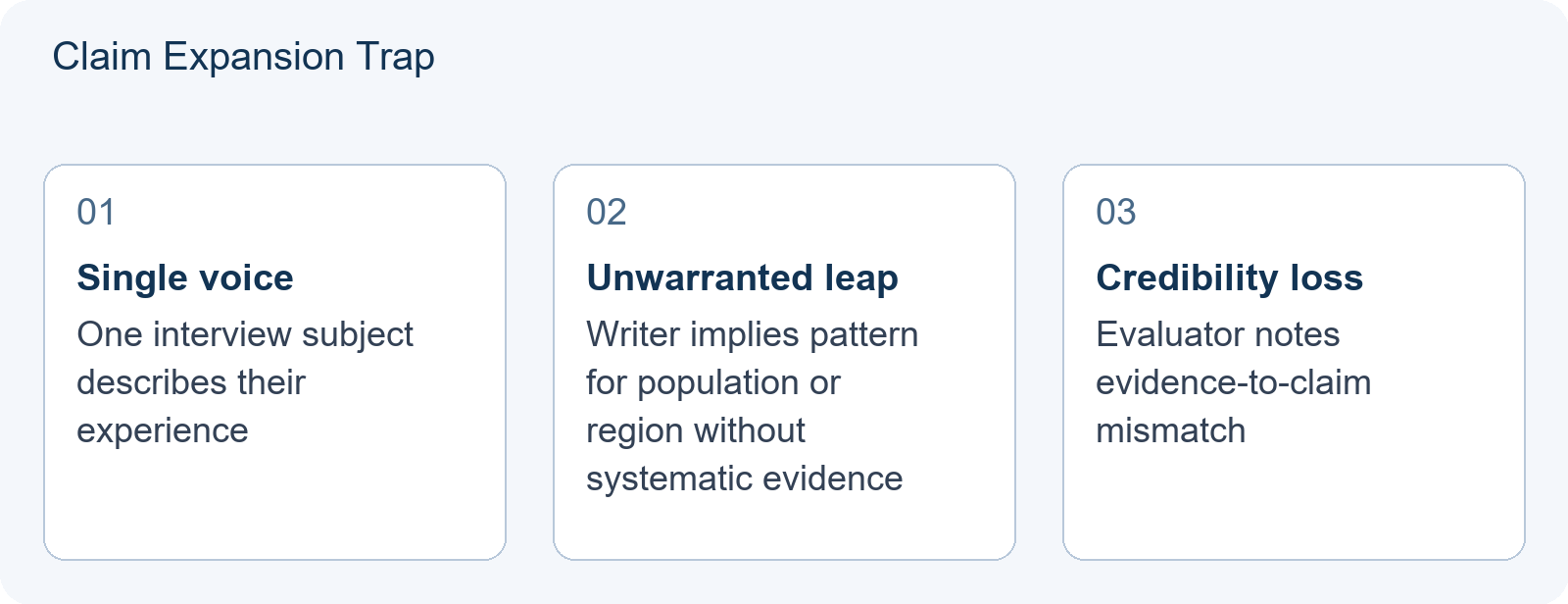
When an HIR essay prompt asks you to examine how digital platforms reshape cultural identity or how emerging technology redistributes power, a personal interview with someone directly affected can feel like gold. You have a real voice, a specific story, and concrete detail that distinguishes your essay from abstract theorising. But the same feature that makes interview evidence attractive—its vivid particularity—also creates a methodological trap. If you present one person’s experience as representative of a broader pattern, you commit the fallacy of generalising from a single voice, and evaluators will notice. The challenge is not to avoid interviews. It is to use them with disciplinary rigour: as bounded, contextualised evidence that supports a carefully scoped claim.
Why Interviews Appeal and Why They Fail
Interviews offer what documents often cannot: texture, motivation, and the causal reasoning of someone living inside the phenomenon you study. A content creator in Shenzhen can explain why she algorithmically tailors her videos for Southeast Asian audiences in ways that platform analytics alone cannot capture. A retired engineer in Ukraine can describe how civilian drone networks altered his understanding of security with a specificity no policy brief matches.
Teaching illustration: These examples are hypothetical scenarios constructed for instructional purposes. They are not drawn from actual contest entries or verified participant experiences.
The failure mode arrives when writers treat these accounts as sufficient proof. Consider a teaching illustration on Theme A, “Global Culture in the Digital Era.” A writer interviews three Chinese students who report feeling that short-video platforms homogenise their cultural consumption. The writer then concludes that “young Chinese users experience algorithmic flattening of cultural identity.” The problem is structural: three self-selected respondents, likely from similar educational backgrounds, cannot support a national generalisation. The claim has overstepped its evidence. HIR’s evaluation criteria emphasise “nuanced topics in international affairs” and “research-based” argumentation; an unqualified generalisation from limited data violates both.
The Three-Step Method for Interview Evidence
The following method treats interview material as one component in a layered evidence strategy. Each step includes a clearly labelled teaching illustration and a contrasting case where the same material fails.
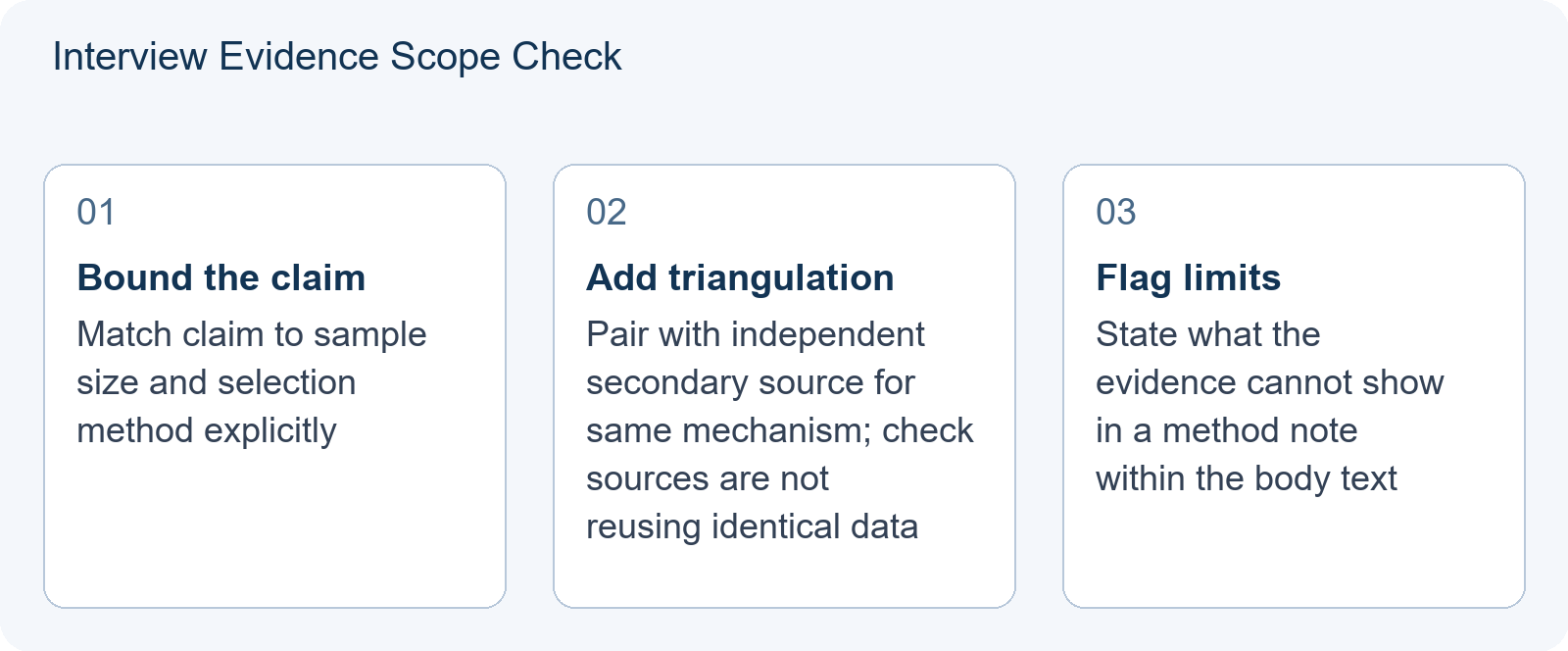
Step 1: Scope the Claim to Match the Sample
Before writing, state explicitly what your interview evidence can and cannot show. A single interview supports a claim about that individual’s experience, their institutional context, or a pattern visible in their immediate network. It does not support claims about national populations, generational behaviour, or universal mechanisms.
Teaching illustration: A writer interviews a single garment worker (Person A) who used a mobile banking app to access wages during recent monsoon disruptions. Person A reports that the app failed twice during peak flooding and that they had to borrow from a supervisor to cover emergency expenses. The properly scoped claim: “Person A’s experience illustrates how a specific mobile wage platform performed during a particular climate event, revealing a potential vulnerability in digital payment infrastructure when physical bank branches are inaccessible.” This claim is bounded to one person’s documented experience. It does not claim all garment workers, all mobile banking users, or all climate events.
Contrasting failure: The same writer claims, “Mobile banking in developing economies creates financial fragility during natural disasters.” The sample is one person in one city during one event. The claim has expanded to “developing economies” generally. The evidence-to-claim ratio is broken.
Step 2: Triangulate with Secondary Sources
Interviews gain authority when corroborated by independent data. The goal is not to replace the personal account but to position it within a recognised pattern. Secondary sources might include industry reports, academic studies, NGO documentation, or journalistic investigations. The interview provides the mechanism; the secondary source provides the prevalence. Two sources may reuse underlying data, so check independence before claiming corroboration.
Teaching illustration: Person A’s account is paired with a hypothetical industry report (Report A) on digital financial services in South Asian manufacturing, which documents that three major mobile wage platforms experienced service interruptions affecting an estimated 12% of registered users during monsoon seasons from 2023 to 2025. The writer’s claim becomes: “While Report A indicates that platform outages affected a minority of users, Person A’s account illustrates the concrete consequences for one worker: wage access delays led to debt dependency on employers. The convergence suggests a vulnerability worth further systematic study, not a universal pattern.” The interview illustrates a mechanism; Report A establishes that similar disruptions occurred elsewhere, though the two sources may draw from overlapping industry data and should not be treated as fully independent confirmation.
Contrasting failure: The writer cites only the interview, then adds, “This suggests systemic problems with mobile banking in South Asia.” Without Report A, there is no evidence that the problem extends beyond one person. The reader has only the writer’s assertion.
Step 3: Flag Limitations Explicitly
Academic writing rewards self-awareness about method. Explicitly noting your interview’s limitations—sample size, selection method, access constraints—signals mature research practice. It also protects you from overclaiming. Place these limitations in the body of your essay where the evidence first appears.
Teaching illustration: The writer includes a methodological sentence: “This account derives from a single semi-structured interview with Person A, a garment worker in Dhaka’s Mirpur district, recruited through a local trade union. The interview provides granular insight into individual experience but cannot establish prevalence or representativeness. The claim is therefore limited to documented mechanisms in this specific context.” HIR evaluators reading this understand that the writer controls their evidence.
Contrasting failure: The writer presents the interview without methodological comment, allowing the reader to assume either that the account is typical (unwarranted) or that the writer does not understand sampling (damaging to credibility). Silence is not neutral; it is interpreted as oversight.
A Worked Diagnostic: Testing Your Own Draft
Apply the following three-question diagnostic to any paragraph containing interview evidence in your HIR essay. Each question requires a specific answer in your draft.
Question 1: What is the smallest population to which your claim applies?
If your answer is larger than “people in circumstances similar to your interview subject,” revise the claim or add qualifying language. For example, “some users,” “workers in this sector,” or “in this context” are acceptable; “young people today” or “countries like X” are not.
Question 2: What non-interview source would most strengthen this paragraph?
If you cannot name a specific source type—academic study, industry report, government data, NGO documentation—the paragraph is under-supported. Note that “more interviews” does not solve the triangulation problem; additional diverse interviews can help, but they do not automatically eliminate shared bias if subjects are drawn from similar networks.
Question 3: Where have you told the reader what this evidence cannot do?
If the answer is “nowhere,” add a limitation sentence in the body text. This is not weakness; it is the mark of a writer who understands how knowledge is constructed.
What the Diagnostic Result Means for Your Next Task
If your draft fails one or more diagnostic questions, the revision path is specific. A failed Question 1 requires claim revision, not more evidence. A failed Question 2 requires research, not rhetorical strengthening. A failed Question 3 requires explicit methodological framing, which can often be added without disrupting essay flow.
Questions that push this revision forward include: “What would falsify this claim?” “Who would disagree with this interpretation, and what evidence would they require?” “If I interviewed someone with the opposite experience, how would your argument change?” These questions push the writer toward argumentative self-awareness that HIR’s evaluation criteria reward.
Adjacent Resources and Further Reading
For related guidance on evidence handling in HIR essays, see HIR Essay Source Disagreement: Writing When Credible Accounts Conflict, which addresses how to weigh conflicting sources without collapsing into false equivalence. For scoping global topics appropriately, HIR Essay Scope: Turning a Global Topic Into an Answerable Question provides a framework for narrowing HIR’s broad themes. For understanding how your essay will be evaluated after submission, HIR Essay Feedback: What to Improve After a Bronze or Silver Result analyses common evaluator comments and their implications for revision.
Interview evidence in an HIR essay is not a shortcut around systematic research. It is a complement to it, valuable precisely when its limitations are acknowledged and its scope is disciplined. The writer who can say, “Here is what one voice reveals, here is what broader data suggest, and here is what remains uncertain,” has demonstrated the analytical maturity that distinguishes medal-level work.
Handling the “Negative Case” Interview
A common pitfall in using interview evidence is assuming that silence or absence of a phenomenon proves its non-existence. If you interview a subject who does not report a specific effect, you might be tempted to claim the effect is rare or nonexistent. This is a logical error known as argument from ignorance. In an HIR essay, particularly when addressing Theme C (Technology, Innovation, and Power) or Theme A (Global Culture), a negative finding requires careful framing.
Teaching illustration: Consider a writer investigating whether algorithmic bias affects hiring decisions for remote workers in Southeast Asia. The writer interviews Person B, a software developer in Jakarta who uses three different job platforms. Person B reports never encountering discriminatory filters based on location or accent. The writer concludes: “Algorithmic bias in hiring is negligible for Southeast Asian developers.” This conclusion is invalid. Person B’s experience reflects only their specific profile, search habits, and the particular platforms they used. It does not prove the absence of bias across all users or platforms.
The correct approach is to treat the negative case as a boundary condition rather than a refutation. Instead of claiming bias is negligible, the writer should scope the claim to the observed context: “Person B’s experience suggests that for developers with strong English proficiency and standardised digital footprints, current platform algorithms may not actively filter candidates by geography. However, this does not rule out bias affecting other demographic groups or less digitally visible applicants.”
To strengthen this interpretation, triangulate with data showing where bias does occur. For instance, pair Person B’s account with Report B, a hypothetical study indicating that 15% of non-native English speakers face automated rejection due to keyword mismatches. The synthesis becomes: “While Person B faced no barriers, Report B indicates that linguistic profiling remains a significant hurdle for others. This disparity highlights that algorithmic neutrality is contingent on user characteristics, not inherent to the technology itself.”
This method transforms a potential weakness—lack of positive evidence for your thesis—into a nuanced analysis of conditional effects. Evaluators reward this precision because it demonstrates an understanding of how technology interacts differently with diverse populations. By explicitly stating what the negative case cannot show (universal absence of bias) and what it can suggest (conditional accessibility), you avoid overgeneralisation while maintaining analytical rigour.
When drafting, ask yourself: Does my negative example disprove the mechanism, or does it merely fail to trigger it? If the latter, revise your claim to reflect the specific conditions under which the phenomenon was absent. This distinction is critical for high-scoring essays that navigate complex global issues without resorting to sweeping generalisations.
Frequently Asked Questions
Can I use a family member’s experience as interview evidence in an HIR essay?
Yes, if you treat it with the same rigour as any other interview: scope the claim to their specific context, triangulate with secondary sources, and explicitly note your relationship as a potential source of bias. The relationship itself is not disqualifying; the unsupported generalisation is.
How many interviews are enough to avoid the single-voice problem?
Quantity alone does not solve the problem. Three interviews from the same social network may share the same bias as one. Additional diverse interviews can help, but they do not automatically eliminate shared bias if subjects are drawn from similar networks. The key is diversity of source and explicit triangulation with non-interview evidence, not a threshold number of conversations.
Where in the HIR essay should I discuss methodological limitations?
A brief methodological note should appear in the body text where the evidence first appears, such as a single sentence in the paragraph or an introductory clause to the quotation. HIR rules do not confirm that appendices are permitted or read by evaluators, so place limitations where they cannot be missed.