Disclaimer: This is an independent preparation guide, not affiliated with or endorsed by Harvard International Review or Harvard University.
When writing a Harvard International Review (HIR) academic essay, choosing which countries to compare is not merely a matter of picking two nations with interesting headlines. The core challenge lies in selecting cases that actively test the validity of your central argument or explanation. A poorly chosen comparison can dilute your thesis, while a well-chosen one strengthens it by demonstrating that your reasoning holds across different contexts or fails precisely where expected. This article explores how to make strategic country selections for HIR essays, ensuring your comparative analysis serves your explanatory goal rather than just filling word count.
The Purpose of Comparison in HIR Essays
HIR essays require students to submit an 800-1200 word English article on international affairs topics such as global culture, security, or technology power dynamics. Within these broad themes, a comparison between two or more countries allows you to isolate variables. However, two-country selection does not isolate causality automatically. Observable matching on visible factors cannot remove unmeasured confounding or reverse causality. If you argue that digital censorship drives cultural homogenization, comparing two nations with different censorship policies but similar economic development might seem controlled. Yet unobserved variables—historical media traditions, linguistic isolation, or pre-existing cultural production capacity—may still drive outcomes independently of your proposed mechanism.
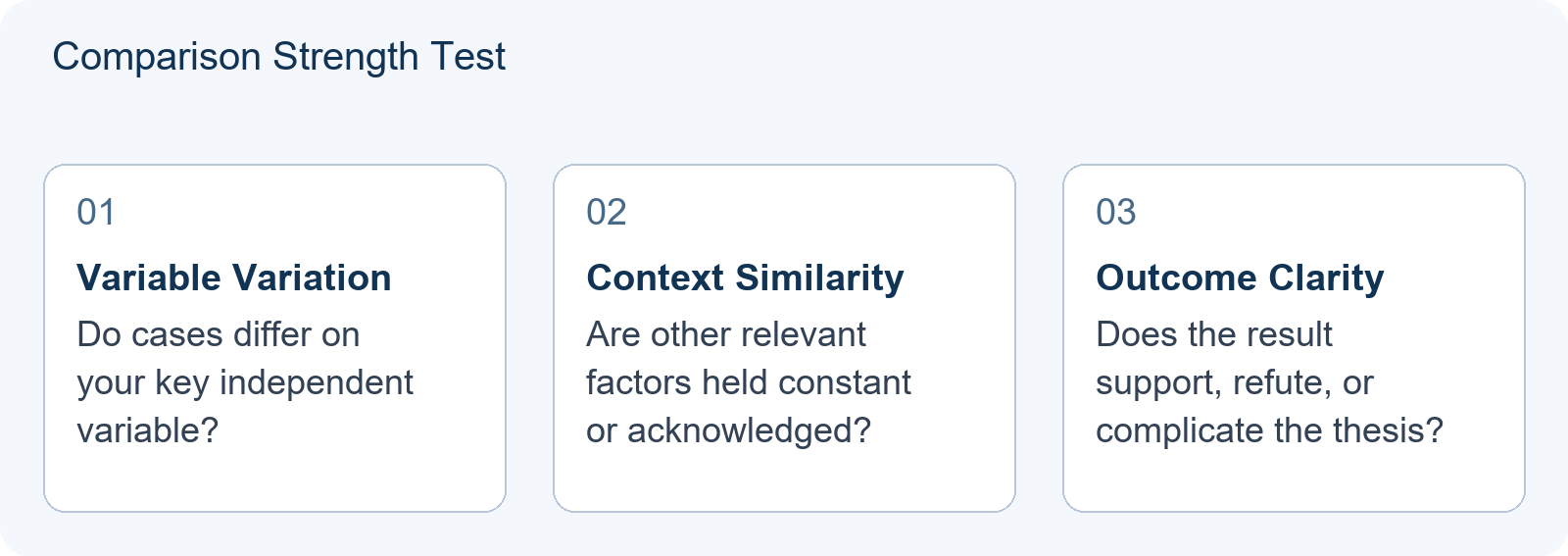
The purpose of comparison is to structure variation so that the mechanism you propose becomes visible, not to prove causation definitively. Most-different cases can be chosen for other purposes, such as demonstrating the range of a phenomenon; it is not mandatory that all controls be similar. If your explanation cannot survive the variation introduced by the second case, your thesis may be too narrow or incorrectly specified. A good comparison may weaken your original thesis, and that is valuable—it reveals where your reasoning needs refinement.
Identifying the Mechanism Before Choosing Cases
Before selecting countries, clearly define the causal mechanism in your thesis. Are you arguing about institutional capacity? Cultural proximity? Economic interdependence? Once the mechanism is explicit, choose countries that vary on the independent variable but are similar on other relevant controls. For example, if your topic is “Security in a Multipolar World” and you argue that small states rely on multilateral institutions when bilateral alliances fail, you might compare two small, economically advanced states facing great-power pressures but operating in different regional security architectures. This contrast tests whether the reliance on multilateralism is a universal strategy for small states or context-dependent. By focusing on the mechanism first, you avoid the trap of comparing countries simply because they are frequently mentioned together in news cycles.
Worked Teaching Illustration: Technology and Power
Note: This is a hypothetical teaching illustration, not an actual contest submission.
Suppose a student argues that “State-led investment in AI infrastructure determines national influence in global governance.” To test this, they initially consider comparing two large powers with divergent political systems. While both are leaders, their fundamental institutional differences make it hard to isolate “state-led investment” as the sole driver. A better comparison might be between two mid-sized powers with strong tech sectors but different coordination models: Country A with a heavily state-directed approach through national conglomerates, and Country B with a more decentralized framework relying on regional coordination and private-public partnerships. Both have comparable GDP per capita, similar education levels in STEM fields, and comparable baseline technological infrastructure as of a fixed reference year.
If the student were to find that Country A’s state-directed model yields disproportionate influence relative to national size in international standard-setting bodies, while Country B’s decentralized model produces more diffuse outcomes, the comparison would support the thesis—provisionally. If both yielded similar influence despite different models, the thesis would need refinement. This illustrates how case selection directly impacts the strength of the argument, while also showing that even well-matched cases cannot eliminate all confounding variables.
Contrasting Teaching Illustration: When Superficial Similarity Fails
Note: This is a hypothetical teaching illustration, not an actual contest submission.
A common error is comparing countries that appear similar but diverge on critical unobserved variables. Consider an essay on “Global Culture in the Digital Era” arguing that social media algorithms erode local language preservation. A student compares two high-income societies with strong pop cultures and high internet penetration, assuming these surface similarities make them comparable. However, if one society has a linguistically isolated language with limited training data in global AI systems, while the other has a language with extensive digital corpora and export-oriented content industries, the algorithmic dynamics may differ for reasons unrelated to policy. The comparison fails to isolate the effect of algorithms because the underlying linguistic and economic contexts are too distinct.
A stronger comparison would be between two societies with similar linguistic families and comparable digital economies but different regulatory frameworks, allowing the student to focus on policy differences in digital regulation rather than inherent structural traits. This highlights the need for rigorous control variables in case selection. Before claiming that conflicting government and NGO data on adoption versus usage proves propaganda, one must check definitions, period, population, and methods first—the discrepancy may reflect genuine measurement differences rather than deliberate distortion.
Diagnostic Application: Testing Your Pairing
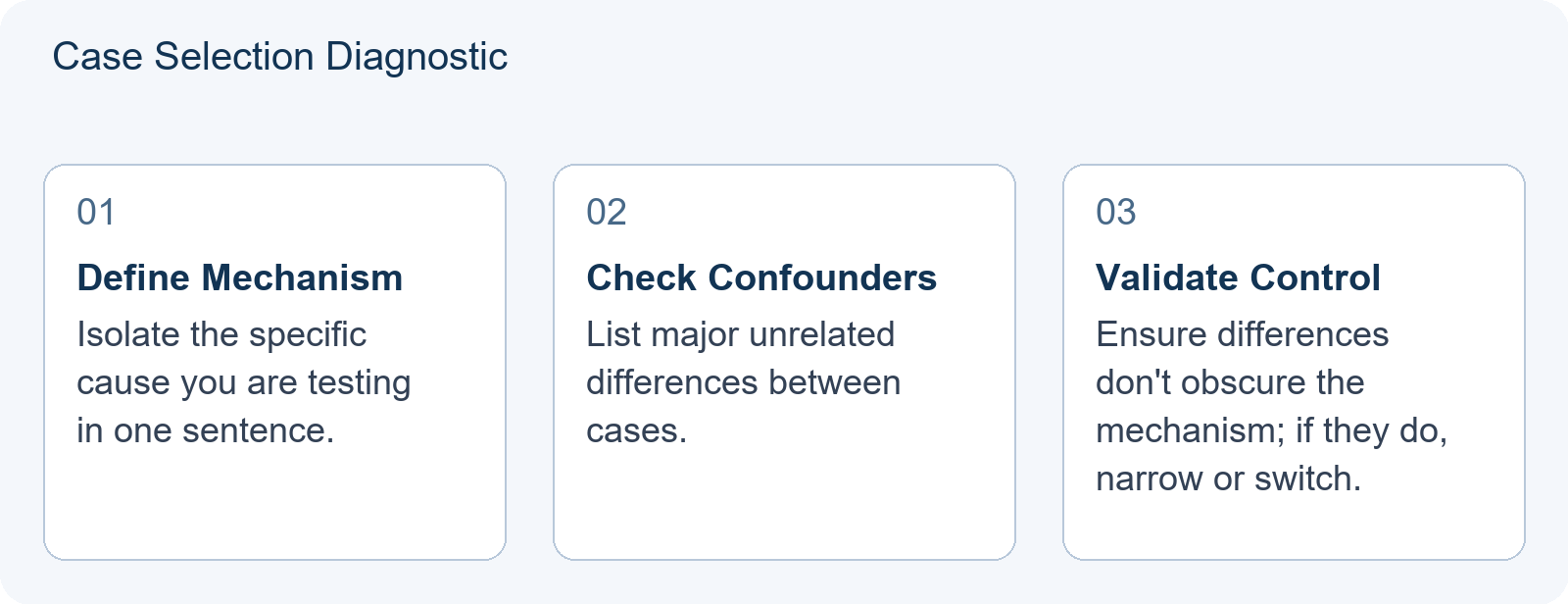
To evaluate your own country choice, apply this three-step diagnostic:
- Step 1: Define Mechanism. Isolate the specific cause you are testing. Write it in one sentence.
- Step 2: Check Confounders. List three major differences between your chosen countries unrelated to your independent variable (e.g., colonial history, geographic location, demographic structure).
- Step 3: Validate Control. Explain why these confounders do not invalidate your comparison. If you cannot, switch to a pair with fewer differences outside your key variable, or narrow your thesis.
If you struggle with Step 3, your comparison is likely too noisy. Revisit your thesis to see if it can be narrowed to a more specific claim that allows for cleaner case selection. Remember that a comparison which weakens your thesis is doing valuable work—it prevents you from defending an overbroad claim.
Implications for Next Learning Tasks
Recognizing weak comparisons early saves time during research and drafting. If your diagnostic reveals confounding issues, your next task is not to rewrite the entire essay but to refine the scope. You may need to limit your analysis to a specific sector (e.g., healthcare AI instead of general AI) where the countries are more comparable. Alternatively, you might shift from a two-country comparison to a single-case deep dive if no suitable pair exists. Understanding this decision point helps you allocate effort effectively. It also prepares you for Defense Day, where you may be asked to justify your methodological choices. Being able to articulate why you chose specific countries—and what limitations remain—demonstrates analytical maturity.
Integrating Source Disagreement Into Comparisons
When comparing countries, you will often encounter conflicting data sources. For instance, official government statistics on digital adoption may differ from NGO reports. Rather than viewing this as a problem to be resolved by choosing one source, use the tension to strengthen your comparison. If Country A’s official data shows high adoption while independent surveys show low active usage, this discrepancy itself becomes an object of analysis. Before concluding that the gap represents state propaganda, examine whether the definitions match (does “adoption” mean household connectivity, individual account creation, or daily active use?), whether the surveys cover the same time period and population, and whether methodological differences explain the divergence. Integrating source disagreement critically adds depth. It shows that you are not just reporting numbers but interpreting them with appropriate caution. For further guidance on handling conflicting accounts, refer to our article on HIR Essay Source Disagreement: Writing When Credible Accounts Conflict.
Scope Management in Comparative Essays
Comparative essays risk becoming too broad. With only 800-1200 words, you cannot cover every aspect of two countries’ relations. Focus on one specific dimension of your thesis. If your argument is about economic power, ignore military alliances unless they directly impact trade. Narrowing the scope ensures that each paragraph contributes to testing your explanation. Use subheadings to guide the reader through your comparison points. For strategies on turning a global topic into an answerable question, see our guide on HIR Essay Scope: Turning a Global Topic Into an Answerable Question. Proper scoping prevents the essay from devolving into a fact tour, which is a common pitfall discussed in When Your HIR Essay Is a Fact Tour: A Three-Layer Test for Answering the Prompt.
Connecting to Related Skills
Case selection for comparisons builds directly on skills developed in other HIR preparation areas. Understanding how to separate genuine causation from mere correlation—covered in our article on HIR Essay Causation: Separating a Trend From an Explanation—helps you identify which variables your comparison must isolate. Similarly, learning to scope questions narrowly ensures your comparison remains manageable within the word limit. These skills reinforce each other: a well-scoped question suggests clearer case selection, and rigorous case selection reveals where your causal claim needs refinement.
Preparing for Defense Day Discussions
Finalists should be prepared to discuss their methodological choices. You may be asked to explain why your selected cases are appropriate for testing your thesis, what alternative cases you considered and rejected, and how your argument would change under different comparative frameworks. The diagnostic framework in this article provides vocabulary for these discussions. Practice explaining your independent variable and control strategy aloud. If you cannot articulate why your comparison is valid in two minutes, your case selection needs more work. This preparation distinguishes students who understand their own argument from those who assembled facts without analytical structure.
Frequently Asked Questions
Can I compare more than two countries in an HIR essay?
Yes, but with caution. Adding a third country increases complexity and may exceed the word limit. Ensure each additional case provides new information that tests your hypothesis differently. Often, two well-chosen cases are more effective than three superficial ones. If you do add a third case, consider whether it serves a distinct purpose—such as demonstrating boundary conditions—rather than merely adding descriptive detail.
What if my preferred countries have very different data availability?
This is a significant constraint. If one country lacks reliable public data, your comparison becomes uneven. Consider switching to a pair with comparable transparency levels or using proxy indicators. Acknowledge data limitations explicitly in your methodology section. Do not assume that absence of data equals absence of phenomenon; instead, state what you can and cannot verify, and how this affects your confidence in the argument.
How do I handle cultural differences in my comparison?
Cultural differences can be confounders or part of the mechanism. If culture is your independent variable, highlight it. If it’s a confounder, try to find cases with similar cultural backgrounds but different policies. Be precise about what aspect of culture you are analyzing. Avoid treating ‘culture’ as an undifferentiated residual category that explains everything; specify which cultural practices, beliefs, or institutions matter for your specific argument.