Every strong entry we see is written by a student who is already good at essays — and that is precisely the problem. IB, A-Level and AP each train a specific, examinable writing habit, and each trains at least one habit that actively hurts an 800–1,200 word article written in AP Style for a journal audience. Knowing which is which is worth more than another draft.
The core distinction is genre. A curriculum essay is written for an examiner who is looking for evidence that you have met stated criteria, and who is obliged to read to the end. An HIR entry is written for editors and judges reading a stack of articles, against an evaluation rubric set out in the contest's Submission Guide, in a format that permits 1,200 words and no footnotes. The reader is not obliged to be interested. Nothing about that is harder than the IB Extended Essay. It is simply different, and the differences are learnable in an afternoon.
What actually changes between the two genres
Before the curriculum-specific advice, the four structural shifts that apply to everyone.
- Length forces a single question. The contest sets 800–1,200 words, excluding diagrams, tables of data and the authorship declaration. That is roughly one section of an Extended Essay. You are not surveying a topic; you are defending one claim about it.
- The citation system is hyperlinks. The official page states citations should be made via hyperlinks, with AP Style formatting for non-digital sources. No footnote apparatus, no works-cited page to hide behind.
- The house style is AP, not your school's. Submissions follow AP Style's newest edition. This governs numbers, dates, titles and abbreviations, and it is not the style guide any of the three curricula teach.
- You may have to say it out loud. Finalists are invited to a virtual Defense Day for a 15-minute presentation and oral defense. No curriculum essay has that consequence, and it changes what a sensible claim looks like — you should not write anything you would not want to be questioned on.
If you have not yet read the contest's own framing of what it is looking for, our overview of the contest structure is the place to start, and our reading of how the marks are distributed is in the 60-point rubric breakdown.
If you are an IB student
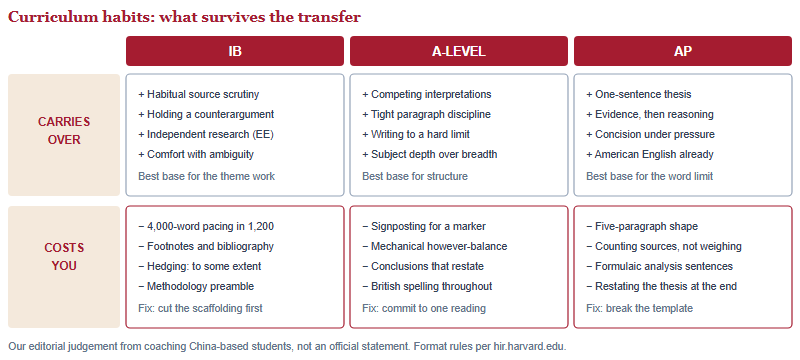
Your advantage is research posture. The IB trains you to interrogate a source rather than quote it — to ask who produced it, why, and what its limitations are. That habit is the single most useful thing anyone brings to this contest, because it is the difference between an article that cites evidence and one that weighs it. Students coming from the Extended Essay also arrive knowing how to sustain independent work over months, which matters far more than it sounds when the summer window is short.
Your risk is scaffolding. The IB rewards showing your working: stating your research question, explaining your approach, flagging your limitations. In 4,000 words that is intellectual honesty. In 1,200 it is 200 words of throat-clearing before the argument starts, and it reads as hesitancy.
Three specific conversions:
- Delete the methodology paragraph. Nobody is marking you on process. Demonstrate rigour by using sources precisely, not by describing how you selected them.
- Convert footnotes to hyperlinks as you draft, not afterwards. If you draft with a footnote system and convert at the end, you will find sentences that only make sense with a footnote attached — and you will have to rewrite them under time pressure.
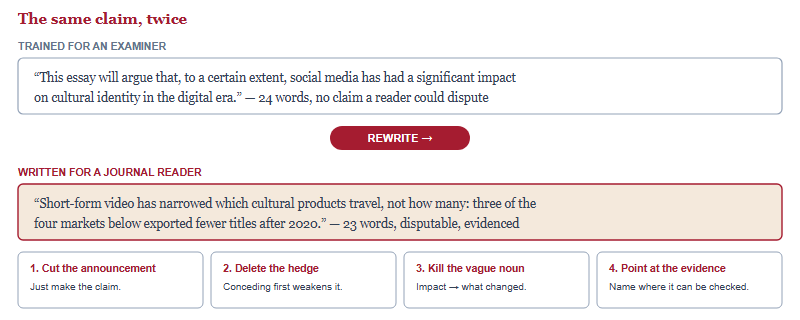
- Strip the TOK hedge. “To a certain extent,” “it could be argued that,” and “from one perspective” are honest instincts trained into you by a good programme, and in this format they read as an unwillingness to commit. The contest describes what it wants as argument rather than agenda — and an argument requires you to have one.
If you are an A-Level student
Your advantage is structural discipline. A-Level History, Politics and Economics candidates write more tightly argued paragraphs than almost anyone, and they are comfortable with the idea that serious people disagree about the same evidence. That maps directly onto what a journal article needs.
Your risk is that you are still writing for a mark scheme. Two habits give it away immediately. The first is explicit signposting — “this essay will first examine…, before turning to…” — which exists to help an examiner locate where you satisfied a criterion. A journal reader does not need a table of contents for a 1,000-word piece. The second is mechanical balance: a paragraph for, a paragraph against, and a conclusion that awards the point to whichever side you mentioned last.
Balance is not neutrality. The contest's framing is worth taking literally: an argument is a position defended against the strongest objection, not a survey that declines to choose. Present the counterargument at its strongest, then say why the evidence still favours your reading. That is a stronger essay and better preparation for being questioned about it.
Two mechanical points. Submissions are written in American English, so a British-schooled candidate needs a deliberate pass for spelling (“organisation,” “defence,” “analyse”) and for the punctuation and date conventions AP Style sets out. And drop the exam-conclusion reflex: a final paragraph that restates the introduction wastes 80 words you could spend on implication.
If you are an AP student
Your advantage is that you are already writing in the target language and the target register. AP courses train thesis discipline, evidence-led paragraphs and concision under time pressure — three things that transfer with almost no adjustment. If you have taken AP Seminar or AP Research, you also have the closest curricular analogue to independent argument-building.
Your risk is the template. AP rewards recognisable structures because they are efficient to score, and students internalise them completely. Three show up constantly in first drafts:
- The five-paragraph reflex. Three body paragraphs of equal weight is a shape, not an argument. Real analytical articles are lopsided: the paragraph that does the hardest work is usually the longest.
- Counting rather than weighing. Document-based training encourages students to demonstrate that they have used enough sources. In a 1,200-word article, four sources used precisely beat nine mentioned in passing, every time.
- The formulaic analysis sentence. “The author uses X to convey Y” is a rhetorical-analysis move, not an argumentative one. In this contest the equivalent sentence should be about what the evidence shows and where it stops showing it.
Also: AP Style is not the AP you know. It is the Associated Press stylebook, a journalism house style, and it has firm views on numerals, titles, dates and abbreviations that no AP course teaches.
A translation table for your own draft
| Habit your curriculum rewards | Why it costs you here | What to write instead |
|---|---|---|
| “This essay will argue that…” | Spends words announcing rather than arguing; a 1,200-word reader can see your structure | The claim itself, in the first two sentences |
| A methodology or scope paragraph | Process is not scored here; it delays the argument by up to 200 words | Precision in how you handle each source |
| Footnotes, endnotes or a bibliography | The contest asks for citations via hyperlinks | Linked attribution on the shortest meaningful phrase |
| “On the one hand… on the other hand…” | Symmetry reads as refusing to decide | Strongest objection stated generously, then answered |
| A conclusion restating the introduction | Wastes the most memorable position in the article | What follows if you are right, and what would change your mind |
| Nine sources to show breadth | Signals collection, not judgement | Four sources you can explain the limits of |
| British spelling and date order | Submissions are in American English under AP Style | A dedicated conversion pass before submitting |
The three things no curriculum teaches you
AP Style itself. None of the three programmes teach the Associated Press stylebook, and the contest asks for its newest edition. You do not need to memorise it. You need to check the handful of rules that appear in every article — numbers, dates, titles, abbreviations, attribution — and apply them consistently.
Hyperlink-only attribution. Without footnotes, the sentence itself has to carry attribution: who said it, when, and on what basis, inside the flow of the prose. This is a genuine writing skill, and it is the one that most improves a curriculum-trained draft.
Defending your work aloud. Finalists face a 15-minute presentation and oral defense. No essay you have written for school has ever been cross-examined, and the prospect changes how you should write: avoid claims you cannot source, avoid numbers you do not understand, and know the weakest point in your own argument before someone else finds it. Our Defense Day preparation guide covers that process in detail.
Across cohorts we have supported, this conversion pass has been where the visible improvement happens rather than in the research — in 2023 more than half of the students we entered reached the final defence and 14 took global awards, and in 2024 one reached the final defence with others taking Outstanding Writing Content and a Commendation Prize. Those figures are de-identified and reported per Hanlin's own records; they describe past cohorts, results vary between years and students, and nothing in them predicts an individual outcome.
A 40-minute conversion pass
Run this on a finished draft, in this order, with the word counter visible.
- Minutes 1–5: delete every announcement. Search for “this essay,” “will argue,” “firstly,” “in conclusion.” Cut them and see what breaks. Usually nothing does.
- Minutes 6–15: hunt hedges. “To some extent,” “arguably,” “it could be said.” Keep a hedge only where you have a genuine reason for uncertainty, and then say what the reason is.
- Minutes 16–25: check every source is doing work. Any source mentioned once and never used again is either underused or unnecessary. Decide which.
- Minutes 26–33: the American English and AP Style pass. Spelling, numerals, dates, titles. Do it as a separate pass, because you cannot proofread style and argument at the same time.
- Minutes 34–40: read the conclusion alone. If it could be swapped with the introduction without anyone noticing, rewrite it.
Questions from curriculum-trained writers
Which curriculum is the best preparation for this contest?
None of them is decisively better. Each supplies a different strength and a different bad habit; the conversion work is what matters.
Can I reuse my Extended Essay or EPQ topic?
The research can inform a new article, but you must write to a current contest theme within the word limit. Check theme requirements on hir.harvard.edu.
Do I really have to write in American English?
The contest states submissions are written in American English and follow AP Style's newest edition. Budget a separate pass for it.
Are footnotes ever acceptable?
The official page asks for citations via hyperlinks, with AP Style formatting for non-digital sources. Confirm current requirements before submitting.
This is an independent guide operated by Hanlin Education for China-based international-school students. We are not affiliated with, endorsed by, or sponsored by the Harvard International Review or Harvard University; the HIR is a student-run journal founded in 1979 and is not an official Harvard University body. IB, A-Level and AP are the trademarks of their respective organisations and are referenced here descriptively only. Contest rules, formats and requirements change between cycles — confirm all current details on hir.harvard.edu before acting on anything here. Errors reported to us are corrected within 7 working days.