A fact-tour essay strings together sourced events, statistics and examples without ever stating what they mean for the chosen HIR prompt. The three-layer test—what happened, why it happened, and what it means for your specific question—gives you a paragraph-by-paragraph filter that separates evidence from argument and ensures every section actually answers the theme you selected.
The Fact Tour: Recognizing the Failure Mode
Open a draft and count the sentences that report an event, cite a figure or name a policy. Now count the sentences that explain what that fact proves about your chosen HIR theme. If the first number dwarfs the second, the essay is touring facts rather than answering a question. The reader finishes knowing more about a topic but no clearer on your position.
This failure mode is distinct from weak sourcing or poor grammar. The research may be solid, the citations correct, the prose grammatically clean. What is missing is the connective claim: the sentence that says this fact matters to my argument because…. Without it, the essay reads like a well-referenced news recap, not a defensible response to a prompt.
What the Teaching Team Observes
According to Hanlin teaching-team material, one of the most common problems in humanities writing is that students know many facts but do not answer the question. The observation spans AP history, AP English Language and competition essays alike: a student can recall dates, quote passages and name actors, yet the resulting paper resembles a complete historical narrative rather than an argument. In literature, the same pattern appears when a writer identifies metaphor, personification and symbolism in sequence without explaining how those devices support a personal interpretation.
The teaching team further notes that the difficulty of writing competitions such as HIR lies in moving from answering someone else’s question to forming one’s own academic view. In an exam, the prompt and the rubric constrain the response. In a competition essay, the writer must discover a question worth discussing, then defend a position on it. That extra step—owning the question—is precisely where the fact tour breaks down, because listing events is easier than committing to a claim about them.
The Three Layers Defined
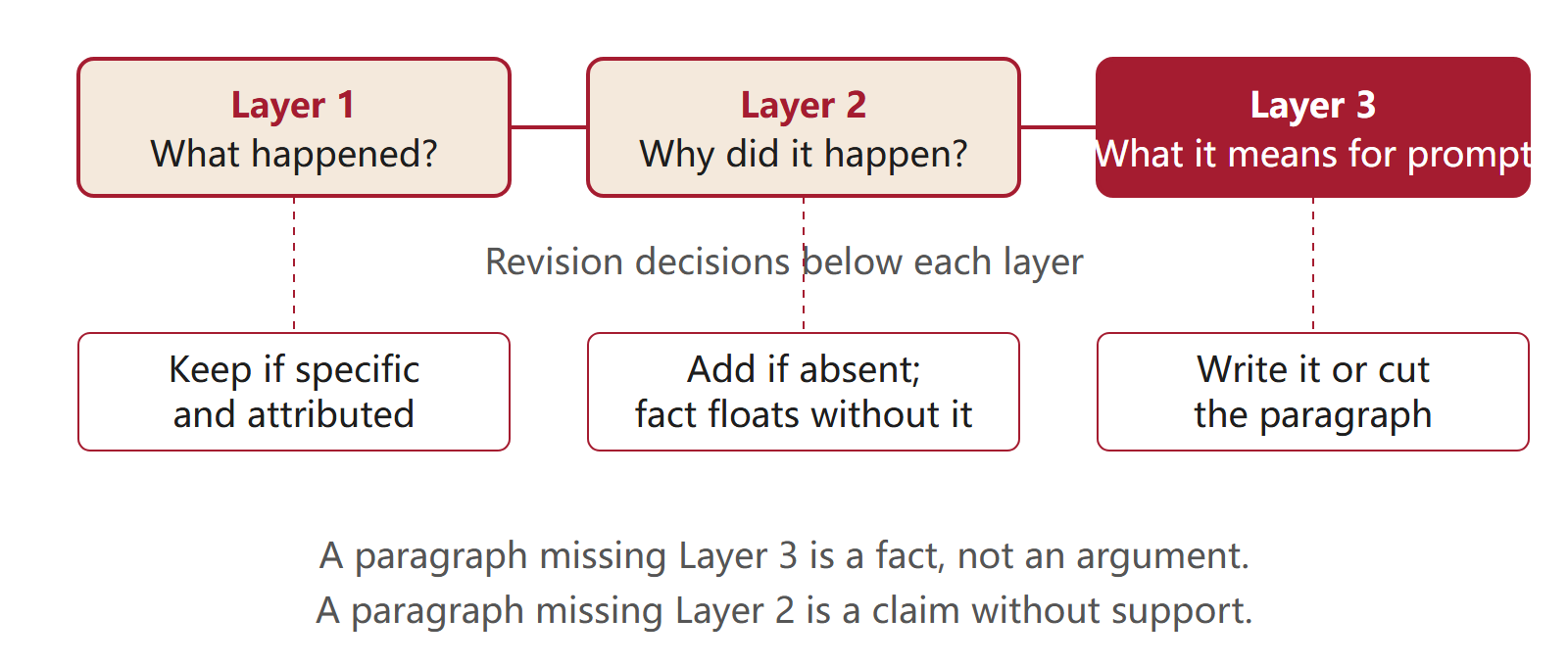
The Hanlin teaching team trains students with a three-layer architecture for every analytical paragraph:
| Layer | Core Question | What It Looks Like in a Paragraph | Revision Action if Missing |
|---|---|---|---|
| 1 – What happened | What actually occurred in the text, event or data set? | A factual sentence with a source: date, actor, statistic, quotation. | Keep it, but ensure it is specific and attributed. |
| 2 – Why it happened | Why did the actor make that choice? Why did the author use that device? What caused the outcome? | An analytical sentence exploring motive, mechanism or context. | Add it; without it the fact floats unexplained. |
| 3 – What it means for the prompt | How does this evidence answer the specific HIR question I chose? | A one-sentence claim linking the analysis back to your thesis. | Write it or delete the paragraph; a fact without this sentence is off-topic. |
Layers 1 and 2 are necessary but not sufficient. Many drafts stall at Layer 2: the writer explains why a policy was adopted but never says what that tells us about the theme of, say, technology and power or security in a multipolar world. Layer 3 is the sentence that transforms information into argument.
The Third-Layer Sentence as a Revision Filter
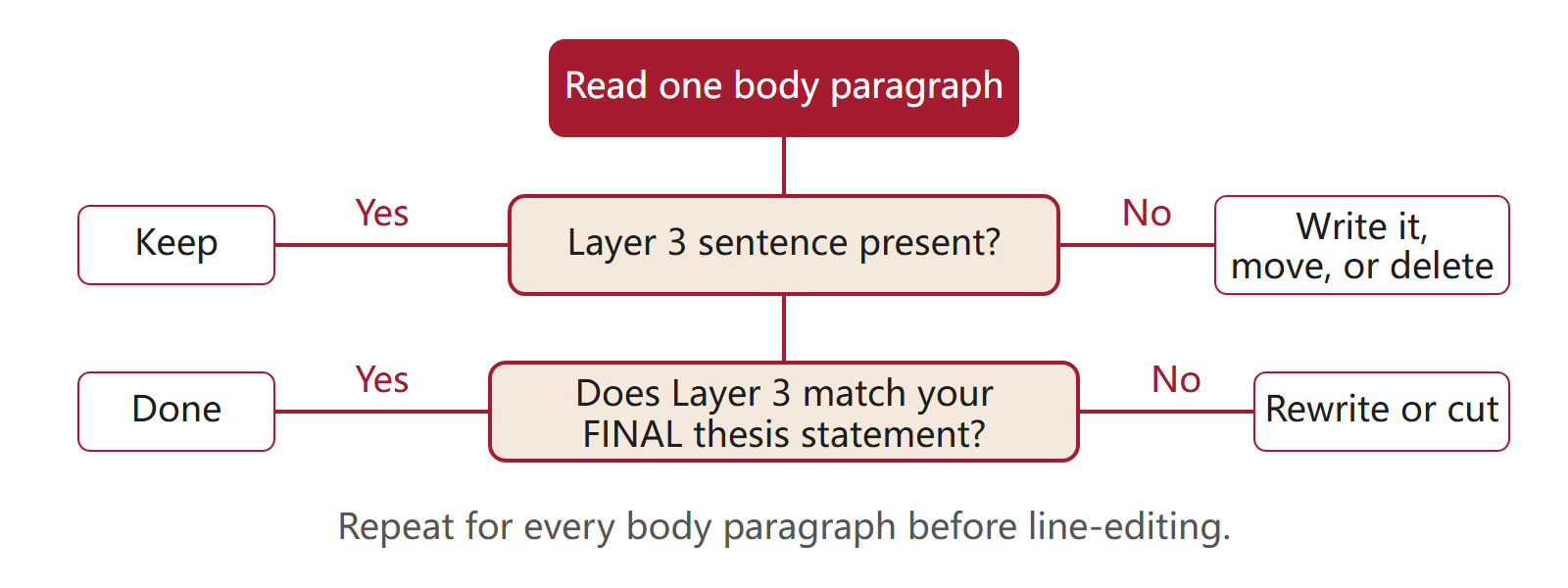
The practical rule is this: after drafting, read each body paragraph and ask whether you can underline one sentence that explicitly connects the paragraph’s evidence to your HIR thesis. If you cannot, the paragraph is either in the wrong essay or needs a Layer 3 sentence added.
This filter works because it is binary. You are not judging style, vocabulary or citation format. You are asking a single yes-or-no question: Does this paragraph contain a sentence that says what the evidence means for my chosen question? If yes, the paragraph stays. If no, you have three options: write the missing sentence, move the fact to a paragraph where it does connect, or delete it entirely.
The filter also catches a subtler problem: paragraphs where the Layer 3 sentence exists but points to a different question than the one your introduction promises. This happens when a writer changes thesis midway through drafting and forgets to update every body paragraph. Running the third-layer test against your final thesis statement, not the one you started with, exposes these orphaned sections.
For writers working through a full multi-pass revision, this test slots naturally into the structural pass before line-editing begins. It pairs well with the broader revision sequence described in the HIR essay revision system for non-native writers, where prompt-alignment checks precede grammar and style passes.
An Illustrative Walkthrough
Illustrative example only – not a real student case or past exam question.
Suppose a writer chooses an HIR theme on technology and power and drafts a paragraph about a government imposing export controls on semiconductor equipment. Layer 1 states the policy, the date and the issuing ministry. Layer 2 explains the strategic rationale: protecting domestic manufacturing capacity while limiting a rival’s access. So far the paragraph is informative but could appear in any news summary.
The Layer 3 sentence might read: “This restriction illustrates that control over fabrication tools, not finished chips, has become the primary lever through which states project technological power—directly supporting the essay’s claim that supply-chain chokepoints now matter more than end-product market share.” That single sentence transforms the paragraph from a fact report into an argumentative unit tied to the writer’s specific thesis.
Notice that the Layer 3 sentence does two jobs simultaneously. It names the analytical point (chokepoints over market share) and it echoes the essay’s central claim. If a judge later asks, “Why does this example matter to your argument?” the writer already has the answer rehearsed in prose.
From Page to Podium: Defense Day Readiness
HIR includes a Defense Day stage after submission, where finalists present and answer questions from judges. The official contest page at hir.harvard.edu/contest confirms this structure as part of the competition cycle. For the Fall/Winter 2026-27 cycle, Defense Day is scheduled for 5 February 2027.
The third-layer sentence is, in effect, a pre-written answer to the most likely judge question: Why does this point matter to your argument? If every body paragraph already contains that sentence, the writer can lift it, rephrase it conversationally and deliver it under pressure. If the sentence was never written, the writer must invent the connection on the spot—precisely the situation that produces hesitation, filler and circular answers.
This link between written structure and oral defense is not incidental. The Hanlin teaching team’s emphasis on forming one’s own academic view, rather than reciting established facts, maps directly onto what judges probe: whether the writer can explain why they drew a particular conclusion, not merely that they drew it. Preparing for the spoken component of Defense Day therefore begins during drafting, not in the weeks between submission and the presentation. Writers building their Defense Day deck will find that paragraphs with clear Layer 3 sentences translate into stronger slide talking points, a connection explored further in the guide to architecting a 15-minute presentation.
Where This Test Fits in a Broader Draft
The three-layer test is a prompt-alignment filter, not a complete revision system. It does not replace checking whether your counterargument paragraph genuinely steelmans the opposing view—a skill covered in the counterargument guide. Nor does it address whether your analytical framework is the right lens for the evidence, a question explored in three analytical frameworks for HIR essays. What it does is answer one question that those other checks assume has already been resolved: Is this paragraph actually about my prompt?
Run the test after your structural outline is stable but before you invest time in sentence-level polish. There is little value perfecting the grammar of a paragraph you are about to delete because it never connected to the thesis. The sequence matters: alignment first, then coherence between paragraphs, then language.
Frequently Asked Questions
How do I know if my essay is a fact tour rather than a genuine argument?
Read through each body paragraph and ask whether it contains a sentence that explicitly states what the evidence means for your chosen HIR theme. If paragraph after paragraph reports events, data or quotations without ever connecting them back to your thesis, the draft is touring facts rather than building an argument. The three-layer test in this article gives you a paragraph-by-paragraph way to confirm and fix the problem.
Can I keep a well-researched paragraph that does not connect to my thesis?
Only if you can write a Layer 3 sentence that links it to your argument. If no honest connection exists, the paragraph belongs in a different essay or should be cut. Keeping it dilutes your focus and signals to judges that the essay is a summary rather than a position. The Hanlin teaching team’s observation is that students often know many relevant facts but lose marks because the facts never answer the question.
How does the third-layer sentence help me on Defense Day?
HIR includes a Defense Day stage after submission, confirmed on the official contest page. You can prepare to practice answering why a particular point matters to your argument. If your written paragraph already contains a Layer 3 sentence linking evidence to thesis, you can rephrase it conversationally under pressure. Without that sentence in the draft, you must invent the connection spontaneously, which is harder to do clearly in a second language or under time pressure.
Editorial note: This article is published by HAWC (en.hawc.org.cn), an independent editorial site covering the Harvard International Review contest for readers in China and beyond. HAWC is not affiliated with, endorsed by or connected to the Harvard International Review or Harvard University. Teaching observations attributed to the Hanlin teaching team reflect professional pedagogical judgment recorded in internal training material; they are not official contest rules. Contest procedures referenced here are drawn from the official HIR contest page. All illustrative examples are constructed for explanation and do not represent real student submissions or past exam questions.