The Two-Cycle Calendar and What It Means for Your School Year
The Harvard International Review Academic Writing Contest offers distinct submission windows each year. As of September 2026, the spring cycle has concluded, leaving two active registration paths for students planning their competition strategy. Understanding how each remaining cycle maps to your academic calendar is the first step in making a strategic HIR registration choice.
According to Hanlin’s 2026 season guidance (published July 18, 2026 and September 8, 2026), the active cycles break down as follows:
| Cycle | Article Deadline | Defense Day |
|---|---|---|
| Summer | August 24, 2026 | October 5, 2026 |
| Fall/Winter | January 2, 2027 | February 5, 2027 |
Source: Hanlin course materials, July 18, 2026 and September 8, 2026.
The summer cycle demands concentrated preparation during late summer break, with Defense Day arriving early in fall semester. The fall/winter cycle spreads preparation across autumn semester but collides with midterm exams and, for seniors, early application deadlines. Each presents distinct constraints that reward honest self-assessment before registration.
Summer Cycle: Maximum Writing Time, Maximum Competition for Attention
The summer cycle’s extended runway—roughly eight weeks from typical school release to the August 24 deadline—suggests obvious appeal. You can research deeply, draft iteratively, and still have buffer for revision.
However, Hanlin’s participant observations note that this same window attracts students with structured summer programs, research internships, or intensive SAT/ACT preparation. The writing time exists technically but may fragment across competing priorities. Students who thrive in summer cycles typically have either concluded standardized testing before June or deliberately blocked calendar segments for HIR work.
The October 5 Defense Day also means your preparation extends into fall semester—useful if you want college applications to reflect the achievement, but requiring sustained attention when peers have moved on.
Fall/Winter Cycle: The Strategic Trade-off for Application-Season Students
The fall/winter cycle’s January 2 deadline and February 5 Defense Day position it as the final opportunity within a given academic year to strengthen your profile before regular decision applications.
Yet this timing carries genuine risk. Hanlin’s September 2026 guidance explicitly frames this cycle as suitable for students making an “application season final sprint”—acknowledging that it serves students who need one more credential but are already stretched thin. Semester exams, holiday travel, and early application stress converge in November and December. The students who succeed here typically began research during summer or early fall, treating the winter deadline as a polishing phase rather than a starting point.
Grade Level and Experience: Matching Cycle Risk to Your Profile
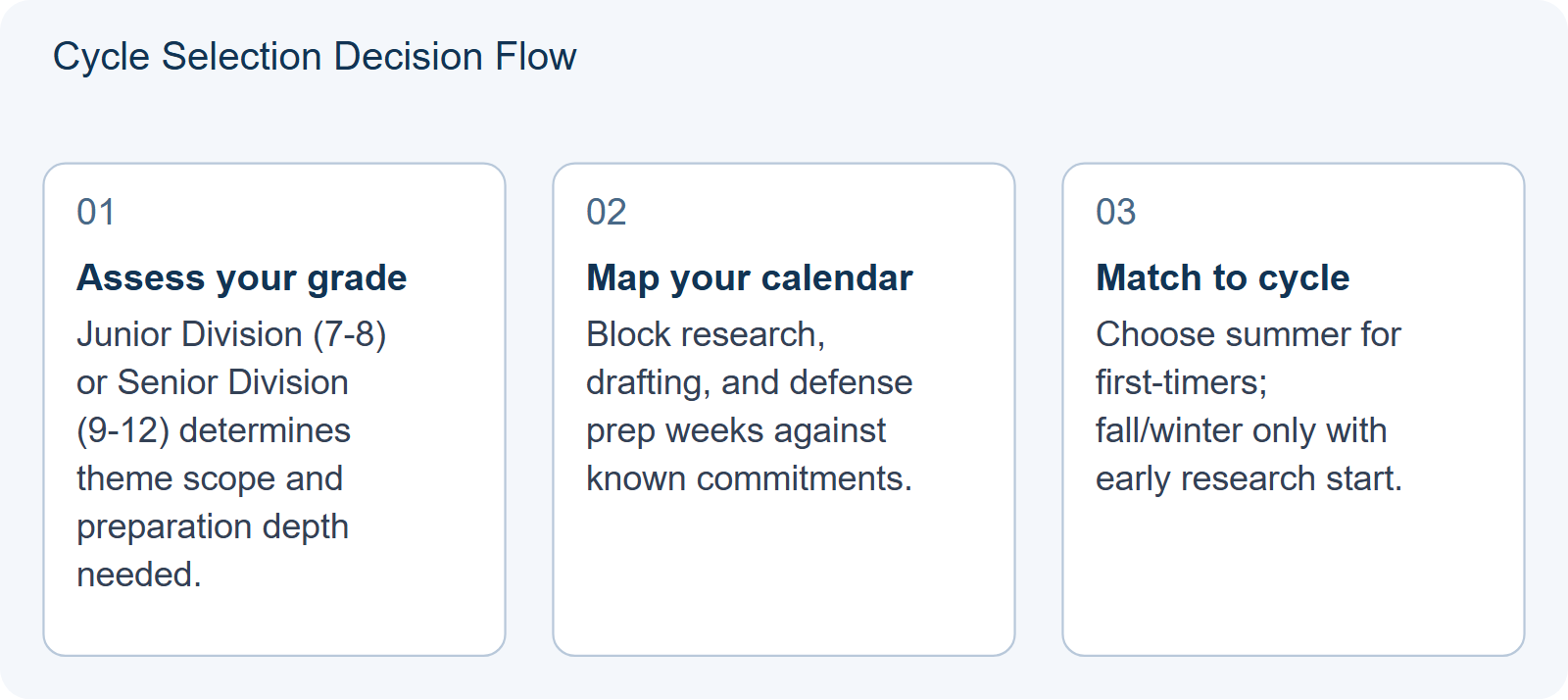
Not every cycle suits every student. Hanlin’s 2026 materials introduce a significant structural change: the division into Junior Division (grades 7-8) and Senior Division (grades 9-12). This matters for cycle selection because younger students face different constraint patterns.
First-time Senior Division entrants often benefit from summer cycle scheduling. The extended preparation window accommodates the learning curve of understanding HIR’s specific demands—800-1200 words, research-based argumentation, and strict citation requirements. The 2026 season also introduced updated themes (Global Culture in the Digital Era; Security in a Multipolar World; Technology, Innovation, and Power), meaning even experienced students needed orientation time.
Repeat participants or students with strong academic writing backgrounds may handle the compressed fall/winter timeline more comfortably. They already understand the defense format and can focus on theme execution rather than process learning.
Junior Division students, newly eligible in 2026, should generally prefer cycles with lower concurrent academic pressure. Their theme—”Inventions that Changed How We Live”—while constrained to the same format rules, may require more guidance in research methodology.
The Defense Day Buffer: What Preparation Actually Requires
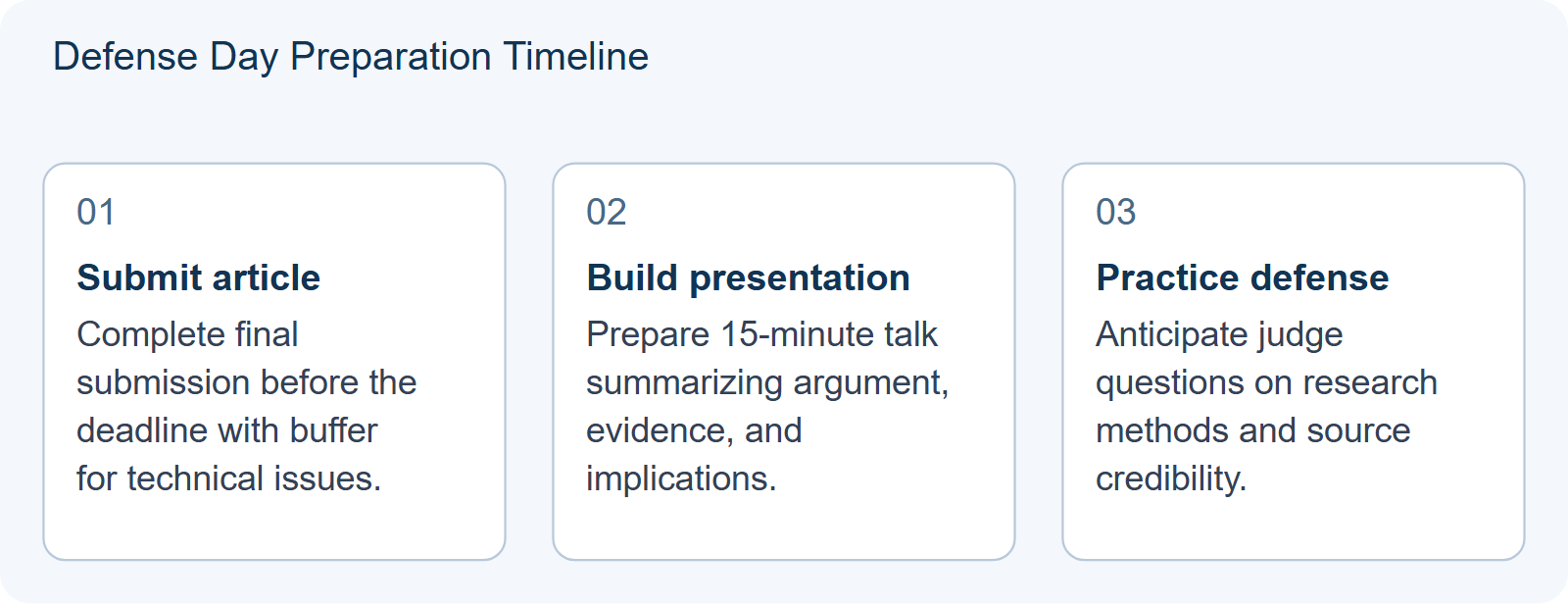
A common planning error treats the article deadline as the finish line. In practice, the gap between submission and Defense Day demands sustained preparation.
Based on Hanlin’s cycle documentation, the intervals are:
- Summer cycle: 42 days (August 24 to October 5)
- Fall/winter cycle: 34 days (January 2 to February 5)
This period requires preparing a 15-minute presentation and anticipating oral defense questions. Students who exhaust themselves meeting the article deadline often underprepare for defense, where judges conduct what Hanlin materials describe as “more careful review and assessment” of work authenticity and depth. The summer cycle’s longer buffer provides meaningful advantage for students who need time to recover from submission effort before pivoting to presentation preparation.
Research Phase Before Registration: The Hidden Timeline
HIR registration is two-step—registration with fee payment, then article submission. But effective preparation precedes registration entirely.
Hanlin’s course structure suggests a preparatory sequence: rules and requirements review, prompt analysis, research methodology, source evaluation, and initial research before intensive drafting. Their two-session coaching model allocates 1.5 hours each to strategic planning and research fundamentals respectively—indicating these are non-trivial components that students often underestimate.
For prospective registrants, this means selecting your cycle based not on when you plan to write, but when you can begin focused research. A student who cannot start until November should not plan for the fall/winter cycle unless they have already completed preliminary reading.
Decision Checklist: Scoring Your Availability Against Each Cycle
Use this framework to assess fit, based on Hanlin’s documented cycle characteristics and typical academic constraints:
| Factor | Summer | Fall/Winter |
|---|---|---|
| Uninterrupted writing weeks | 4-6 possible | 1-2 realistic |
| Competing priorities | Internships, testing, travel | Exams, applications, holidays |
| Defense preparation window | 42 days | 34 days |
| Profile timing for applications | Early/regular decision | Regular decision, gap year |
| First-timer risk level | Lower | Higher |
Preparing for a Consultation: What to Bring to Your Inquiry
If you are considering Hanlin’s HIR coaching, preparing specific information will help advisors recommend cycle-appropriate planning:
- Your current grade level and whether you qualify for Junior or Senior Division
- Standardized testing schedule (SAT/ACT, AP exams) for the target year
- Planned summer activities and their time commitments
- Application timeline—early decision, regular decision, or non-applicant
- Prior experience with research-based writing and citation
- Availability for the Defense Day periods, considering time zone for virtual presentation
This preparation allows more targeted discussion of whether Hanlin’s cycle-specific coaching—covering rules interpretation, theme selection, research planning, and defense preparation—aligns with your chosen timeline.
Related Resources
For the mechanics of HIR’s two-step registration process, see HAWC Registration Explained: Why Entry Is Two Steps, Not One. For summer-specific preparation timelines, refer to Four Weeks to the HAWC Summer Deadline. For approaching the final deadline window, see The 2 January Deadline Lands in Your Busiest Term: A Fall-Winter HAWC Schedule Built Around Applications and Mocks.
Disclaimer: This is an independent preparation guide, not affiliated with or endorsed by Harvard International Review or Harvard University. The Harvard International Review Academic Writing Contest is organized by the Harvard International Review, a student-run publication at Harvard University. It is not an official Harvard University program. For official contest information, refer to the organizer’s website.
Frequently Asked Questions
Can I switch cycles after registering for one?
HIR registration is cycle-specific. Once you register and pay for a particular cycle, your submission window is fixed. Plan your cycle selection carefully before completing registration, as the system closes after each deadline with no extensions.
Does the Junior Division have the same deadlines as Senior Division?
Yes, the cycles share the same article deadlines and Defense Days across both divisions. Junior Division students follow identical timing but write on a different theme and compete within their own division for awards.
How does the AI detection policy affect preparation timing?
The 2026 season's stricter AI policy means you need additional time for genuine research and iterative drafting. Rushed writing increases risk of unintentional patterns that trigger detection. Build this verification time into your cycle selection.