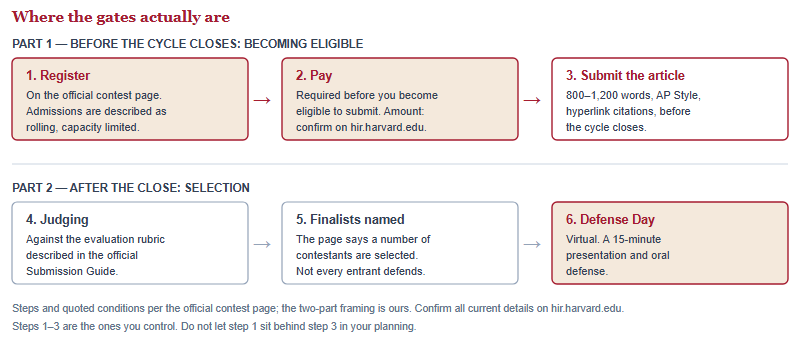
Entering the HIR Academic Writing Contest is two steps, not one. The official contest page states that contestants “are requested to register and pay before becoming eligible to submit their articles prior to the submission deadline,” and that “admissions are done on a rolling basis! Capacity is limited.” For the 2026 Summer cycle that page lists submissions closing Aug. 24, with Defense Day on Oct. 5.
Most of the advice you will read about this contest — including most of ours — is about the essay. That is the hard part. But every year a proportion of well-prepared drafts never become entries, and the reason is almost never the writing. It is that a student treated the submission deadline as the only date on the calendar, and discovered late that there was a gate in front of it.
The entry gate: register and pay, then submit
Read the official sentence carefully, because the sequencing is the whole point: contestants register and pay before becoming eligible to submit. Registration is not a formality attached to the moment you upload a file. It is a precondition. Until it is complete, you are not in a position to submit at all.
This has three practical consequences for a student working from an international school in China.
- Your real personal deadline is earlier than the published one. If the cycle closes on the date the official page lists, the date that governs your week is whenever registration is settled — not the close itself.
- Payment involves an adult and, often, a bank. The official page does not publish the fee amount, so confirm it on hir.harvard.edu. What we can say from experience is that the payment step frequently sits with a parent, and a family card that works fine domestically is not always the card that clears an overseas academic charge on the first attempt. Build in a working day of slack rather than an hour.
- Nobody is going to chase you. This is an open international contest, not a school assignment with a teacher tracking submissions.
What “rolling basis, capacity is limited” should and should not change
The official page uses two phrases together: admissions are rolling, and capacity is limited. It does not publish a number, a running total, or a closing threshold. So the honest position is that we do not know how much headroom remains in any given cycle, and neither does anyone selling you urgency about it.
What you can do is act rationally under that uncertainty. The asymmetry is stark. Registering early and then discovering your draft is not ready costs you the entry fee (the page publishes no refund policy) and some pride. Finishing a strong draft and then discovering you cannot register costs you the entire cycle — which, for the Summer window, means waiting until the Fall/Winter cycle and defending in 2027.
The rule that follows is simple and applies to almost every student we work with: if you are seriously intending to enter this cycle, complete registration and payment well before you finish the essay. Registration is not a reward for having a finished draft. It is the thing that makes finishing the draft worth doing.
Two caveats, because this cuts both ways. First, do not register for a cycle you have no realistic chance of meeting; a rushed 800-word article submitted for the sake of having submitted is not a good use of a fee or of the reader’s attention. Second, whether registration itself has an earlier hard cut-off than the article deadline is not something the page spells out, so ask the organiser directly rather than relying on a forum post or on us.
Register into the right division and the right cycle
Two selections happen at registration that you cannot casually undo later: which division you are in, and which cycle you are entering. Both are structural rather than stylistic, and both are worth five minutes of care.
On division, the 2026 contest runs a Junior division for grades 7–8 and a Senior division for grades 9–12, and the two do not share themes. Junior entrants write to “Inventions that Changed How We Live.” Senior entrants choose among three themes. If you are on the boundary — a Chinese international school’s Grade 8 and Grade 9 labels do not always map cleanly onto the US grade system a contest assumes — resolve it with the organiser before you pay, not after you write. Our fuller comparison of the two divisions sits in our overview of what the contest is and how it is structured.
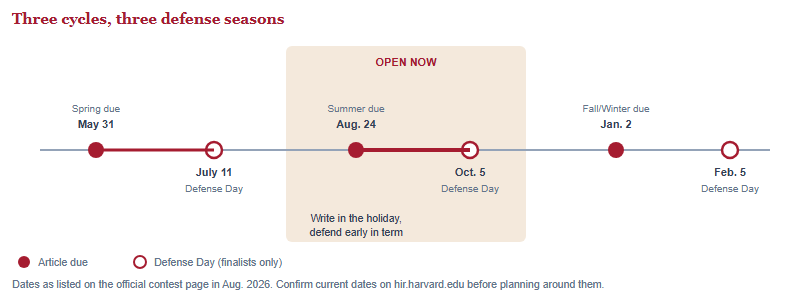
On cycle, the official page lists three windows across the 2026 contest year. The dates matter less as trivia than as a question about which school term you want to be defending in.
| Cycle | Article due | Defense Day | What the defense lands on, for a China-based student |
|---|---|---|---|
| Spring 2026 | May 31, 2026 | July 11, 2026 | Closed. Summer holiday defense — the least congested of the three. |
| Summer 2026 | Aug. 24, 2026 | Oct. 5, 2026 | Open now. You write over the holiday and defend in early October, after term has started but before most first-semester assessment peaks. |
| Fall/Winter | Jan. 2, 2027 | Feb. 5, 2027 | You write through the first semester and defend in early February — alongside mock exams, and close to the Lunar New Year period. |
Read the right-hand column before you assume the latest deadline is the easiest one. The Fall/Winter cycle gives you five months to write, which sounds generous, and then asks you to prepare a 15-minute oral defense in the same weeks as internal exams and, for Grade 12 students, application deadlines. The Summer cycle is tighter on writing and considerably kinder on defending.
Confirm your own close date before you plan backwards
One housekeeping point, and it is not a trivial one. Third-party listings of this contest do not always agree on the summer close — late-August dates circulate in more than one version, including on pages of ours that predate this check. As of the beginning of August 2026, the official contest page lists Aug. 24 for the Summer cycle submission with Defense Day on Oct. 5.
We are not going to resolve that conflict by asserting a date at you. The correct move is the boring one: open hir.harvard.edu yourself, read the date on the page today, and screenshot it. Then plan backwards from that. If you have already registered, treat any email confirmation from the organiser as more authoritative than any guide, including this one.
Plan to the earlier of the dates you have seen. If you finish for Aug. 24 and the window turns out to be a week longer, you have a week of polish. If you plan for the later date and it turns out to be the earlier one, you have nothing.
The resubmission rule, and what a second entry actually buys you
The official page states that contestants “have the option to resubmit their articles; however, the new submission must explore a different theme from the originally submitted article within the same contest year.” That single sentence answers a question we are asked constantly, and it answers it in a way most students do not expect.
Resubmission is not a revision mechanism. You cannot enter, receive an outcome you dislike, and send an improved version of the same argument. A second entry within a contest year must go to a different theme — which means new reading, a new claim, and a new article, not a tightened draft.
That reframes it usefully. A second entry is worth considering if you have a genuinely different question you want to write about and the time to research it properly. It is not worth considering as insurance against a weak first attempt; the fix for a weak first attempt is a stronger first attempt. Whether a resubmission requires a further registration or fee is not spelled out on the page, so ask before you assume either way.
A three-week runway that is about paperwork, not prose
With about three weeks left in the Summer window, here is a runway that deliberately ignores your draft. Your draft has its own plan. This is the administrative layer that sits underneath it, and it is the layer that quietly loses entries.
- This week: settle registration. Open the official page, confirm the close date and the fee, and complete registration and payment. Save the confirmation email somewhere you can find it in October — you will want it when Defense Day logistics arrive.
- This week: lock the division and the theme. Junior or Senior, and if Senior, which of the three themes. Changing theme after you have 900 words drafted is not a revision, it is a restart.
- Second week: check the format constraints against your draft, not your memory. 800–1,200 words, AP Style's newest edition, citations made via hyperlinks. Our checklist for that pass lives in our breakdown of the evaluation rubric.
- Second week: write the authorship declaration. It is excluded from the word count, which means there is no cost to doing it properly and no excuse for doing it at the last minute.
- Final week: submit with days, not hours, to spare. Upload portals are busiest at the end, home internet in China is not uniformly reliable, and the contest operates on a US-facing calendar. Do not spend your last evening discovering a file-format problem.
- Final week: start Defense Day preparation before you know whether you are a finalist. Only finalists are invited to defend, and the gap to Oct. 5 is short. Our Defense Day preparation guide explains why the useful work starts in early September, not late.
For context on what a completed entry has looked like among students we have supported: in 2023 more than half of the students we entered reached the final defence and 14 took global awards, and in 2024 one student reached the final defence with others taking Outstanding Writing Content and a Commendation Prize. Those figures are de-identified and reported per Hanlin's own records; they describe past cohorts, results vary between years and students, and nothing in them predicts any individual outcome. We include them for one reason only — every one of those students got through the registration gate first.
Questions we get asked at this point in the cycle
Do I have to register before I finish writing?
The official page says contestants register and pay before becoming eligible to submit. Given rolling admissions and limited capacity, register early.
How much is the entry fee?
The official contest page requires payment but does not publish the amount. Confirm the current fee directly on hir.harvard.edu before you plan.
Can I resubmit a better version of the same essay?
No. The page states a resubmission must explore a different theme from the original within the same contest year.
Is the Summer deadline Aug. 24 or Aug. 31?
Listings differ. The official page showed Aug. 24 in early August 2026 — check it yourself and plan to the earlier date.
This is an independent guide operated by Hanlin Education for China-based international-school students. We are not affiliated with, endorsed by, or sponsored by the Harvard International Review or Harvard University; the HIR is a student-run journal founded in 1979 and is not an official Harvard University body. Contest dates, fees, eligibility and rules change between cycles — confirm all current details on hir.harvard.edu before acting on anything here. Errors reported to us are corrected within 7 working days.