The Fall-Winter cycle of the HIR Academic Writing Contest closes on 2 January 2027 — roughly seventeen weeks from today. That sounds generous, and the generosity is the trap. Those seventeen weeks contain university application deadlines, winter mock exams and a school holiday. This is a plan built around those collisions rather than around a term in which you have nothing else to do.
A seventeen-week runway fails differently from a seven-week one
When we published a week-by-week plan for the Summer cycle, the deadline was close enough to be visible from day one. Short runways fail from time shortage: you run out of days. Long runways almost never fail that way. They fail from two other things.
Drift. Nothing is due, so nothing gets done. Weeks one through nine produce a browser tab of half-read articles and a vague sense that the topic is “something about supply chains.” Then week fourteen arrives and the essay becomes a sprint.
Collision. The sprint lands in the exact eight weeks when your school life is heaviest. This is the part students consistently underestimate. A seventeen-week runway does not mean seventeen usable weeks; for a Grade 11 or Grade 12 student in a Chinese international school it can easily come down to about ten usable weeks, with a badly placed gap in the middle.
The fix for drift is to convert time into artifacts. An artifact is something you can hand to another person: a thesis sentence on paper, a list of five sources you have actually read, a draft with a word count. “I did some reading this week” is not an artifact and cannot be checked, by you or anyone else. The fix for collision is to know where the collisions are before you build the schedule, which is the next section.
Do the collision audit before you plan a single writing session
Open your school calendar and your own application spreadsheet and fill in the middle column below with real dates. We cannot do this part for you — every school publishes a different mock timetable and every applicant has a different list of universities. The point of the exercise is that the weeks you cross out are gone, and a plan that pretends otherwise will break in November.
| Collision | Your dates (fill in) | Realistic cost | What it means for this cycle |
|---|---|---|---|
| University application deadlines (Grade 12) | 2–4 weeks of usable writing time | Finish the essay before the peak or enter the next cycle | |
| Winter mock exams | 2–3 weeks, plus a recovery week | Do not put your revision phase here | |
| Internal coursework deadlines (IA, EE, NEA, coursework drafts) | 1–2 weeks, often unannounced until late | Ask your teachers now, not in November | |
| School holiday and family travel | Assume zero productive hours | Treat it as buffer, never as work time | |
| The submission process itself | Check on hir.harvard.edu | Longer than one evening | Entry involves more than pressing send |
One line in that table deserves emphasis. 2 January 2027 is a Saturday, sitting at the end of the New Year holiday. If something goes wrong with your file, your account or your internet connection on 1 January, there is no school IT office, no teacher and quite possibly no reliable connection to fix it. Check what time of day and what time zone HIR states for the cut-off, then convert it to China Standard Time (UTC+8) yourself and write the converted moment in your own calendar. A deadline expressed in someone else’s time zone can pass while you are asleep.
The four-phase Fall-Winter calendar
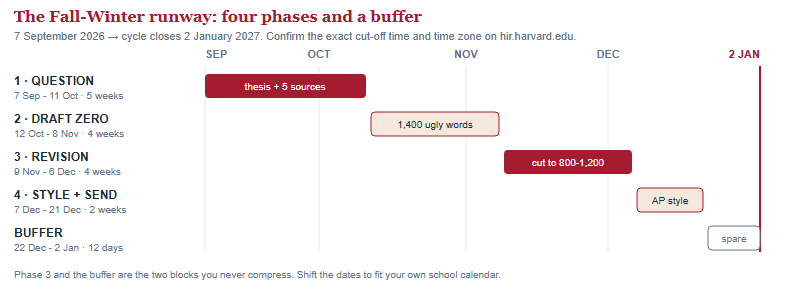
Phase 1 — Question (7 September to 11 October). Five weeks to arrive at one sentence. That ratio looks wrong to most students and it is the single highest-return decision in the whole cycle, because everything downstream inherits the quality of the question. Read widely for three weeks, narrow for two. Confirm which prompts or themes HIR has published for the cycle you are entering before you commit — the set is published by the organiser and you should read it on hir.harvard.edu rather than assume it matches a previous cycle. For the cycle now open, HIR lists a set theme for the Junior division while Senior writers choose from three themes; confirm the current arrangement for your division on hir.harvard.edu.
Phase 2 — Draft zero (12 October to 8 November). Write long on purpose. Aim for 1,400 to 1,600 words knowing the finished piece must sit inside 800 to 1,200. Cutting a paragraph you wrote and rejected is an editorial decision; padding a thin draft up to length is not. Draft zero is allowed to be ugly, repetitive and badly transitioned. Its only job is to prove the argument survives contact with a keyboard.
Phase 3 — Revision (9 November to 6 December). This is where the points are. Cut to length, tie every claim to a source, and score yourself against the rubric before anyone else does. If you have not worked through how the 60-point rubric splits 30 points of content against 30 of style, do it at the start of this phase rather than the end — it changes what you cut.
Phase 4 — Style and send (7 December to 21 December). The AP Style pass, the reference list, the declaration, and the mechanics of actually entering. Two weeks feels like a lot for a proofread; it is not a proofread. It is a style pass plus the discovery of every administrative thing you did not know you had to do.
Buffer (22 December to 2 January). Plan no work here. This block exists to absorb the flu, the family trip, the corrupted file and the misread instruction. If you reach 21 December with a submitted entry, the buffer costs you nothing. If you reach 21 December without one, the buffer is the only reason you still have a cycle.
Grade 12, Grades 10–11 and Junior: three versions of the same term
The phases above are a template, not a uniform. Which version you run depends mostly on what else is due.
Grade 12. Your application peak and Phase 3 want the same November weeks, and applications win — they should. You have two honest options: pull the whole schedule forward by four weeks and finish in November, or skip this cycle and target the next one with a clear diary. What you should not do is run both at half attention and submit something that neither defends well nor represents your writing. On the admissions side, be clear-eyed about what a contest result does: an admissions reader cross-checks an award against your transcript, your activity list and your own essays, and a writing result is useful precisely because it corroborates the writing they are already reading. That is a reason to submit something you are proud of, not a reason to submit something in a hurry.
Grades 10–11. You are the natural fit for this cycle. Your main collision is mocks, which usually sit inside Phase 3. Move Phase 3 forward and let Phase 2 run shorter rather than letting revision get squeezed — revision is where the rubric is won.
Junior (Grades 7–8). Seventeen weeks is longer than most thirteen-year-olds can hold a single project, and the drift risk is highest here. Run a compressed nine-week version starting in late October, with the same phase order and the same artifacts, and use September and October for reading rather than writing. The 800-1,200 word band and the rubric are the same, and finalists in either division are invited to the same Defense Day; only the runway is shorter. If you are still deciding whether the Junior division is the right entry point, our full guide to what the contest is and how it is structured is the place to start.
Your personal deadline is 21 December, not 2 January
Every experienced editor works to a deadline earlier than the real one, and the gap is not superstition. Here is what actually fills a twelve-day buffer:
- Entry is not a single click. Confirm on hir.harvard.edu exactly what the process involves for the current cycle, and do the parts that can be done early, early.
- Time zone conversion. Read the stated cut-off time carefully, convert it to UTC+8 and write the converted time down. Do not rely on a date alone.
- File and format requirements. Word counts, file names, document formats and any required declaration all have to be right, and none of them are things you want to discover on 1 January.
- The declaration of authorship. HIR prohibits AI-written work, and you should be able to account for how the piece was produced. That is easier to do while you still remember the process.
- The reason nobody plans for. Illness, travel, a laptop failure, a school system outage. Something in this category is common enough that a plan with no slack in it is a plan that assumes nothing goes wrong.
Put 21 December in your calendar as “HAWC deadline” and stop thinking about 2 January. The real deadline should be a fact you never have to use.
If you fall behind: what to compress, what to protect
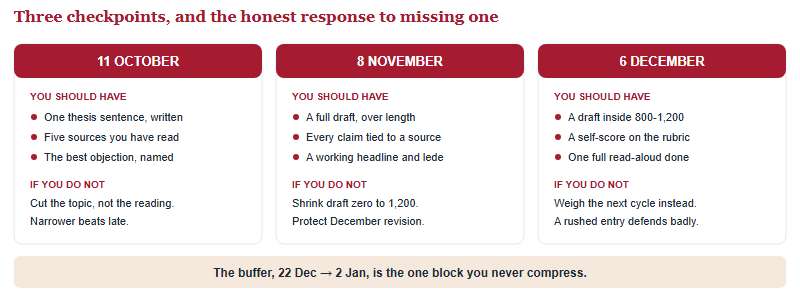
Falling behind is normal. Handling it badly is what costs points. The rule is that you compress the phases where compression costs you least and protect the ones where it costs you most.
Compressible. Draft zero. A 1,200-word rough draft works nearly as well as a 1,600-word one; you simply have less to cut. The style pass can also drop from two weeks to four focused days if you already write clean English, though it should never drop to one evening.
Protected. Phase 1 and Phase 3. A weak question cannot be revised into a strong essay, and an unrevised draft cannot be styled into a scoring one. If you have to choose between a longer reading period and a longer drafting period, take the reading.
Never touched. The buffer, and – if you are selected as a finalist – the Defense Day preparation that follows. HIR selects a number of contestants as finalists and invites them to a virtual Defense Day built around a fifteen-minute presentation and oral defense, and it is not something you improvise successfully. Whatever gap HIR schedules between the close of the cycle and the defense — confirm the current calendar on the official site — that gap is preparation time, not rest time. Our guide to preparing for Defense Day is worth reading in December rather than after you submit, because knowing you will have to defend a claim out loud changes which claims you are willing to make.
One last piece of triage. If 6 December arrives and you have no draft, entering anyway is usually the worse choice. A hurried entry consumes your December, produces work you would not show anyone, and gives you a defense you cannot deliver. Deferring to the following cycle with a question already chosen and five sources already read is a genuinely stronger position than submitting something thin in the first week of January.
Frequently asked questions
When exactly does the Fall-Winter cycle close?
The Fall-Winter cycle closes 2 January 2027, a Saturday. Confirm the exact cut-off time and time zone on hir.harvard.edu and convert it to UTC+8.
Is seventeen weeks too long to spend on an 800-1,200 word essay?
No. Most of that time is reading and choosing a question. Actual drafting occupies about four weeks in this plan.
I am in Grade 12 with applications due. Should I enter?
Only if you can finish by late November. Otherwise target the next cycle rather than splitting attention between two things that both matter.
Why set a personal deadline twelve days early?
Because entry involves more than pressing send, and 2 January sits in a holiday when no school or teacher can help you fix a problem.
This is an independent guide operated by Hanlin Education for China-based international-school students. We are not affiliated with, endorsed by, or sponsored by the Harvard International Review or Harvard University; the HIR is a student-run journal founded in 1979 and is not an official Harvard University publication. Deadlines, prompts, divisions and entry requirements are set by the organiser and change between cycles — confirm current details on hir.harvard.edu before you rely on anything here. Errors are corrected within 7 working days of being reported.