If you draft a Fall-Winter HIR essay in November, submit it in December and defend it out loud some weeks later, the world will have moved in between. International affairs is the one subject where your evidence can be overtaken while your document sits still. The fix is not to avoid current events. It is to write claims at the level that ages slowly, and to date-stamp the ones that do not.
The gap nobody plans for
Most contest advice treats submission as the finish line. In this contest it is not, because the HIR Academic Writing Contest selects a number of contestants as finalists and invites them to a virtual Defense Day with a fifteen-minute presentation and oral defense. That structure creates a problem no purely written competition has: the essay is frozen at submission, and you are not.
Plan on the assumption that once you submit, the text cannot be changed — HIR’s published contest page offers a resubmission option but requires the new submission to explore a different theme, so it is not a route to correcting the essay you already filed; confirm the current process on hir.harvard.edu. Whatever gap the organiser schedules between the close of your cycle and Defense Day, confirm it on the official calendar and then treat it as a period in which your essay stands still and your subject does not.
Students respond to this in two wrong ways. Some choose a topic so historical that nothing can move — and lose the relevance and immediacy that an international affairs essay is supposed to have. Others chase the freshest possible story and end up defending a paragraph that stopped being true in week three. The workable answer sits between them, and it starts with understanding that not all claims decay at the same rate.
Three kinds of claim, ranked by shelf life
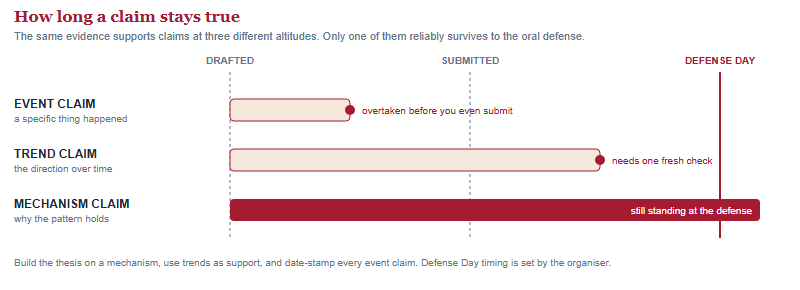
Take one piece of evidence and notice that you can write it three ways.
The event claim reports a specific occurrence: a vote passed, a figure was published, a leader said something. It is concrete, easy to source and easy to check — and it has the shortest shelf life of anything you can put on the page. Votes get reversed, figures get revised, statements get walked back.
The trend claim describes a direction across time: the share has risen for four consecutive years, the gap has narrowed since 2019. This ages more slowly, because a single new data point rarely reverses a multi-year direction. It still ages: one more quarter of data can flatten a trend you called steep.
The mechanism claim explains why the pattern exists: which incentive, which constraint, which institutional design produces the behaviour. Mechanisms change too, but on the timescale of years, not weeks. This is where your thesis belongs.
The practical rule is a hierarchy. Thesis at mechanism level. Support at trend level. Illustration at event level, always date-stamped. An essay built the other way round — thesis pinned to last month’s headline, mechanism mentioned in passing — is fragile in exactly the way the oral defense is designed to expose.
This also happens to be the structure the rubric rewards. Analysis of evidence is scored separately from use of evidence, which is another way of saying that reporting what happened is not the same as explaining why it happened. If that distinction is not yet concrete for you, work through how the 60 points split into 30 for content and 30 for style before your next draft.
Date-stamping, and how AP Style lets you do it without footnotes
An HIR essay runs on AP Style, which means attribution lives in the sentence rather than in a footnote. That constraint is usually described as a limitation. For this problem it is an advantage: AP-style running attribution makes it natural to say when something was true, because you are already naming the source and the moment in the prose.
Three patterns do most of the work:
- The as-of clause. “As of the agency’s October release, the figure stood at…” This converts a claim that could be falsified into a claim that cannot: the figure genuinely did stand at that level in that release, whatever happens later.
- The publication anchor. “In a report published in September, the institute argued…” You are reporting what a document said, not asserting that its conclusion is still current.
- The explicit vintage. “The most recent comparable data, from 2024, show…” This tells the reader you know the data are not fresh, which is far stronger than being caught not knowing.
A note on the mechanics: AP’s convention is to abbreviate certain month names when they appear with a specific date — Jan., Feb., Aug., Sept., Oct., Nov. and Dec. — while March, April, May, June and July are always spelled out, and months standing alone without a date are spelled out too. Check the current stylebook entry rather than trusting memory, and above all be consistent within the essay. Date-stamping is only credible if the dates themselves look like they were handled by someone who knew the style.
There is a bonus effect worth naming. A dated claim reads as more careful, not less confident. “Unemployment is falling” is an assertion a reader must take on trust. “Unemployment fell in each of the three quarters reported through September” is an assertion a reader can verify, and one that stays true permanently.
Choosing a question with a stable core and a live surface
Because you have months rather than weeks before this cycle closes, you can afford to test a question for durability before committing to it. Ask three things.
Would this question still be interesting if the current news story resolved tomorrow? If your essay is only worth writing while a particular crisis is unfolding, it has an expiry date built into its premise. If the underlying question — how do institutions of this type handle shocks of this type — survives the resolution, you have a stable core.
Could a single announcement make my thesis false? If yes, either the thesis is too narrow or it is really a prediction. Predictions are the highest-risk claim you can make in a defended essay, because the defense may happen after reality has voted.
Is there a version of this argument that would survive being wrong about the details? The best answer here is usually yes, and finding it is what moves your thesis up to mechanism level. If your argument is “this policy will fail,” the durable version is “this policy design creates the following incentive problem, which is why implementations of it have historically produced the following pattern.”
Note what this is not. It is not an argument for vagueness. A thesis that cannot be falsified by anything is not durable, it is empty, and it will not survive fifteen minutes of questions either. You want a claim that is specific about the mechanism and appropriately hedged about the outcome — which is also, not coincidentally, what “argument, not agenda” asks of you. If the contest’s basic framing is new to you, our complete guide to what the contest is and how it is judged covers the ground.
The expiry audit: one pass before you submit
Add one dedicated pass to your revision cycle. It takes about forty minutes on a 1,000-word essay and it is the pass that most directly protects your defense. Go through the draft and mark every sentence containing a number, a date, a name in office, or a verb in the present tense that describes a situation rather than a mechanism. Then classify each one.
| Sentence type | Risk if the world moves | Rewrite |
|---|---|---|
| Bare figure with no date “The share is 34 percent.” |
High — falsified by one revision | Add the source and the release: “as of the July release, 34 percent” |
| Named official in a role “The current minister has argued…” |
High — people leave office | Anchor to the statement, not the status: “in remarks in October, then-minister X said” |
| Present-tense situation “Negotiations are stalled.” |
High — the situation is the news | Date it, or move up a level to why they stall |
| Prediction “This will lead to…” |
Very high — reality may answer first | Convert to a conditional with a stated mechanism and a stated test |
| Multi-year trend “The gap has narrowed since 2019.” |
Moderate — one point rarely reverses it | Keep. State the window explicitly. |
| Mechanism “Because the subsidy is paid per unit…” |
Low | Keep. This is your thesis material. |
Two cautions. First, this pass is not licence to strip every specific out of the essay — specifics are what evidence points are made of, and an essay with no figures in it will score badly on use of evidence. You are dating your specifics, not deleting them. Second, do the audit inside your word budget. Adding “as of the October release” to five sentences costs roughly twenty-five words, which is real money inside an 800-1,200 word limit; find the twenty-five words somewhere else rather than pushing over.
Finally, keep a one-page note of every dated claim and where it came from. You will want it in the weeks before the defense, when the only sensible thing to do is check whether any of them have moved.
Defense Day: the three-move script when a fact has been overtaken
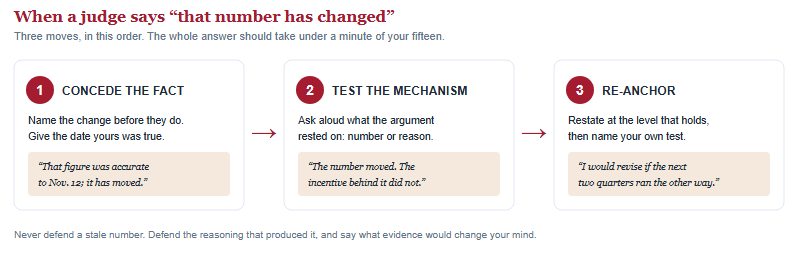
Sooner or later a question begins “that has changed since you wrote this.” Here is why the order above matters.
Concede first. Students instinctively defend, and defending a fact that has demonstrably moved is the fastest way to look like someone who has not followed the story. Conceding immediately does the opposite: it signals that you have kept reading since submission, which is exactly the impression you want. Say what your figure was and when it was true.
Then separate the number from the reason. This is the move that saves the essay. If your thesis was pitched at mechanism level, a changed data point is a detail, not a refutation, and you can say so in one sentence. If your thesis was pitched at event level, this is the moment you discover it — which is the strongest possible argument for doing the expiry audit before submission rather than in the room.
Then re-anchor and name your test. Restate the claim at the altitude that still holds, and volunteer what evidence would change your mind. A student who can specify what would falsify their own argument is demonstrating exactly the discipline the contest asks for, and doing it under pressure is worth more than a fact you happened to get right.
The preparation for all of this is simple and almost nobody does it: in the fortnight before the defense, re-check your dated claims and write one line for each — still true, revised, or superseded. Bring that page. Our Defense Day preparation guide covers the wider rehearsal; this is the piece specific to a subject that will not hold still, and it takes an hour.
Frequently asked questions
Should I avoid very recent events in an HIR essay?
No. Use them as illustration, date-stamped, and keep the thesis at the level of mechanism rather than the level of the headline.
Can I update my essay if a fact changes after I submit?
Plan on no. Assume the text is frozen at submission and confirm the current process on hir.harvard.edu before relying on anything else.
What if the judge raises a change I had not seen?
Concede it, distinguish the number from the mechanism, then restate the claim at the level that still holds. Never argue with the update.
Does date-stamping waste words I need elsewhere?
It costs roughly five words per claim. Budget for it in revision rather than adding it on top of a draft already at 1,200 words.
This is an independent guide operated by Hanlin Education for China-based international-school students. We are not affiliated with, endorsed by, or sponsored by the Harvard International Review or Harvard University; the HIR is a student-run journal founded in 1979 and is not an official Harvard University publication. Contest rules, cycle dates, defense arrangements and submission procedures are set by the organiser and change between cycles — confirm current details on hir.harvard.edu before you rely on anything here. Errors are corrected within 7 working days of being reported.